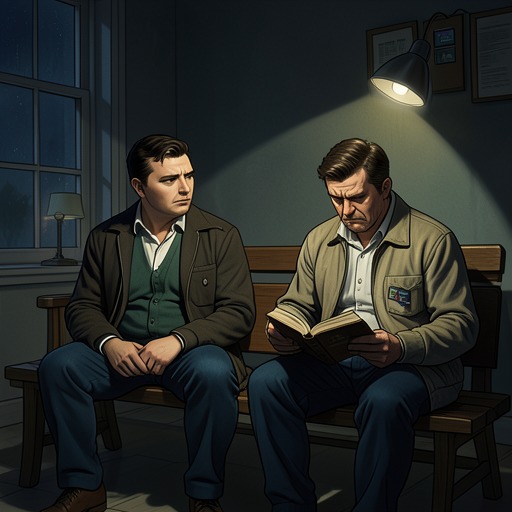
Perry’s psychological torment after the crime
In Cold BloodPerry Smith’s psychological torment after the murders is marked by a conflict he cannot settle: he recognizes that he took part in an act he once believed himself incapable of committing, yet cannot accept that he and Dick might escape its consequences. His memories return in sensory fragments, and his effort to speak about them repeatedly meets Dick’s impatience. The contrast exposes two different forms of evasion: Perry voices his fear, while Dick dismisses it even as the possibility of punishment troubles him too.
The crime returns in fragments
On their second day in Mexico, Perry and Dick stopped at a promontory to picnic. Dick looked through binoculars across mountains, circling hawks, and a dusty village; Perry raised the subject of what they had done. He said that something must be wrong with them, and then insisted that deep down he had never thought himself capable of such an act. The setting is outwardly calm, but Perry’s words turn the pause into an encounter with the past. The conversation does not resolve his distress: Dick reacts with annoyance and tells him to stop bringing it up, recalling their informal agreement to forget the crime.
Perry’s difficulty is more than a wish to discuss what Dick would rather leave unspoken. He experiences spells of helplessness in which memories intrude without invitation. They come as images and sounds: blue light exploding in a black room, the glass eyes of a toy bear, a silver dollar rolling across a floor, boots on hardwood stairs, and the gasping breaths of a man whose windpipe has been severed. The passage presents recollection as a series of sensory returns rather than a composed account. Perry may agree that talk should stop, yet the fragments continue to press on him.
The difference between silence and forgetting is central to his torment. Perry knows that opening the subject will displease Dick and says he would sometimes rather avoid it himself. But his memories interrupt that intention. When he admits that something may be wrong with him, he is not making an easy confession: the thought is painful partly because he fears the cause might be something he was born with rather than something he chose. The passage thus links his judgment of the crime to a wider anxiety about whether his capacity for violence belongs to an unchangeable part of himself.
Self-judgment, denial, and the false story
Perry’s uncertainty is sharpened by a story he once told Dick about killing a Black man. Dick had treated that tale as evidence of Perry’s character and potential, and Perry continues to affirm it when challenged. Yet the narrative discloses that Perry had known a man named King under the circumstances he described but had never attacked him; he does not know whether King is alive or dead. Perry is therefore sustaining a fiction, not confessing to that earlier killing. His insistence that he did it sits beside his troubled claim that the family murders were beyond what he thought himself capable of. The contrast complicates his self-presentation: the boast that helped shape Dick’s image of him persists even when its truth is denied by the account.
When Perry distinguishes the earlier tale from the murders, his explanation does not relieve the deeper anxiety. He says that what troubles him is the possibility that anyone could commit such an act and simply get away with it. For him, escape from legal punishment seems almost impossible to believe. He cannot put the crime out of his mind because he expects that something must happen in response. The fear is therefore both moral and practical: he questions what the act says about him, and imagines a consequence still waiting to arrive.
The narrative places this fear against Perry’s family history, which he himself invokes when he wonders whether something might be wrong with him by birth. His mother, an alcoholic, died after choking on her vomit. Of his siblings, Barbara alone is described as having entered an ordinary adult life, marrying and raising a family. Perry loved Fern and remembered her as artistic and talented; after she fell fifteen floors from a San Francisco hotel, he tried to believe that she had slipped. His older brother Jimmy drove his wife to suicide and then killed himself. These losses do not establish an explanation for Perry’s actions, but they show why his fear of an inherited or familial misfortune carries such weight for him.
Dick’s resistance and shared apprehension
Dick answers Perry’s distress by declaring himself normal and assigning the problem to Perry. His judgment draws on their time cellmates at Kansas State Penitentiary: he remembers Perry wetting the bed, crying in his sleep, sucking his thumb, and poring over treasure guides. He also regards Perry’s temper as frightening because it could flare suddenly while his outward manner remained cool. Dick had once thought he could regulate these episodes, then learned he could not; afterward he felt unsure of Perry and believed he ought to fear him, even though he could not explain why he did not. This history makes Dick’s dismissal more complicated than simple confidence. He treats Perry as the disturbed one, but his own account records unease about the man beside him.
At the promontory, Dick counters Perry’s doubts by invoking the earlier tale of the Black man, then asks whether Perry really killed him. Perry’s staring response makes the exchange tense, especially because Dick dislikes the mirrored sunglasses that hide Perry’s eyes. Dick’s original assessment of Perry had rested partly on the supposed killing. What he took as proof of a violent capacity is, the narrative reveals, a falsehood that Perry continues to defend. The concealed eyes and the false story together leave Dick with no secure measure of what Perry has done or might do.
Dick’s certainty also fails to hold. Although he says he has never believed in God or been troubled by superstition, Perry’s fear that they cannot get away with the crime touches a doubt Dick shares. He, too, has wondered whether they can escape after what they did. His command that Perry be quiet therefore works as suppression, not proof that the question has vanished. The two men differ in how they handle their fear, but the scene shows that Perry has given words to a possibility already circling in Dick’s mind.
Fear of The Corner
The torment resurfaces during the fugitives’ later flight, when lack of money leads Dick to insist on returning to Kansas City to pass forged checks. Perry objects that the move is dangerous, knowing they are wanted, while Dick argues that they can move quickly and hopes they might continue to Florida. Dick again urges Perry to forget the other matter and claims that investigators have made no connection and never will. Perry replies that Dick could be wrong—and that if so, it means The Corner, the prisoners’ name for the gallows shed at Kansas State Penitentiary.
This exchange makes the threat concrete without resolving it. The Corner is no longer merely an abstract possibility: it enters the fugitives’ practical argument about where to go and how to get money. Yet Dick answers with mockery rather than reassurance, and the plan to return to Kansas City remains driven by need and his confidence in forged checks. Perry’s warning does not stop the movement; it reveals the fear traveling with them.
The Mexico scene ends with a stark contrast between Perry’s unsettled conscience and Dick’s casual violence. After ordering Perry to stop talking, Dick drives toward an old, mangy dog on the road and celebrates having run it down, a habit the narrative says he repeated whenever he had the opportunity. The juxtaposition does not settle what either man believes about the murders. Instead, it places Perry’s inability to dismiss the past beside Dick’s immediate satisfaction in an act of cruelty. Across both conversations, the past returns for Perry as memory and anticipated punishment; Dick can try to silence it, but his own doubts show that silence is not the same as escape.