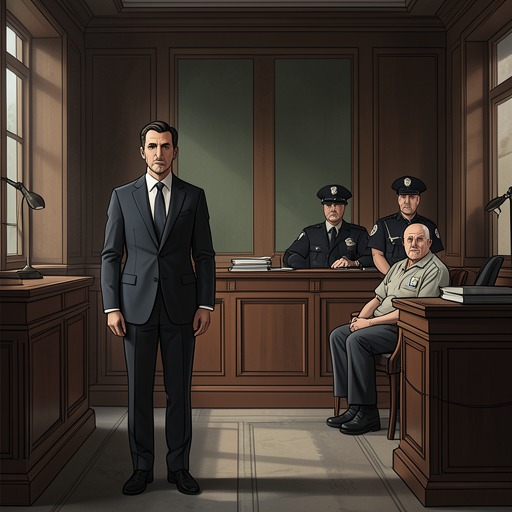
Roland H. Tate
In Cold BloodRoland H. Tate, judge of the 32nd Judicial District, presides over the trial of Perry Smith and Richard Hickock. The narrative introduces him through a prisoner’s scrutiny of the man who will judge him, then measures that impression against Tate’s choices in court: he follows legal requirements closely, rejects a request to postpone the trial, and does not authorize the comprehensive psychiatric examinations the defense sought. His significance lies in that meeting of personal reputation and procedural authority, as two defendants’ lives depend on decisions made within the limits he understands the law to set.
Identity and Reputation
From his cell, Perry Smith studies Tate as he pauses in the courthouse square to talk and laugh with other men. At a distance, the judge’s firm jaw, downturned mouth, and lowered eyes make him seem stern and unsparing. Yet the passing glimpses of his joking and sociable manner complicate that first impression. Smith sees someone who might recognize another person’s human side, and entertains the possibility that Tate might give the defendants a break. The narrative makes clear, however, that this hope does not express Smith’s real expectation: he believes his crime cannot be forgiven and anticipates execution.
Tate is an established and imposing figure in western Kansas. The account describes him as wealthy, a horse raiser and landowner, and the father of two sons. After the younger son’s death profoundly affected Tate and his wife, they adopted a small boy who had appeared in court as an abandoned, homeless child. These details give substance to Smith’s brief conjecture about the judge’s compassion, but they do not establish that Tate’s family history determines his judicial conduct. His public authority rests instead on his position and his adherence to legal text.
A fellow jurist characterizes Tate as a lawyer who avoids experimentation and follows the wording of the law. The same assessment draws a pointed distinction between the judge’s value to an innocent person and his severity toward a guilty one. The narrative does not present that reputation as a complete account of Tate’s character; it sets it beside the visible humor Smith glimpses in the square. The contrast leaves open the difference between personal warmth and judicial leniency.
Venue and the Trial’s Setting
As the scheduled March 22, 1960, trial approaches, the defense considers seeking a change of venue. Arthur Fleming warns that moving the case elsewhere in Kansas may not lessen public feeling, and argues that Garden City could be as favorable as any alternative. He points to the city’s religious character and to ministers, including Reverend Cowan, the Clutters’ minister and a close family friend, who opposed capital punishment. This is defense counsel’s assessment of the trial’s setting, not a finding by Tate that local opinion would benefit the accused.
A separate concern arises when the defense asks to postpone the trial. On March 14, counsel cites the illness of Richard Hickock’s father, described as a material witness, and the planned auction of the Clutter estate on March 21—the day before proceedings are due to begin. Harrison Smith argues that advertisements in shops, banks, restaurants, and the railroad station, as well as newspaper and radio notices, will keep the victims’ estate before local residents, including the 150 prospective jurors. Tate denies the postponement motion without comment. The ruling leaves the trial date in place despite the defense’s concern that the auction’s timing could prejudice the defendants.
Psychiatric Examinations
The dispute over the defendants’ mental condition presents Tate with a choice between the defense’s request for specialist assessment and the narrower procedure customary in the county. The defense asks that Perry Smith and Richard Hickock be examined at Larned State Hospital, whose maximum-security facilities could accommodate them. Harrison Smith explains that Larned is the only nearby institution with appropriately trained specialists, that an evaluation would require four to eight weeks, and that the state hospital would perform the work without cost to the county.
The prosecution objects that the law does not require specially qualified psychiatrists. Local general practitioners, it argues, regularly conduct sanity hearings, making a trip to Larned unnecessary. In response, the defense stresses the gravity of the case and contends that two lives at stake warrant examinations by people with specialized training. It also invokes recent developments in psychiatry and changing approaches in federal courts, framing the request as a chance to apply newer knowledge to criminal cases.
Tate does not grant the requested examinations at Larned. Instead, he appoints a commission of three Garden City doctors, the procedure he considers sufficient under the law. After meeting the defendants and questioning them for about an hour, the doctors conclude that neither man has a mental disorder. Perry Smith doubts the adequacy of their assessment, feeling that their interest was in hearing a killer’s account rather than making a serious diagnosis. Richard Hickock’s attorney is dissatisfied as well: he returns to Larned and seeks a psychiatrist willing to come to Garden City. Dr. W. Mitchell Jones, a specialist in criminal psychology and criminal insanity who has studied and worked in Europe and the United States, volunteers to examine both men and testify if his findings support it. The available account establishes that offer, but not the outcome of Jones’s examinations.
Judicial Method and Narrative Role
Tate’s decisions distinguish procedural compliance from the broader questions raised by the defense. He appoints local doctors rather than the specialists requested, and refuses to delay the trial even as counsel objects to the auction’s proximity to its opening. In each instance, his actions keep the case within the course he considers legally adequate. The narrative’s description of him as a strict, text-oriented jurist helps explain those choices without turning them into proof of indifference: the same portrait includes the social ease Smith occasionally observes, while showing that perceived humanity does not guarantee a reprieve.
That gap between a judge’s possible human sympathy and the demands of his office is central to Tate’s role. Smith looks for signs of compassion in the man who controls the courtroom, but the proceeding is shaped by rulings, deadlines, and the legal standards Tate applies. His reputation for fidelity to the text becomes consequential when the defense asks the court to accommodate psychiatric expertise and to reconsider the timing of trial. Tate is therefore more than a stern figure glimpsed from a cell: he is the point at which personal hope encounters the procedural boundaries governing the defendants’ case.