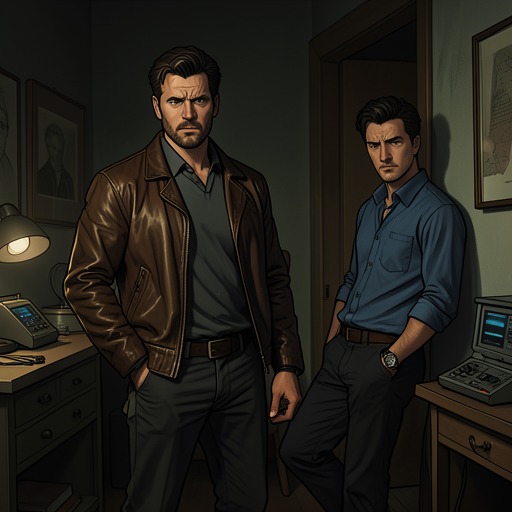
Walter Hickock
In Cold BloodWalter Hickock, Dick’s father, is a small farmer whose recollections place his son’s criminal history inside a family shaped by financial hardship, loyalty, and incomplete knowledge. His testimony first presents Dick as a gifted young man whose prospects narrowed when the family could not afford college; later, Walter becomes an important witness in the investigation and a defender of his son, even as evidence connects Dick to the Clutter murders. His account helps show how parental love can preserve a version of events that the accumulating facts make difficult to sustain.
Identity and Family Background
Walter lives with his wife, Eunice Hickock, on a forty-four-acre farm that, by his account, yields barely enough to support them. When Harold Nye visits, Walter is described as an aging, tired man, and he tells the agent that he has cancer. The family’s limited means recur in his memories of Dick’s youth: Dick wanted to attend college and study engineering after graduating from high school in 1949, but Walter says the family could not pay for it. He recalls Dick as an outstanding athlete in basketball, baseball, and football, and as a good student in subjects including history and mechanical drawing. In Walter’s telling, the thwarted college ambition is an early disappointment, not evidence of an inherently wayward boy.
Walter describes his son’s early adulthood as a rapid accumulation of work, marriage, and financial pressure. Dick took a job with Santa Fe Railways in Kansas City and married Carol Hickock when he was nineteen and she was sixteen. Walter recalls that the couple rented a sizable house and bought an expensive car, while living beyond their means. Dick later worked as an ambulance driver and as a mechanic and car painter for the Markl Buick Company. Walter connects Dick’s gambling and bad checks to mounting debt, and also to a car accident that, he believed, left Dick concussed and changed his behavior. This is Walter’s explanation, rather than an independently established cause. Eunice’s account supplies a more affectionate family memory: she had taught Dick to dance the foxtrot and remembered him as a sweet-tempered child.
Dick’s Troubles and the Father’s Expectations
Walter’s account of Dick’s imprisonment centers on a borrowed hunting rifle. He insists that Dick had not intended to steal it, though Dick was convicted of burglary and sent to the Kansas State Penitentiary. Walter says his son was imprisoned for seventeen months and returned home seeming like a stranger, difficult to talk to and convinced that the world was against him. Dick’s second marriage also ended while he was in prison, as his wife filed for divorce. Walter thus recalls a series of reversals that, in his view, left Dick isolated and resentful.
By the time Dick returned to live with his parents, Walter believed he was settling into a more responsible routine. Dick worked at the Bob Sands Body Shop in Olathe, Kansas, came home at night, and, Walter said, was not violating parole. Walter remembered a recent promise from his son that he would not do anything more to hurt him. That assurance carries particular weight because Walter knew he was ill and did not expect to live long. When Dick disappeared, Eunice feared he had fallen into trouble again and blamed his new companion; Walter’s testimony likewise shows how strongly the parents hoped that Dick’s recent stability had been genuine.
The Visit from Harold Nye
When Nye arrived at the Hickock farmhouse at dusk, the parents did not know that the investigation concerned murder. They understood the visit as an inquiry into a parole violation and financial fraud, and the Clutter name and the word murder were not mentioned during their conversation. Walter and Eunice welcomed the agent into their home and answered his questions without realizing the full purpose of his inquiries. The gap between their understanding and Nye’s knowledge gives the interview its tension: ordinary family recollections are being gathered as evidence in a case the parents do not yet know they are discussing.
Walter described Dick’s association with Perry Smith, whom Dick had introduced as a friend from Las Vegas. He recalled that Dick had asked whether Perry could stay at the farmhouse, but Eunice refused; Dick instead found him a room at a hotel in Olathe. Walter said that Dick later drove Perry to Fort Scott on an overnight trip, supposedly to collect money held by Perry’s sister. Walter understood the sum to be fifteen hundred dollars. When Nye asked about the trip, Walter explained that the sister could not be found. He also supplied a small but revealing account of Dick’s return: Dick ate Sunday dinner hungrily and then fell asleep during a televised basketball game, which Walter considered unusual. Together, the trip and the changed behavior gave Nye a more exact chronology to compare with other evidence.
The shotgun in the farmhouse brought the interview closer to the crime without Walter understanding why. Nye noticed it propped against a kitchen wall and asked about it. Walter identified it as Dick’s, a Savage Model 300 twelve-gauge shotgun used occasionally for rabbit hunting with Dick’s brother David. Eunice explained that Dick had bought it on credit less than a month earlier and that the parents were liable for the payments because he had used their names. Nye later acknowledged that he had felt certain the weapon was connected to the Clutter killings, but he did not disclose that suspicion to the couple. Walter’s cooperation therefore provided investigators with a location and history for the gun while he continued to regard it as a household possession.
Evidence, Defense, and Decline
After Dick and Perry’s arrests, investigators found the shotgun still propped against the kitchen wall and a knife in a fishing-tackle box at the Hickock home. Walter refused to believe his son had taken part in the crime and insisted the gun had not left the house since the first week of November. That assertion conflicted with Perry’s account and with the physical evidence: tests linked recovered shells to the shotgun, while buried remnants of cord and tape matched materials used to bind the victims. Walter’s loyalty could not undo the evidence, but his insistence records the family’s resistance to the case as it came together.
Walter later spent three hours visiting Dick in custody. Speaking afterward to a reporter, he said that Dick had denied planning violence and had claimed he was not in the room when Perry attacked Herbert Clutter. According to Walter’s retelling, Dick said he had entered after hearing a struggle and that Perry had taken the shotgun. Walter also reported that Dick believed he should have seized the weapon and stopped Perry, and that he would have been better off had he done so. These claims are Walter’s account of what Dick told him; the book places them alongside the investigation’s evidence and Perry’s differing statements, rather than presenting them as an uncontested reconstruction.
Walter’s defense of his son continued as his own health deteriorated. After the visit, he walked to the Garden City depot and spoke of the prospect that both men would be hanged, describing a son’s execution as an unbearable fate for a father. During the trial, Eunice wept when the court heard that Perry had tried to take responsibility for killing Bonnie and Nancy Clutter so that Dick’s mother would not believe her son had killed members of the family. Walter remained beside his wife but did not respond visibly. She later said that Walter was dying and seemed no longer to mind what happened. The narrative thus leaves him not with a resolution of the family’s competing accounts, but with illness, the expected death of his son, and the limits of what a father’s testimony can establish.