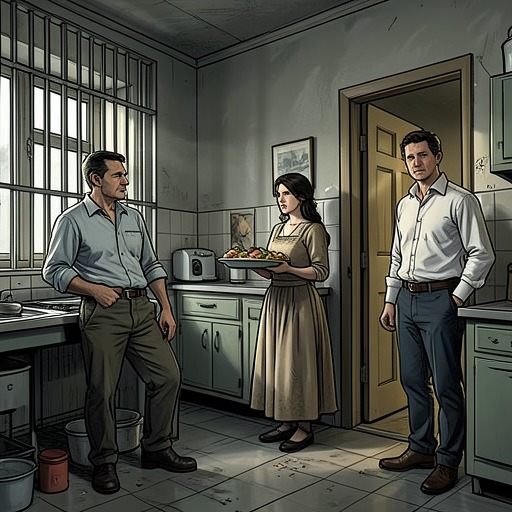
Wendle Meier
In Cold BloodWendle Meier, the undersheriff at the Finney County Courthouse, lives with his wife, Josephine Meier, in an apartment adjoining the jail’s women’s cell. His quiet domestic setting stands beside the jail’s routines and, after the Clutter murders, the danger posed by its most notorious prisoners: Dick secretly makes a shiv intended for an attack on him as part of an escape plan.
Identity and Household
In January 1960, the apartment known as the Sheriff’s Residence is occupied not by Sheriff Earl Robinson but by Wendle and Josephine Meier. They have been married for more than twenty years and are described as tall, strong, calm-faced people. Their only child is married and lives in Kansas City, leaving the couple to share their home with the jail’s daily presence.
The apartment is a five-room domestic space, furnished with soft chairs and lace curtains, but its separation from the jail proper amounts to steel doors and a short corridor. The Meiers’ private life is therefore not wholly apart from the institution: the women’s cell is an isolated unit within the residence itself, adjoining the kitchen.
Domestic Life Beside the Jail
Josephine’s long working day begins at five in the morning with Bible reading and ends at ten at night. She cooks, sews for prisoners, darns and launders their clothes, tends to her husband, and keeps the apartment. Her care for people held in the jail includes conversation and meals, making the kitchen a point of contact between household life and confinement.
Wendle is present in this setting primarily through his role as undersheriff and husband. The contrast between his wife’s practical, compassionate attention to prisoners and the jail’s institutional severity is sharpened by their adjoining living and custodial spaces: the Meiers’ home is comfortable, but a steel barrier and the women’s cell are only steps away.
Response to the Clutter Murders
Wendle was among the first people at the Clutter property after the bodies were discovered. That experience shapes his response when Josephine, after speaking with Perry Smith in the cell, tells her husband that Perry did not seem like the worst young man she had encountered. Wendle rejects her impression and points her back to the four dead members of the Clutter family, arguing that she would judge Perry and Dick differently if she had seen the scene herself.
His recollection of the murders makes him resist the softness of Josephine’s first impression. She wonders whether either prisoner is troubled by the thought of the four graves; Wendle’s response instead emphasizes the violence and the evidence of what the men did. The exchange places the Meiers’ differing reactions to the prisoners inside their shared home: Josephine meets a captive through conversation, while Wendle answers from the memory of the crime scene.
A Target Within the Jail
Dick’s outwardly easy manner conceals a plan to escape because he expects a Kansas trial to end in execution. Before attempting to break out, he decides he needs a weapon. Over several weeks he dismantles a toilet brush, concealing a piece of wood and a length of hard wire beneath his mattress, then sharpens the wire against the concrete floor of his cell.
The intended victim is Wendle: Dick imagines the weapon entering between the undersheriff’s shoulder blades. The threat is part of a calculated escape scheme, not a recorded confrontation between the two men. Dick hopes to take a car and hide alone in a Colorado mountain cabin until spring, so Wendle’s place in the plan is starkly practical: the domestic undersheriff who shares the jail’s residence becomes an obstacle Dick means to eliminate.