Zenith Portable Radio
In Cold BloodThe Zenith Portable Radio is a small missing possession that becomes a material thread running from the Clutter home to the fugitives’ flight and the investigation’s unsuccessful search. Its absence gives the investigators concrete grounds to reconsider robbery as a motive, but it never resolves the larger question of why the family was killed. As it passes from a child’s room into the fugitives’ crowded car and then into a sale in Mexico City, the radio registers both the practical movement of stolen goods and the limits of what a missing object can explain.
Identification and Discovery
The radio enters the investigation through a search of the Clutter home. While accompanying a Kansas Bureau of Investigation agent through River Valley Farm, Mabel Helm repeatedly sensed that something in Kenyon Clutter’s room was wrong. The room’s familiar contents included Kenyon’s old baseball mitt, mud-spattered work boots, and abandoned spectacles. As she looked around, she realized that his little radio was missing. The discovery was not the result of a formal inventory alone: it emerged from her intimate recognition of the room and of what should have been there.
The investigators identify the absent object as a gray portable Zenith. That specificity makes the radio more than a general report of missing property: it supplies a recognizable description that can be carried into the search beyond the house. Yet the initial discovery establishes absence, not the circumstances in which the radio left the room. Its disappearance invites an inference of theft, while leaving open who took it and whether it can be securely connected to any later radio described in the narrative.
A Clue That Complicates Motive
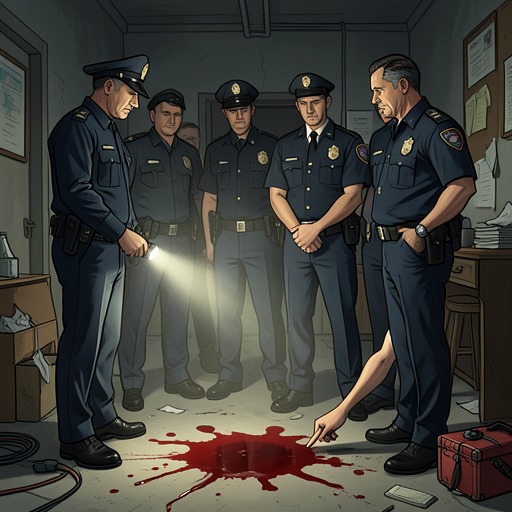
The radio’s absence, considered alongside a gold wristwatch found tucked into the toe of Nancy Clutter’s shoe, leads Alvin Adams Dewey to reconsider the possibility of plain robbery. He reasons that Nancy may have heard intruders and hidden the watch, a treasured gift from her father. In that reconstruction, a missing radio and a concealed watch suggest that someone in the house might have understood the danger as a burglary in progress. The objects sharpen the possibility that the killers sought valuables, but they do not establish that the radio was the purpose of the crime.
Dewey cannot accept that the family was slaughtered for only a few dollars and a radio. The thought conflicts with his developing sense that the carefully carried-out crime involved calculated motives and killers who had some emotional involvement with their victims. Other details at the scene, including the placement of a mattress box and the arrangement of bedcovers, intensify that interpretive conflict. The radio thus sits among two competing accounts: as tangible evidence consistent with robbery, and as inadequate compensation for a crime whose execution and details resist a simple explanation. It makes the theft theory harder to dismiss, without making it sufficient.
In the Fugitives’ Possessions
On November 21, the old Chevrolet leaves Kansas with Dick driving and Perry Smith holding his Gibson guitar. The car is packed nearly to the point of disorder: luggage is tied to the fenders and roof, the trunk cannot be shut, and two television sets stand on the back seat. Among the other belongings inside is a gray Zenith portable radio. Its presence among the fugitives’ possessions gives the earlier report of a missing gray Zenith a later, striking counterpart. The narrative connects the same kind of object to both the Clutter home and the men’s flight, although the account does not describe a separate identification procedure establishing the radio’s identity.
The radio is one item in a cargo of possessions accumulated or carried along as the men travel. Alongside it are Perry’s cardboard suitcase, root-beer syrup, and boxes of books, manuscripts, and memorabilia—boxes that Dick curses and kicks because of their weight. This crowded inventory presents the fugitives’ escape not as an abstract movement across a map but as travel burdened by things. Some possessions matter to Perry as personal attachments; others can be traded. The radio moves toward the latter category, becoming property that can be converted into money rather than a durable possession of its own.
Search, Sale, and Evidentiary Limits
In Las Vegas, Harold Nye investigates locations associated with Perry Smith and seeks help from local police. The warning circulated to officers identifies Dick and Perry as wanted for parole violations, says they may be armed and dangerous, and describes the Chevrolet they are believed to be driving. Nye and a local detective also check pawn tickets from the preceding month. The missing Zenith is a specific target of that search, but Nye finds no ticket for it. One broker does remember Perry and produces a ticket for a bearskin rug pawned in November; that lead helps Nye obtain the address of a rooming house, but it does not locate the radio.
A later account supplies another stage in the radio’s passage: Dick and Perry have sold a gray Zenith portable radio to a Mexico City policeman whom Dick had met. By then they have also disposed of other goods, including a camera, cuff links, television sets, and binoculars. The account does not show the radio being recovered by investigators or independently traced back to Kenyon’s room. Instead, its importance rests on the narrative’s sequence of absence, possession, attempted tracing, and sale. It is at once a possible stolen object, a clue that supports but cannot settle a motive, and a saleable possession carried into flight. Its route makes the crime’s material aftermath visible while preserving a distinction between suggestive correspondence and definitive proof.