“The dead exist only in us”
In Search of Lost Time“The dead exist only in us” names a paradox of mourning in which the lost person survives through the living mind, yet that very survival can sharpen the knowledge of loss. The narrator’s grandmother returns not as an abstract subject of thought but as a living presence recovered through involuntary memory; the recovery brings belated grief, remorse, and the recognition that remembrance is also the place where the dead continue to act.
The phrase and the return of memory
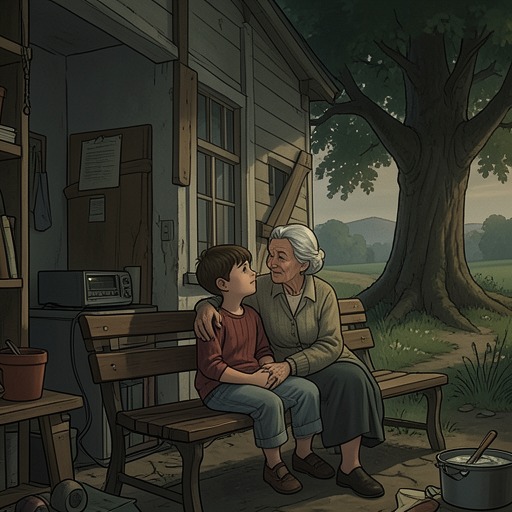
The phrase arises as the narrator reflects that he cannot recall his grandmother without pain. On his first night back at Balbec, while stooping to remove his boots in a state of cardiac fatigue, he suddenly remembers her tender, preoccupied face from the first evening of his earlier visit. The bodily situation restores the sensations in which that memory had been preserved, and with them the earlier self who had sought refuge in her arms. The person who returns is not the grandmother he had lately discussed or thought about, but the living woman whose care he had once experienced directly.
That return reveals how little his conscious thoughts had contained. More than a year after her burial, he understands for the first time that she is dead: only now has he recovered her as real enough to lose. The calendar of events and the calendar of feeling have diverged. His prior forgetfulness was not a hidden store of grief but an absence of the living memory required to make the loss emotionally present; recollection reunites him with his grandmother and at once confronts him with her irreversible absence.
Survival and annihilation
The memory gives the narrator back a love that seems to have been made expressly between grandmother and grandson. Yet the intensity of that recovered bond is pierced by the knowledge that she can no longer return it. He feels both the tenderness that once made him its center and the annihilation that has turned her into someone who might, by chance, have spent a few years with him but is now a stranger. The phrase therefore does not promise that memory restores the dead intact. It marks the mind as the place where attachment survives and where the fact of death becomes newly painful.
The narrator refuses to soften this contradiction by speaking to the photograph taken by Saint-Loup as if his grandmother were merely elsewhere and still able to hear him. Instead, he holds to the pain because it proves that the memory is present. He recalls, too, the occasions when he exaggerated his suffering and caused her grief, and the impatient words he had muttered when she posed for the photograph in her wide-brimmed hat. In the present, those small injuries cannot be repaired by the kisses that once followed them. His continuing remembrance wounds him because the person he wounded can no longer be consoled.
The mother as successor
The same inward continuation takes another form in the narrator’s mother. When she arrives at Balbec in mourning, her appearance makes him recognize that she seems to have become, in some sense, his grandmother: not simply a bereaved daughter, but a successor carrying forward the dead woman’s presence. He describes this inheritance as the dead annexing the living. Grief can hasten the emergence of traits already latent in a person, while the survivor’s attention turns toward what the dead loved and embodied.
His mother’s mourning gathers around objects and repeated practices. She cannot bear to part from her mother’s bag, muff, or clothes, which intensify their physical resemblance, and she treasures the copies of Mme de Sévigné that her mother carried everywhere. In her three letters before arriving, she quotes Mme de Sévigné as though her own mother were writing through her. At Balbec she goes to the beach with her mother’s sunshade and later sits there daily, reading the books her mother had loved. These acts do not undo death; they make a continuing bond visible in habits, possessions, and resemblance.
Grief’s different times and forms
The narrator’s belated grief also changes how he understands his mother’s suffering. Her blank, tearless gaze, which had seemed to invite little pity from Françoise, now appears fixed on the same contradiction he has encountered: a beloved person can be vividly present in memory and nevertheless no longer exist. His own sudden sorrow opens a way toward recognizing the depth of hers, though he distinguishes his delayed, transient grief from the years-long suffering that has crushed her.
The phrase’s significance lies in that distinction as much as in its affirmation of survival. The dead continue to affect the living because the mind must recreate what ordinary life leaves unnoticed; memory can restore affection, transmit a way of seeing, and keep old injuries active. But the continuation belongs to the survivors, not to a preserved consciousness of the dead. The grandmother is present in the narrator’s pain and in his mother’s gestures precisely because she is absent from the world in which those gestures might reach her.