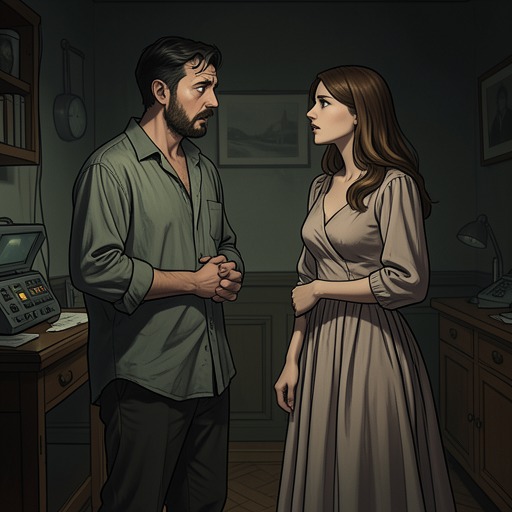
Albertine stays the night at Balbec
In Search of Lost TimeAlbertine’s overnight stay at Balbec turns a train departure into a fragile reprieve: when she steps toward the door at Parville, the narrator feels the separation as an unbearable rupture and catches her by the arm; after he asks her to stay, she agrees, and later comes to his room when he summons her. Her willingness to remain briefly soothes the very anguish her departure has awakened, but does not resolve its cause. Instead, the night binds intimacy to concealment and gives the narrator’s jealousy a new practical objective: keeping Albertine near him and preventing her journey onward.
The departure at Parville
The train stops at Parville with no other passengers aboard. As Albertine stands facing the narrator, she sees that she has reached her destination, crosses the compartment, and opens the door. Her movement to get off makes the distance between them feel false: although she appears to be a yard away, the narrator experiences her as belonging inside him. He reaches after her and catches her desperately by the arm. The gesture makes visible the contradiction at the center of the encounter: Albertine is physically separate and free to leave, yet the narrator experiences that freedom as a bodily wound.
He asks whether it would be physically possible for her to spend the night at Balbec. Albertine answers that it is possible, but says she is exhausted. The narrator tells her that staying would do him an enormous favour. She agrees, adding that she does not understand why he had not told her sooner. The decision is immediate, but its emotional meaning is unequal: Albertine consents without knowing the full force of the narrator’s distress or what has made her departure unbearable to him.
A night of concealed anguish
The narrator’s mother is asleep when he returns to his own room, having engaged a separate room for Albertine on another floor. He sits at the window and suppresses his sobs so that his mother, separated from him by a thin partition, will not hear. His distress is sharpened by the sight of the evening sky: its faint glow recalls a sunset study by Elstir and the narrator’s first arrival at Balbec. Then the evening had seemed to precede a new day and unknown happiness; now he imagines the coming days as nothing but an extension of suffering.
In that sleepless interval, what he had feared about Albertine becomes, to him, certainty. He connects her friendship with Mlle Vinteuil to his earlier unease at seeing Albertine with Andrée, and recalls a gesture Albertine had made toward Rosemonde that had reminded him of Mlle Vinteuil. He now interprets the resemblance as evidence of a shared inclination, and imagines Albertine consenting to Mlle Vinteuil’s desires. These are the narrator’s inferences and suspicions, not a confession from Albertine in this scene. The night’s crisis thus combines a new conviction with the uncertainty that produced it: he believes he has recognized the truth, but his knowledge remains organized by jealousy and interpretation.
The late-night visit
At an hour when the lift-boy is also acting as night watchman, the narrator asks him to go to Albertine’s room and say that he has something important to tell her. Albertine replies that she would rather come to the narrator. She arrives in her dressing-gown. Before explaining himself, he warns her to keep her voice low, so that his mother will not wake. The same thin partition that once seemed to echo his grandmother’s intentions now limits the conversation to whispers, linking present secrecy with an earlier family intimacy.
The narrator tells Albertine a fiction: that he has left behind a woman he was supposed to marry, a woman ready to sacrifice everything for him; that she is due to begin a journey that morning; and that he has spent the past week wondering whether he could resist telegraphing that he would return. He claims that the effort made him so miserable he thought he would kill himself, and that he had asked Albertine to come to Balbec because he wanted to say goodbye before dying. He lets himself weep, using the invented story to make his real anguish intelligible without disclosing its cause. The tale is false, but it successfully communicates the strength of the distress Albertine has already sensed.
Relief, dependence, and the next plan
Albertine is sincerely moved. She says that, had she known, she would have spent the night beside him, and tells him she had noticed his unhappiness during the journey from La Raspelière. Her reading of its timing is mistaken: the narrator says his grief began only at Parville, while his earlier irritability came from the tedium of spending more days in her company. Yet her compassionate response is real, even though she does not know what has actually precipitated the scene. She promises that she will not leave him again and will spend all her time at Balbec.
Her promise brings the narrator temporary relief. The person he experiences as the source of his sickness becomes, through her presence and sympathy, its only remedy; the relief leaves him as weak as a convalescent. But it cannot settle his fear of what will happen next. He anticipates Albertine leaving Balbec for Cherbourg and then going to Trieste, where he imagines her old habits might return. He wants to prevent her from taking the boat and to carry her off to Paris. There he considers using Mme de Guermantes’s influence to keep Mlle Vinteuil’s friend elsewhere and thus obstruct a possible meeting. Even as he recognizes that Paris would offer Albertine other opportunities if she had the tastes he suspects, his jealousy remains fixed on Mlle Vinteuil’s friend. The overnight stay therefore ends not in trust, but in a short reprieve that intensifies the narrator’s effort to manage the movements and relationships he fears he cannot know.