Beaumont
In Search of Lost TimeBeaumont is a hill near Balbec that first appears to the narrator as a remote world apart, then loses that separateness when a motor-car brings it into immediate relation with places he already knows. Its changing position in his mental geography makes it a striking instance of how travel can both disenchant a landscape and disclose its precise, newly discoverable form.
The isolated destination
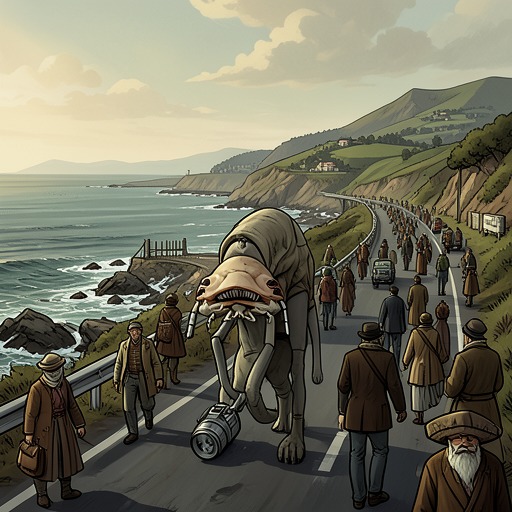
During the narrator’s first stay at Balbec, Mme de Villeparisis liked to drive up Beaumont because the hill offered a view of nothing but sea and woods. The approach followed a road of old trees that climbed continuously, forcing the carriage to crawl. At the summit the party would get out and walk, then return by the same route without passing a village or country house. The excursion had no onward destination: Beaumont was reached and left by a road that seemed to lead nowhere else.
That repetitive journey made the hill feel less like part of the surrounding district than a place set apart from it. The narrator knew it was in the same region as Balbec, yet could not place it in relation to any other locality. Because the road took so long and was never used as a route elsewhere, distance became a quality of the place itself; Beaumont occupied, in his imagination, a special plane beyond ordinary geography.
Recognition by motor-car
Later, while travelling by motor-car through Incarville and down a by-road towards Parville, the narrator glimpses the sea from a natural terrace and asks the chauffeur where they are. Before the chauffeur can answer, he recognizes Beaumont. He has passed close to it whenever taking the little train, and it is only two minutes from Parville. What had seemed remote and difficult to reach is suddenly adjacent to familiar places.
The discovery dissolves the hill’s imaginative privilege. The narrator compares the change to learning that a seemingly mysterious, singular person is actually related to people with whom one often dines. In the same way, Beaumont becomes an ordinary component of the district once its connections are visible. He reflects that literary figures such as Madame Bovary or the Sanseverina might likewise have seemed ordinary had they been encountered outside the enclosed atmosphere of a novel. The comparison links the hill’s enchantment to the mental distance that gives a place—or a character—its exceptional aura.
Roads, perception, and the landscape
The motor-car does not preserve the railway’s illusion of arrival at a town represented by its name and station. Instead of delivering the traveller as if by magic to a self-contained destination, it takes him into streets and makes him stop to ask a resident the way. Yet this practical, sometimes uncertain progress has its own power: the chauffeur may retrace his route, while changes in perspective make a castle, hill, church, and sea seem to move in relation to one another as the car approaches.
The landscape thus first seems to evade the traveller, then gathers into a specific point in the valley. The motor-car strips away some of the mystery associated with the railway journey, but it also enables a more exact, exploratory apprehension of the site. Beaumont matters not simply as a scenic height but as a test of how routes organize perception: familiarity can flatten a place’s aura, while close approach can reveal its proportions and position with new precision.