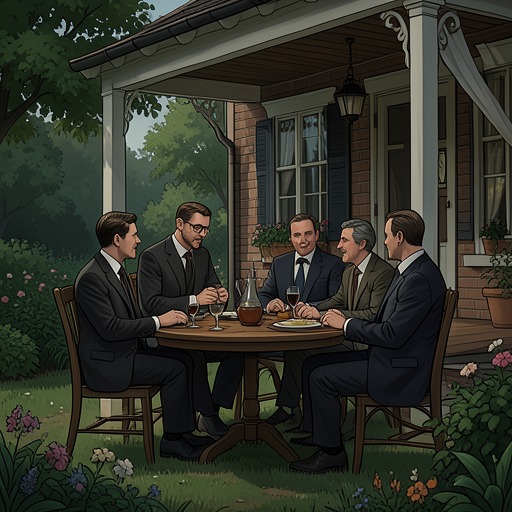
Brichot
In Search of Lost TimeBrichot is a scholar of formidable memory and wide-ranging learning whose erudition turns place-names into histories of migration, language, and landscape. At the same time, he is a socially dependent member of Madame Verdurin’s circle: prized when his talk pleases its audience, but increasingly vulnerable to its changing judgments. His career in the novel is marked by that contrast. The names he explains become more vivid to the narrator, while the salon that gives him distinction gradually withdraws its affection.
Scholar and Salon Performer
Brichot belongs to the Sorbonne, where his work has included lectures and examining. As his eyesight progressively weakens, he reduces his work after dark and confines himself to those duties. He is also out of sympathy with the modern Sorbonne, where scientific exactitude, modeled on German scholarship, is gaining ground against humanism. The decline in his sight thus accompanies, though it does not cause, a narrowing of his professional life; social engagements take up more of his available time.
At Madame Verdurin’s gatherings, Brichot presents learning as a performance. Welcoming the narrator to the circle, he praises its ease and pleasure by invoking Talleyrand, then playfully decorates the names of historical figures with titles and elaborate labels. His diction signals a scholar’s habits of mind, but also his effort to make erudition entertaining in a room governed by social taste. Cottard presents the circle as inclusive of distinguished scholars and nobility, including Princess Sherbatoff; Brichot’s presence is part of the salon’s claim to combine intellectual distinction with fashionable company.
His scholarship ranges beyond academic exposition. At dinner, Brichot offers a Norwegian visitor a sequence of botanical interpretations of surnames, connecting Houssaye to holly, d’Ormesson to elm, and other names to birch, alder, box, and cabbage. He continues even when the visitor stops eating to listen, while the narrator privately resolves to pass on the explanation of Albaret to Céleste. The comic disproportion between a meal and a cascade of etymologies shows both the pleasure Brichot takes in his subject and the way his memory can overwhelm a social occasion.
Etymology and the Balbec Landscape
The most sustained example of Brichot’s learning is his correction of a local priest’s explanations of Norman place-names. He argues that bricq means a bridge, not a height or fortified place, and that fleur means a harbour, relating it to the Danish fjord. He also rejects an interpretation of Saint-Martin-le-Vêtu as “the old,” tracing the name instead to vastatus, a devastated or bare place, and connects the area’s names with Norse and other linguistic histories. These examples establish Brichot not merely as a collector of word origins but as a disputatious interpreter who tests one explanation against competing forms and regional evidence.
His later explanations turn the railway journey into a lesson in settlement and historical layering. He associates names ending in ville with Norman settlers, identifying Incarville as the village of Wiscar and Tourville as the village of Turold. He points to traces he attributes to Alemanni, Saxons, Goths, Moors, and Romans, and explains Thorpehomme through Norman terms rather than the misleading surface suggestion of homme. When the party reaches Doncières, he connects its name with Dominus Cyriacus and compares the town’s appearance to Saint-Cyr, Versailles, and Fontainebleau. The movement from a place-name to its possible linguistic history repeatedly interrupts ordinary travel, making the train route a map of successive cultural claims.
Brichot’s accounts also change how the narrator hears familiar names. On journeys with Albertine, the narrator recalls that the endings fleur and boeuf had once seemed picturesque and individual; after Brichot explains fleur as harbour and Norman boeuf as hut, those apparent curiosities become elements of a wider pattern. The names lose some of their initial strangeness, but gain historical intelligibility. The effect is not simply to replace one word with another: scholarship alters the narrator’s perception of the region and the imaginative associations he had attached to it.
Brichot’s interpretation can itself be contested. At the dinner, he offers one account of bec, connecting it with streams and with forms such as Bricquebec, while elsewhere he presents his arguments against the priest’s derivations. The narrator values what Brichot teaches, even when others treat the material as tiresome or excessive. That difference becomes important: knowledge that can illuminate a landscape does not necessarily secure its speaker a favorable place in society.
Loyalty, Politics, and Social Dependence
Brichot’s social life becomes more concentrated in the Verdurin circle as his professional work contracts. He attends evenings at Madame Verdurin’s and gatherings hosted by members of the faithful, whose train journeys are organized so that the party can find one another and travel together. As his sight worsens, someone watches for his straw hat, green umbrella, and blue spectacles and guides him to the chosen compartment. The practical care given to him is a sign of group loyalty, but it also makes visible his reliance on the group’s routines.
Love has twice nearly drawn Brichot away from the circle. Madame Verdurin intervenes in both cases, separating him from the person who might detach him from the salon. In one instance the person is his laundress, whom Madame Verdurin expels from his fifth-floor rooms after objecting that Brichot entertains her. He remembers this intervention as a protection against the degradation of old age and grows still more attached to his patroness. The episode reveals an unequal bond: Brichot experiences Madame Verdurin’s control as a favor, while she enjoys the drama of managing and disciplining the circle’s members.
His political example shows how social contact can redirect conviction. At one point, the Duke de Guermantes regards Swann’s support for Dreyfus as a grave betrayal and treats the matter as a danger to society. The Duke is less astonished by Saint-Loup’s Dreyfusard position, whom he considers a wayward young man, than by Swann’s choice, because Swann is an established and respected figure. The difference illustrates how political judgment is filtered through status and expectations of character.
The Duke’s own position later reverses after a spa visit. There he meets an Italian princess and her two sisters-in-law, whose intelligence impresses him; they challenge his anti-Dreyfusard arguments and find his supposed evidence unconvincing. He returns to Paris a Dreyfusard. Brichot’s narrative world therefore places political allegiance among the social opinions that may shift through intimate influence, just as the Duke’s outlook changes through the pressure of a small circle of persuasive acquaintances. The episode does not make Brichot the agent of the Duke’s conversion, but it belongs to the wider pattern in which political positions are carried and altered by social relationships.
Decline in the Verdurin Circle
Brichot’s learning initially contributes to his standing among the faithful, but the salon’s response changes. Madame Verdurin mocks his lack of originality and taste, his prodigious memory, and his habit of throwing dictionary-like masses of information at dinner guests. The narrator, by contrast, is interested in precisely the place-name material that she dismisses. The disagreement turns Brichot’s scholarship into a test of audience: what one listener experiences as discovery, another hears as tiresome display.
The narrator reads this change less as a change in Brichot’s speech than in the room’s acoustics and the listeners’ attitude. Brichot continues to speak with the same fluency, but his words meet hostile silence or disagreeable echoes rather than the responsiveness that once made them effective. Madame Verdurin warns the narrator about him; Brichot, whose hearing remains keener than his failing sight, catches her gesture and turns a brief, philosophical glance toward her before withdrawing it. His outward perception has deteriorated, while the narrator suggests that his inward understanding has broadened: he has begun to see how little human affection can be relied upon.
Brichot nevertheless remains attached to Madame Verdurin, even though he knows she sometimes laughs at him publicly, including at his infirmities. When she notices that he has heard her, she resolves to be kind to him for the remainder of the evening. This moment offers a limited reprieve, not a restoration of his former place. The narrator describes the fall from favor as final, and Brichot’s continuing loyalty makes the imbalance especially poignant: he can recognize the instability and cruelty of social affection without ceasing to need the circle that supplies his social identity.
Narrative Significance
Brichot’s etymologies and his social fortunes are linked by a recurring tension between surface appearance and underlying history. Place-names that sound singular acquire wider origins when he examines them; words that once seemed to preserve a local landscape reveal the movement of languages and peoples. In the salon, by contrast, a familiar voice can acquire a new meaning when the audience changes. Brichot’s speech stays recognizably his own, yet its social value rises or falls with the listeners’ disposition.
He is therefore both a source of knowledge and an example of the limits of knowledge as social capital. His accounts allow the narrator to perceive Balbec and its surroundings differently, but scholarly command does not guarantee originality, popularity, or durable affection. As his professional world narrows and his eyesight weakens, the Verdurin circle becomes more central to his life; as that circle grows weary of him, his dependence becomes more exposed. Brichot’s arc makes the salon’s welcome look less like a stable judgment of merit than a favor that can be granted, managed, and withdrawn.