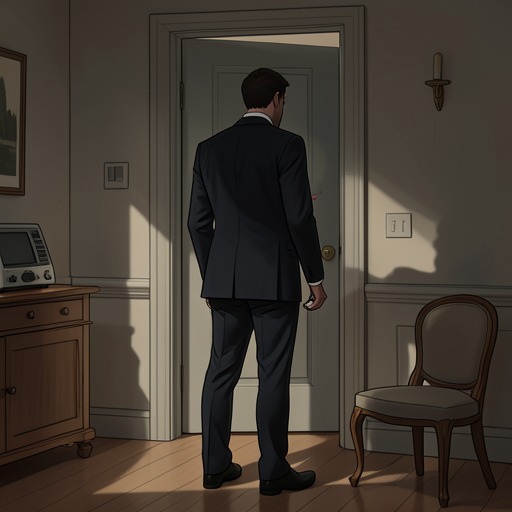
Brichot’s progressive blindness
In Search of Lost TimeBrichot’s progressive blindness is a bodily change that reorganizes his daily life and social identity. It reduces his work after dark and makes him reliant on the Verdurin circle during travel, yet the loss also sharpens his attention to sight itself: his spectacles and the effort of looking become conspicuous, while visual beauty grows newly precious.
Effects on Work and Social Life
As Brichot’s sight steadily weakened, he had to curtail his work after dark, even in Paris. He confined himself to lectures and examining, leaving him more time for evenings at the home of Madame Verdurin and for dinners hosted on her behalf by members of her circle. His changing circumstances thus brought a practical consequence and a social one: less professional work, but deeper attendance among the Verdurins.
Love had twice nearly drawn him away from the group. Madame Verdurin intervened to break his connection with a laundress who was one of those attachments she regarded as dangerous, dismissing the woman from Brichot’s fifth-floor rooms. Brichot remembered this as a service that had saved his old age from ruin, and grew still more attached to Madame Verdurin. His worsening sight therefore belongs to a broader period in which his work diminished while his dependence on the circle—and the circle’s management of his private life—increased.
Dependence and Recognition Among the Faithful
On journeys with the Verdurin party, Brichot could have missed the signals by which the group found one another because of his partial blindness. The others watched for his straw hat, green umbrella, and blue spectacles, then guided him gently but quickly to their chosen train compartment. The care is practical and collective: the group makes its meeting ritual work for a member whose impaired vision might otherwise leave him behind.
At the station, Brichot’s conspicuous spectacles seemed to shine like the reflectors used by throat specialists, while his gaze appeared fixed even on trivial things. The description makes his impairment visible to others, but does not reduce him to helplessness: he remains part of the travelling party, and his companions’ attention accommodates his difficulty. In another journey, he asks whether the Princess is on the train, and the party discusses whether Madame Verdurin might join them at Maineville. The scene places his impaired sight within ordinary social anticipation rather than apart from it.
Loss and the Value of Sight
Brichot’s illness, as it gradually deprived him of sight, also disclosed to him the beauty of that sense. The narration compares this belated appreciation to giving away an object in order to study, regret, and admire it: separation makes the object newly perceptible. The comparison turns blindness into more than a practical obstacle, while keeping its lived consequences in view—reduced work, dependence on companions, and the need to adjust to visual limits.
The contrast is central to Brichot’s portrayal. His failing sight makes him less able to navigate independently, yet it intensifies his recognition of what vision affords. The narrative does not present the loss as a cure or a simple moral lesson; instead, it holds together the bodily diminution and the heightened attention that follows, showing how an altered capacity can change both social arrangements and the meaning of an everyday sense.