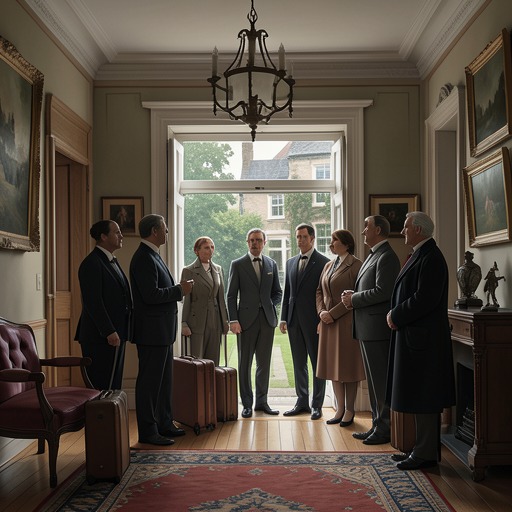
Countess Cambremere
In Search of Lost TimeMme de Cambremer, the elder Marquise de Cambremer, is a wealthy and high-born figure of the Balbec coast whose graciousness repeatedly draws her across social boundaries her family would rather preserve. A dutiful hostess and neighbor, she attends small local gatherings despite their modest standing; a respected musician whose playing is dismissed by her daughter-in-law; and a member of a family caught between aristocratic pride and the rising prestige of the Verdurins, she makes courtesy itself a measure of the difference between rank as inherited status and rank as social performance.
Identity and Social Position
The Marquise’s birth and wealth place her above the petty nobility of the district, but her conduct does not follow the narrow rules of social exclusivity. She accepts invitations to even the least distinguished gatherings along the coast, partly because she fears disappointing those who have invited her. Hosts, in turn, anxiously await her arrival: her presence can lend their party a reflected prestige, and they hope the local press will report her name among the guests. She is happy to have her attendance publicized, even when her hosts pretend to resent the notice as an indiscretion.
Her social generosity is not merely ceremonial. When she learns that the narrator has arrived at Balbec and is unwell, she calls, leaves a card, and returns to Féterne without insisting on seeing him. The journey is made in her old barouche, drawn by two horses; its familiar passage is heard in Balbec and other coastal places between Balbec and Féterne. The small, considerate visit expresses the same habit as her attendance at local parties: she is unwilling to let another person’s invitation or need go unanswered merely because the occasion is beneath her family’s station.
That ease with lesser local society has material and social consequences. A planned afternoon gathering at Féterne promises guests gardens where fig trees, palms, and roses grow outdoors, and a yacht that can collect important visitors from across the bay and serve as a refreshment room before carrying them home. The expense of such hospitality has helped lead the Marquise to let La Raspelière, one of her properties, for the first time. Her public generosity thus stands beside a practical effort to meet its costs.
Family, Name, and Inherited Distinction
At a gathering with the Cambremers, the Marquise explains that the family place-name came from her grandmother Arrachepel, whose family she describes modestly as old and good country stock, rather than illustrious. Her daughter-in-law immediately corrects that account: the family arms occupy a window in Bayeux Cathedral, and the family has tombs in the principal church at Avranches. The exchange reveals not a dispute over the basic antiquity of the lineage, but a difference in how family distinction should be advertised. The older Marquise presents ancestry without flourish; the younger woman insists on its visible credentials.
The younger Marquise’s correction leads into a story about a priest who had been appointed to the living at Criquetot after leaving Combray, where he had felt himself becoming neurasthenic. The sea air did not suit him, and he returned inland, but his research into local charters had given him a new interest. He compiled a pamphlet on place-names in the region and was working on a larger study of Combray and its surroundings. The younger woman offers to send the narrator the pamphlet about Féterne, including its account of La Raspelière. The older Marquise’s modest family recollection is thus taken up and enlarged into an account of local history and documentary scholarship.
Music provides a second point of tension within the family. The narrator tells the older Marquise that he knows her to be a great musician and would like to hear her play. Her daughter-in-law looks out to sea rather than join the conversation, regarding the elder woman’s musical tastes as not truly musical and her highly regarded talent as mere technical accomplishment. The narrator’s praise is supported by a strong external measure: Chopin’s only surviving pupil declared that the Master’s style and feeling had been transmitted through her to Mme de Cambremer alone. Yet her daughter-in-law considers playing like Chopin no recommendation, since she despises the composer. The scene sets recognized musical inheritance against the younger woman’s cultivated modern judgment.
Courtesy and the Verdurin Circle
Relations between the Cambremers and Madame Verdurin become strained when the family considers how to receive her. The younger Marquise speaks dismissively of inviting her, reasoning that in the country one meets anybody; nevertheless, the Cambremers are sufficiently awed by Madame Verdurin’s standing to consult the narrator about how to make the invitation. He advises them to invite her to meet the smart local guests who own the château of Gourville. The Cambremers refuse, worrying that the two sets of guests will not mix, that one group might bore the other, or that combining them would violate proper social form.
Instead, they plan to invite Madame Verdurin and her little group on a separate evening. For the dinner with the fashionable neighborhood circle, they invite Morel, hoping that his presence will indirectly inform Palamède de Charlus of the distinguished company and that Morel will entertain the guests with his violin. They also invite Cottard, whose manner the Marquis thinks will go down well at dinner, but invite him without his wife to avoid setting anything in motion with her. Madame Verdurin is outraged to learn that two members of her group have been invited without her. She dictates a stiff refusal for Cottard, worded in the plural to signal that he is not detachable from Mme Cottard and to teach the Cambremers a lesson. Morel, for his part, does not need her to prescribe impolite behavior; he adopts it himself.
The episode exposes the gap between the Cambremers’ confidence in their inherited position and their apprehension about managing social distinctions. They wish to make a polite gesture toward Madame Verdurin, yet fear the consequences of placing her among their more fashionable guests. Her circle, meanwhile, insists that its members be treated as a collective. An invitation becomes a test of affiliation, and the attempt to keep different kinds of guests apart intensifies the very conflict the hosts hoped to avoid.
Rank, Desire, and Political Connection
The narrator’s account of the Cambremers’ relations with the Verdurins also shows that the younger Marquise’s apparent social assurance can coexist with anxiety and imitation. She and her family are described as holding to a family style of speech, including a fondness for strings of three adjectives and an emphatic way of catching the breath. Such habits are presented as inherited through repeated imitation of Aunt Zélia, to the point that relatives treat a young girl’s manner of speaking as a sign that she takes after her. Family identity, here, is made visible in small verbal mannerisms as well as in heraldry and estates.
At another point, the narrator and Palamède de Charlus discuss the Cambremers after a dinner at La Raspelière. When the narrator compares them to figures from Balzac’s provincial scenes, Palamède de Charlus objects to his characterization of the wife as superior to the husband and redirects the comparison. The exchange belongs to the narrator’s broader portrait of a household whose differences are read and judged by the surrounding circle, rather than being settled by the family’s own claims to position.
The Marquise also speaks of Saint-Loup’s political affiliation in connection with a possible marriage to Mlle de Guermantes-Brassac. She notes that the Prince de Guermantes is a Dreyfusard and says Saint-Loup is reputed to be one as well, suggesting that this might explain the marriage. The narrator corrects the political detail: Saint-Loup once supported Dreyfus but no longer does. The correction shows how political identities and marriage rumors circulate together in this society, and how quickly an assertion about a person’s allegiance can become part of speculation about family alliances.