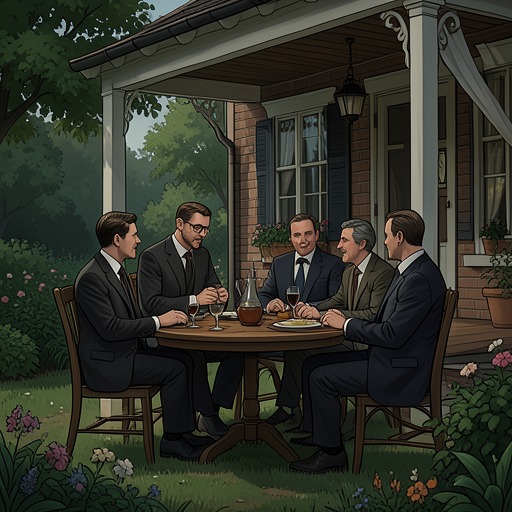
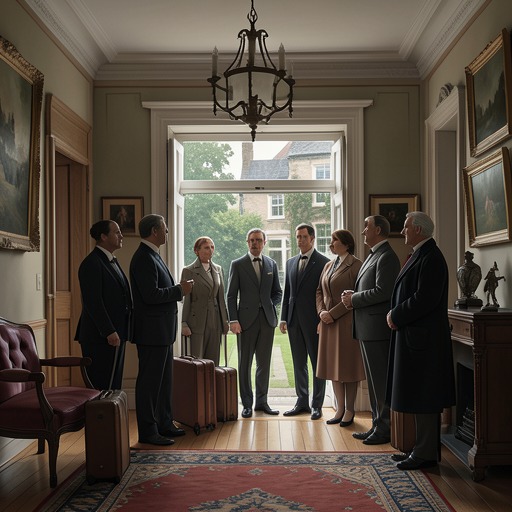
Féterne château
In Search of Lost TimeFéterne château, the Cambremers’ country house, matters less as a catalogue of architectural beauties than as a contested object of perception. The narrator is moved by the expectations its name and spaces awaken, while Mme de Cambremer judges its furnishings by the conventions of taste; meanwhile Mme Verdurin turns the house into a rival destination in her campaign to secure her guests’ company. Its old moat and drawbridge, worn hangings, draughts, and gallery give the château a concrete presence, but its social meaning changes with the observer.
A house encountered through memory and expectation
The narrator’s response to Féterne château diverges sharply from the Cambremers’ own account of its charms. The beauties they point out leave him cold, while confused reminiscences carry him away. He confesses that the place is not as rustic as its name had led him to imagine, a remark that enrages Mme de Cambremer. His response depends not simply on what the house contains but on the gap between a place’s name and the inward picture formed before arrival.
A draught slipping through a chink in a door prompts him to stop in ecstasy and smell the breeze. His hosts answer that he seems to like draughts, treating as a peculiarity what has become, for him, an occasion of heightened attention. He is equally delighted by a piece of green lustre plugging a broken pane; Mme de Cambremer calls it frightful. The contrast makes the house a measure of divergent sensibilities: what its owners see as damage or discomfort can become, to the narrator, an arresting detail.
The gallery produces his most distinctive association. Hearing his footsteps echo there, he says that he felt as if he had entered a village mairie, with a map of the district on the wall. Mme de Cambremer responds by resolutely turning her back on him. The scene does not establish that the château literally contains such a map; it records the narrator’s imaginative impression, which proves more vivid to him than the fine objects his hosts wish him to admire.
Taste, status, and the Cambremers’ judgment
The Cambremers’ conversation after the visit reveals their own divided assessment. M. de Cambremer asks his wife whether she found the arrangement too bad, with the anxious solicitude of someone asking how she endured a painful ceremony, and insists that the house has some fine things. Mme de Cambremer replies that the objects are not in the right places and questions whether they are really fine at all. Her answer turns the issue from the presence of valuables to their arrangement and rank within the room.
M. de Cambremer points out Jouy hangings worn thin and threadbare. His wife adds that a fabric patterned with huge roses resembles a peasant woman’s quilt, and objects to the draught-curtains as bad form. She explains the supposed failures through the social identity she assigns the owners, calling them retired tradespeople who could not know better. Her condemnation is therefore not simply a practical inventory of worn furnishings: it makes the house’s decoration evidence in a judgment of its occupants.
The narrator’s response exposes the instability of that judgment. The same draught that indicates discomfort to the hosts carries fragrance for him; the broken pane’s green patch, dismissed as frightful, is an object of praise. The château’s rooms do not yield one authoritative aesthetic verdict. Their significance is produced through different habits of attention, expectation, and social distinction.
A rival destination in Mme Verdurin’s campaign
At La Raspelière, Mme Verdurin tries to establish what the narrator’s invitation to Féterne will mean for his place in her circle. She asks whether he will dine with the Cambremers and advises him against going, disparaging provincial counts and marquises whom nobody knows. When he says he may have to go once or twice, she warns that the place is unhealthy and might bring on pneumonia or chronic rheumatism, then reverses course enough to propose that he bring his young cousin Albertine when she herself dines there.
Her invitation is conditional and strategic. She suggests that the château is not bad and could be amusing with its old moat and drawbridge, offers to bring her circle, and presses the narrator to join a carriage excursion to Harambouville. The house is now one element in an effort to draw him away from other company while making Mme Verdurin herself appear willing to attend. Her shifting account of Féterne—first dangerous, then worth seeing—shows that its evaluation serves her immediate social purpose.
She continues to contrast her own hospitality with the rival destination. Féterne becomes a place of hunger and rats in her warnings, while she promises the narrator and Albertine food, rooms overlooking the valley, and a change of air. She even urges the narrator to bring Saint-Loup instead, claiming to have heard of him from Morel, though Saint-Loup and Morel do not know one another. The château’s role in the conversation is thus inseparable from Mme Verdurin’s wish to keep the narrator within her circle and to direct whom he visits.
The house in the social landscape
The journey away from La Raspelière links Féterne to the practical choreography of country-house society. Because the Cambremers do not want to bring their horses all the way up to La Raspelière at night, they take the train with the party at Douville-Féterne; their nearer station is La Sogne. At Douville-Féterne, M. de Cambremer gives the Verdurins’ coachman a franc, turning the small payment into a conspicuous act by asking whether it is indeed a franc and whether twenty sous is right for a short drive. He makes sure the gift is visible in the lamplight, so the faithful can report it to Mme Verdurin.
The departure gives the château a place in a wider network of invitations, travel, and social observation rather than isolating it as a picturesque backdrop. Its old moat and drawbridge help Mme Verdurin advertise it as an excursion, while the narrator’s gallery, breeze, and green glass resist the judgments through which its occupants and rivals try to define it. Féterne becomes a small theatre of competing claims: ownership does not guarantee agreement about beauty, and an invitation to a country house can also be a test of belonging.