Grand Hotel at Balbec
In Search of Lost TimeThe Grand Hotel at Balbec is more than a place to stay: it is a social stage, a storehouse of sensory memory, and the setting in which the narrator’s return to the coast turns from expectation into belated grief. Its corridors and familiar routines initially promise ease and renewed desire; the scent of its soap and the recollection of an earlier arrival instead bring his dead grandmother vividly back to life. Later, the hotel anchors the narrator’s life with Albertine, making its rooms and departures part of an intimacy that both soothes and unsettles him.
Setting and the Return to Balbec
The narrator returns to Balbec with expectations shaped by memory, imagination, and the prospect of meeting women through the people staying nearby. The Verdurins have rented La Raspelière, one of M. de Cambremer’s houses, for the season and invited Mme Putbus. The narrator learns that her lady’s-maid will eventually join them, and imagines that a connection to her mistress and to the Verdurins might help him approach the maid. He also expects Balbec’s beach and hotel-front to offer opportunities for making female acquaintances, which now seem accessible to him because he has friends and resources he lacked on his first visit.
That anticipated pursuit does not come to fruition. Mme Putbus is not due at La Raspelière early in the season, and circumstances eventually make the narrator dread the maid’s possible arrival; the intended object of his expedition is neither attained nor pursued. The gap between expectation and experience establishes a pattern for the hotel’s significance: returning to a place does not make it conform to the picture that drew someone there. Memory’s images can be as selective and elusive as imagined ones, while a fresh reality may alter or even extinguish the desire that prompted the journey.
Familiarity, Habit, and the Hotel as Theatre
At first, the hotel’s familiarity seems to promise a restorative contrast with the narrator’s first visit. Then, a tourist without protection or prestige, he had found the hotel strange and opaque: returning guests, young women going to dinner, servants in corridors, and an American visitor with her chaperon all seemed to look past him in ways he could not interpret. On the later visit, the same ascent in the lift carries him through a known building where he feels at home. He thinks of the work required to impose a familiar inner life on surroundings that once seemed frightening, an operation he must begin again whenever he enters a new place.
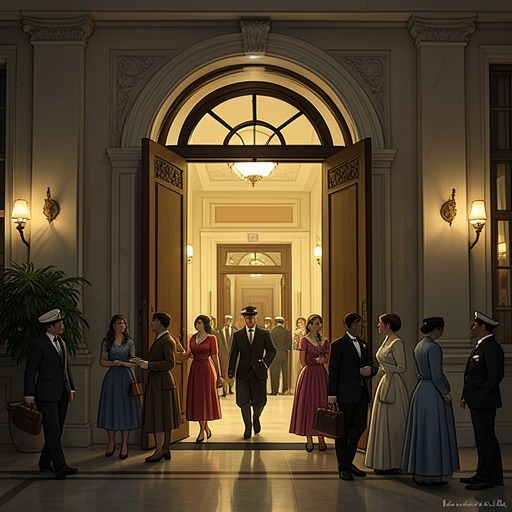
The Grand Hotel is also a social theater whose inhabitants and staff give its spaces their changing meanings. The lift-boy, taciturn on the first visit, now sets the lift in motion with pleasure and remains silent out of respect rather than disdain. The manager, meanwhile, supervises the narrator’s placement in the dining-room and worries that the narrator’s absence might mean a recurrence of his spasms. When the narrator fears an unwanted visit from the senior judge, the manager promises to prevent it and proposes putting the lift-boy on guard outside his door. His comic account of hotel hierarchy—there are older colleagues, promotion would cause an outcry, and the boy lacks seriousness—shows the institution managing rank even in its smallest domestic routines.
The narrator’s expectation of renewed seaside pleasure depends on the hotel’s ability to feel both familiar and strange. The building can shelter the possibility of an enchanted, unknown existence, but habit threatens to dispel that possibility. In retrospect, its remembered corridors and thresholds are not simply scenery: they are places where the narrator’s ideas about home, desire, and the past can be revised by experience.
The Room, Sensation, and Belated Grief
The decisive transformation begins in the narrator’s room on his first night back. Suffering from cardiac fatigue, he bends down cautiously to remove his boots. As he touches the top button, sobs overwhelm him. The memory that returns is not merely an image of his grandmother as he had recently thought of her, but a vivid recollection of her tender, preoccupied, disappointed face on the first evening of their earlier arrival at Balbec. For the first time since her stroke in the Champs-Élysées, he recovers her living reality in an involuntary memory.
That recovery also makes the fact of her death newly real. More than a year after her burial, he recognizes that the grandmother he now longs to embrace is dead. He had spoken and thought about her before, but those conscious recollections had not restored the person whose loss he now feels. The room therefore becomes the setting for a painful mismatch between the calendar of facts and the calendar of feelings: his understanding of bereavement arrives late, when the familiar circumstances of the earlier hotel visit re-create the lost person with unexpected force.
The hotel continues to work through physical sensation after this upheaval. The narrator smells the Grand Hotel’s unusually scented soap while washing his hands and finds that it belongs at once to the present and to his earlier stay. The sheets, too fine, light, and large to remain tucked in place, once would have distressed him; now their shifting folds seem to cradle the remembered sunrise. Smell and touch make the hotel’s past perceptible without turning the return into a simple repetition. Familiarity first offers comfort, then opens the way to a grief that familiarity alone had not allowed him to feel.
Albertine and the Hotel’s Domestic Life
The Grand Hotel becomes the narrator’s base for a relationship whose daily arrangements draw other people into its rooms and routines. On his arrival, Albertine is staying at a nearby watering-place rather than in Balbec itself. She has changed her plans, has been there for three days, and sends word asking when she can see him. The manager conveys her message and remarks that people ultimately desire the narrator’s company, but the narrator, still affected by his private upheaval, says that he wishes to see nobody. The episode places social availability beside emotional withdrawal: the hotel can connect him to visitors and acquaintances without making him ready to receive them.
Later, the narrator’s time with Albertine is organized around departures, returns, and messages. After dinner, the car brings her back; sometimes he goes to fetch her beneath the arcade of the market at Maineville. They spend evenings together and he returns her to Parville, sometimes driving back to Balbec only at daybreak. When he has gone out alone, he may find a telegram or postcard on his table, written by Albertine at Quetteholme to say that she is thinking of him. The hotel’s room is thus a point of return where absence is filled by written messages, while the car and nearby places extend their shared life beyond Balbec itself.
This intimacy brings comfort to the narrator but also anxiety to his mother. When he sends the chauffeur to fetch Albertine, his mother objects to the expense and asks him not to become like Charles de Sévigné, whose hand, she recalls, was said to be a crucible in which gold melts. She does not demand that he stop seeing Albertine, but wants it to be possible to meet one without the other. Her concern threatens a life the narrator had imagined he could end at will; in response, he says that her advice will delay his decision to change it by perhaps two months. The hotel is therefore not just a backdrop to romance: from it, the narrator’s repeated summonses of Albertine become visible as a costly habit, and a private relationship becomes a source of family tension.