Henry document
In Search of Lost TimeThe Henry document is the forged document whose exposure helps convince the Prince de Guermantes that Alfred Dreyfus may be innocent. In the Prince’s account, it first appears as the supposed overwhelming proof of Dreyfus’s guilt; once its falsification becomes known, it becomes a turning point in his reassessment of the trial and the Army he had long revered.
Role in the Prince’s Reassessment
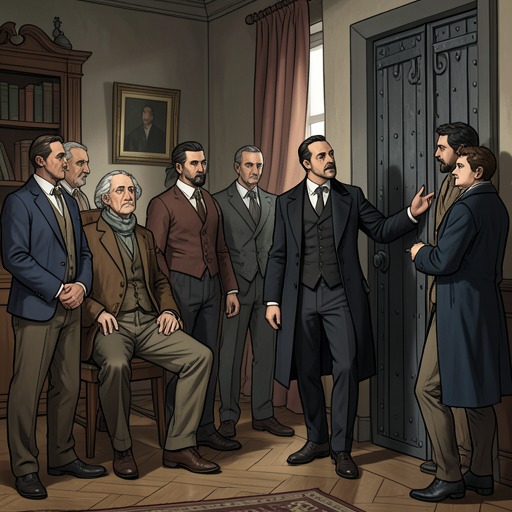
The Prince recounts that his doubts began with the possibility that serious illegalities had occurred during the trial. His conversations with General de Beauserfeuil confirmed that there had been culpable intrigues. Yet Beauserfeuil still maintained that Dreyfus’s guilt was established by overwhelming proof, which he identified as the Henry document. The claim therefore supplied a final support for the Prince’s existing confidence in the prosecution, even as the possibility of procedural wrongdoing troubled him.
That support collapsed when the Prince learned a few days later that the document was a forgery. The revelation was not an abstract irregularity: it undermined what had been presented to him as decisive proof. The Prince began reading the newspapers Le Siècle and L’Aurore every day, soon became convinced, and could no longer sleep. He confided his distress to the abbé Poiré, who shared his conviction; the Prince then asked the abbé to say masses for Dreyfus, his wife, and their children.
Political and Social Consequences
The document’s exposure belongs to a wider change in the Dreyfus controversy. The Prince’s account connects the forgery to his gradual movement from reverence for the Army and reluctance to suspect its officers toward the conviction that an innocent man might be suffering an infamous punishment. Evidence of the document’s falsity gave that suspicion force, while the Prince’s reading and discussions helped turn it into a settled position.
The controversy also had consequences beyond the Prince’s private judgment. At the Hôtel de Guermantes, the Duke de Guermantes describes Swann’s support for the Dreyfusard position as a social betrayal, arguing that people would treat one Jewish supporter as proof about Jews as a group. The contrast places the Henry document’s evidentiary role against the prejudices and social pressures surrounding the case: the same political crisis could be discussed as a question of proof, loyalty, military honor, and group identity.
A Turning Point, Not a Complete Explanation
The Prince’s account establishes the Henry document as a crucial cause of his reassessment, but the later narrative also shows that political positions could shift through changing social encounters. After a spa visit, the Duke de Guermantes, formerly a fanatical anti-Dreyfusard, returned convinced that Dreyfus should be acquitted. His change followed conversations with three women whose judgments challenged his assumptions. The episode does not undo the document’s importance in the Prince’s story; it shows that the public meaning of the case continued to be formed through evidence, argument, and social influence.
The Henry document thus stands at the junction of a legal claim and a political transformation. Presented as proof of guilt, it becomes, once exposed as false, a reason to distrust the case against Dreyfus. Its significance lies not only in the revelation of forgery but in the chain of consequences that follows: the Prince’s renewed inquiry, his changed conviction, and his recognition that the Army’s authority could not settle the question of truth.