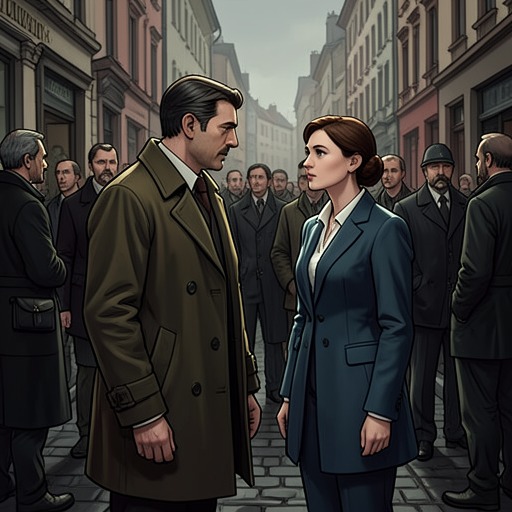
Jupien’s shop
In Search of Lost TimeJupien’s shop is the former tailor’s workplace in the courtyard of the Hôtel de Guermantes, where Palamède de Charlus and Jupien first meet and recognize one another without prior acquaintance. Its threshold stages their unspoken courtship; its adjoining empty shop later gives the narrator a concealed vantage on the encounter’s aftermath. The place makes private desire visible while also exposing how chance, social performance, and the risks of observation shape what can be known.
Setting and First Encounter
Jupien is an ex-tailor whose shop opens onto the courtyard. The narrator sees Palamède de Charlus there after leaving Mme de Villeparisis’s house. Their meeting is unusual: de Charlus generally visits the Hôtel de Guermantes in the afternoon, when Jupien is at his office, and the two men have apparently never encountered one another before. A change in Mme de Villeparisis’s circumstances has brought them together at an unexpected hour.
At first they are held face to face, each studying the other. The narrator watches their postures alter in accord: de Charlus affects an air of indifference, while Jupien sheds the kindly humility the narrator had associated with him and adopts a more deliberately coquettish pose. The exchange is wordless, yet appears to the narrator as an accomplished performance, an immediate mutual understanding that needs no prior introduction. The shop threshold is the scene’s hinge: both men pause there, and the change in their bearing makes recognition legible before either speaks.
From the Threshold into the Shop
The initial exchange develops through glances and movements. Jupien leaves by the carriage gate, turns his head several times, and disappears into the street; de Charlus follows briskly, humming and greeting the porter, who does not hear him. Jupien then returns, followed by de Charlus. Asking for a light, the Baron says he has left his cigars at home, and Jupien invites him inside. The shop door closes behind them, ending the narrator’s direct view of the pair.
The narrator interprets the meeting through the image of an orchid and a bee: the comparison gives form to the apparent fit between two people who have arrived at a rare conjunction by chance. He stresses that this is an analogy, not a scientific claim. For years, the Baron’s visiting hours had kept him from meeting Jupien; now an unplanned change in routine has opened the possibility of their encounter. The shop is not merely a backdrop to that chance. Its doorway marks the transition from a public display of mutual attention to a private meeting the narrator can no longer see directly.
The Adjoining Space and the Act of Watching
Frustrated that the closed shop prevents him from hearing more, the narrator notices a vacant shop separated from Jupien’s by a very thin partition. He could reach it discreetly by going up to the flat, through the kitchen and service stairs, and across the cellars to the basement steps leading into the empty premises. Instead, he crosses the courtyard in the open, keeping close to the walls. He later offers impatience, a memory of watching Mlle Vinteuil at Montjouvain, and the courage he had drawn from accounts of exploration and the Boer War as possible reasons for choosing the riskier route.
Inside the empty shop, the narrator takes care not to creak the wooden floor, since sound carries between the premises. A ladder has been moved there from the coach-house; it would let him reach the fanlight above and hear more clearly, but he fears making a noise. The arrangement of the two shops turns ordinary features of the building—a partition, a floor, a ladder, a fanlight—into conditions governing what he can observe. He is concealed, but not omniscient: he arrives after the encounter has begun, cannot make out every word, and must infer from incomplete sounds and gestures.
The narrator reflects that he could have used the safer cellar route, but instead seems drawn to the exposed crossing. He associates such revelations with scenes encountered under imprudent and clandestine circumstances, and compares his passage across the courtyard to crossing open ground under threat. The comparison is deliberately disproportionate: the danger he names is the neighbors’ eyes, not physical attack. The shop and courtyard therefore frame observation as an act with its own mixture of curiosity, calculation, and self-dramatization.
What the Shop Reveals
From the neighboring premises, the narrator first hears indistinct sounds and later sees de Charlus emerge. He reports that the Baron tries to press money on Jupien, who refuses it insistently. Their conversation continues at the threshold. De Charlus asks why Jupien shaves his chin; Jupien then reproaches him for asking about men in the neighborhood, including a chestnut seller and a chemist’s delivery cyclist, and calls him a flirt. When de Charlus makes a further request too quietly for the narrator to hear, Jupien’s annoyance gives way to evident pleasure, and he agrees to grant the favor.
The scene does not make the shop transparent to the reader. The narrator misses the words that would explain the request and reconstructs the encounter from what he can hear and see. The thin partition provides access, but it also sets a limit: he is close enough to witness the shift in Jupien’s response, not close enough to know everything that passed between the men. The place thus embodies the story’s distinction between seeing an event and understanding it.
Elsewhere, the shop’s setting is contrasted with the formal worlds of aristocratic hospitality. At the Princesse de Guermantes’s gatherings, chairs are arranged in groups, and the hostess moves among them to display her social skill; the narrator also describes the custom that a sovereign prince is treated as host wherever he happens to be. At a dinner, de Charlus turns M. de Cambremer’s offer of a chair into an occasion to assert precedence reserved, in his account, for princes of the blood. In the shop, by contrast, the Baron’s rank does not organize the encounter in the same explicit way: he asks for a light, follows Jupien inside, and engages in a personal exchange whose terms are supplied by their immediate rapport. Yet his manner and language still carry the hauteur and eccentricity associated with his aristocratic persona.
Jupien’s shop is consequently more than the location of a first meeting. It is the physical point where the narrator’s observations of de Charlus’s public manner meet a less guarded encounter, and where chance briefly brings two people together whom routine had kept apart. The adjoining empty premises then make the narrator’s watching possible while exposing its limits. The scene’s significance rests in that double arrangement: a private recognition occurs behind a shop door, while the observer remains separated from it by a thin wall, a narrow fanlight, and the uncertainty of what can be inferred.