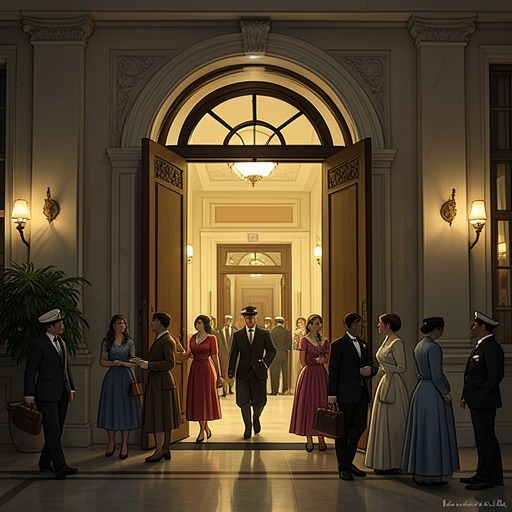
M. Nissim Bernard
In Search of Lost TimeM. Nissim Bernard is a wealthy elderly visitor to Balbec whose discreet pursuit of young men is known to some people around him but remains a taboo subject for the hotel’s management. His recurring appearances connect the novel’s reflections on concealed desire to a sharply comic story of mistaken identity: at the Cherry Orchard, his short sight repeatedly leads him to approach the wrong one of a pair of identical twin waiters, with bruising consequences.
Identity and Social Position
Bernard is Bloch’s uncle, and the family accepts his habit of never lunching at home as the eccentricity of an elderly bachelor, perhaps explained by a liaison with an actress. They do not suspect the actual reason for his absences. At the Balbec hotel, however, his private life is so sensitive a subject that the manager avoids mentioning Bernard when advising Bloch’s niece to be more circumspect. Bernard thus occupies two social identities at once: the respectable older relative in his family’s account, and a man whose sexual interests are understood but not openly discussed in the hotel.
That contrast places Bernard within the novel’s wider treatment of men whose desires must be concealed or misread. The narrator’s reflections on the social pressure surrounding same-sex desire describe a life shaped by secrecy and the risk of exposure; Bernard’s story gives that pressure an everyday, comic form. The hotel’s silence protects appearances without making his conduct unknown.
The Twin Waiters at the Cherry Orchard
Bernard has recently transferred his attentions from the chorister in Athalie to a waiter at a busy local farmhouse called the Cherry Orchard. The waiter has a twin brother, and the two are so alike that the narrator compares them to identical products from an industrial process. Their resemblance, however, conceals a consequential difference: one is willing to cater to the tastes of certain men, while the other devotes himself to serving women.
Because Bernard is short-sighted, he repeatedly mistakes one twin for the other. Remembering agreeable encounters with the brother he seeks, he arrives at the Cherry Orchard and innocently invites the other to meet him later. The mistaken waiter responds by giving him a thorough beating. The confusion can happen more than once over the course of a single meal, when Bernard continues with one twin a conversation he began with the other. What looks to an outside observer like a simple failure of recognition becomes a recurring collision between desire, resemblance, and the limits of Bernard’s knowledge.
Tomatoes and Comic Aftermath
The incidents eventually make Bernard avoid tomatoes, even when they are merely food. The twins’ tomato-like faces have become inseparable in his mind from the confusion at the Cherry Orchard, so that association converts a humiliating encounter into a lasting aversion. His private misadventure has also produced an odd public habit: when he hears a stranger order tomatoes at the Grand Hotel, he intervenes with a warning that they are bad that day and claims he never eats them himself.
The warning works. A stranger thanks him, calls back the waiter, and cancels the order. Aimé, who has seen Bernard do this before, recognizes that the old man has once again persuaded someone else to change their order. Bernard’s attempt to steer clear of a reminder of his own embarrassment therefore becomes a small performance of benevolence, understood by the hotel employee as a familiar piece of mischief.
Narrative Role
Bernard’s story is episodic, turning a concealed relationship into a chain of concrete consequences: a twin mistaken for his brother, an invitation answered with a beating, and tomatoes rendered inedible by association. The narrator’s amused attention to the waiters’ identical faces makes the physical likeness both the mechanism of the plot and the image through which its comic reversal is understood. Bernard is not simply the target of the joke: his warnings to strangers show him trying to convert an awkward private history into a public service, while Aimé’s knowing amusement quietly reveals how recognizable the routine has become.