M. Nissim Bernard’s seduction of the young hotel waiter
In Search of Lost TimeM. Nissim Bernard’s seduction of the young hotel waiter turns an apparently ordinary lunchtime routine at the Grand Hotel at Balbec into a sustained private attachment, with consequences for the waiter’s work and Bernard’s annual habits. The episode’s significance lies not only in the relationship itself but in the way the hotel’s service hierarchy, patronage, and theatrical public life make it possible to conceal and sustain it.
Setting and Circumstances
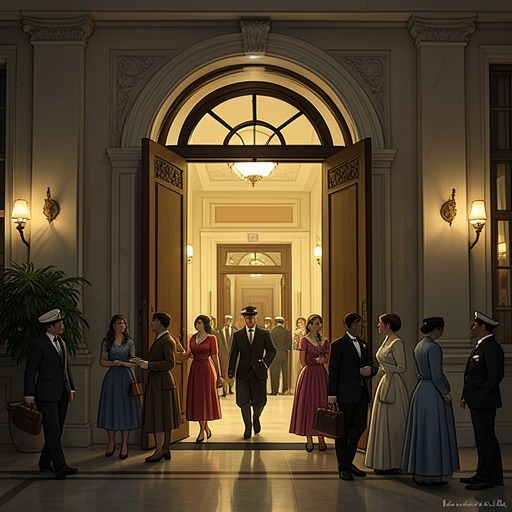
The relationship unfolds in a hotel whose young male staff are presented as part of its elaborate performance. The narrator likens the Grand Hotel at Balbec to a theatre: guests are not merely spectators, because their own lives proceed amid the sumptuous stage and its cast of servants. In the dining room, Bernard’s daily attendance and the waiter’s movements become a recurring scene, visible to other guests but not understood by them as a private arrangement.
Bernard’s attachment also sits within a larger pattern of family and hotel life. Each year he rents a magnificent villa at Balbec for his nephew, and he insists on returning there to dine at his own table rather than accepting invitations elsewhere. His relatives regard him as an eccentric old bachelor with a taste for the coast and its views; they do not know that his daily hotel lunches are connected to his interest in the young waiter. Even Bernard, the narrator suggests, does not fully recognize how much his fondness for the beach and restaurant setting contributes to his desire to keep one of the hotel’s servers.
Courtship and Turning Point
The narrator describes the waiter’s first response through a sequence of allusions to Racine. On the first day, the young man’s reaction is presented as an embrace prompted either by fear or by eagerness for affection. The following day, after Bernard has taken him out, the narrator marks a decisive change in the relationship. The account is oblique rather than a direct scene of courtship, but its sequence makes clear that Bernard’s pursuit rapidly becomes an established intimacy.
From that point, the waiter’s life is altered. Although his duties remain those of a server carrying out orders, the narrator portrays his expression as newly animated. Bernard comes to the hotel at lunchtime and watches him make his rounds through the restaurant, all the way to the cashier’s distant station. The waiter’s attentiveness is directed to the restaurant’s customers generally, not especially to Bernard. The narrator leaves open whether this distance reflects the waiter’s confidence in Bernard’s affection, annoyance at it, or concern that its visibility might cost him other opportunities.
Patronage and the Waiter’s Position
Bernard’s attachment is bound up with his ability to influence the waiter’s employment. He maintains excellent relations with the hotel manager and with Aimé, the head waiter, so that the young man might be promoted to under-waiter or even entrusted with a row of tables. A cellar position is offered, but Bernard has him decline it: in the cellar, the waiter would no longer be visible in the dining room, where Bernard comes every day to watch him work.
This intervention makes the arrangement more than a private affair. Bernard’s patronage can improve the waiter’s position, but it also shapes which work he accepts and preserves Bernard’s access to him in the public restaurant. The hotel’s routine thus serves two purposes at once: it provides the waiter with a place in the staff hierarchy and gives Bernard a daily occasion to observe him. The narrator does not treat the waiter’s service as a simple expression of affection. His relative coldness toward Bernard may coexist with dependence on Bernard’s support, leaving the relationship legible through gestures and arrangements rather than an explicit account of the waiter’s feelings.
Concealment and Public Misreading
The relationship remains hidden from Bernard’s family. His annual return to Balbec is explained by relatives as a combination of poetic appreciation for the coast and eccentric bachelor habits. Bloch, too, supplies an interpretation of Bernard’s lunches: he takes them as evidence of an old man’s gastronomic absenteeism. These explanations are not wholly false, since the narrator notes that Bernard himself is unaware of the full force of his attachment to the place and its sea view. But they obscure the decisive reason for the daily visits: the young waiter is there.
The narrator’s theatrical image of the hotel clarifies how this concealment works. Bernard occupies his familiar place at lunch as though in an audience, while the waiter moves about the green dining room in the course of his duties. The public can see the repeated performance without necessarily understanding its private meaning. Bernard’s wish to keep the waiter in a visible post, rather than in the cellars, intensifies that paradox: the relationship depends on being able to watch the young man in public while its personal basis remains unknown to Bernard’s relatives and is not openly discussed in the hotel.
Consequences and Narrative Significance
The episode also connects Bernard’s private attachment to a wider question of protection and influence at the hotel. In the same setting, a scandal involving Bloch’s sister and a retired actress prompts complaints to the manager, yet the narrator says that Mlle Bloch is protected by Bernard without her knowing it. That protection arises from Bernard’s position and his dealings with the hotel, while the waiter’s prospects likewise depend in part on Bernard’s good relations with its staff. The hotel’s social order is therefore not merely a backdrop: access, employment, and discretion are shaped by personal networks.
Bernard’s relationship with the waiter is recounted through the narrator’s characteristic mixture of comic comparison, classical allusion, and attention to mistaken explanations. The staged language of Racine makes the waiter’s changing role resemble a part in a recurring performance, while the narrator’s account of Bernard’s relatives shows how a person’s motives can remain partly obscured even from himself. The affair has no narrated public resolution in these passages. Its clearest outcome is its continuation: Bernard returns to Balbec year after year, keeps his place at the lunch table, and maintains the conditions that allow the waiter to remain before him in the restaurant.