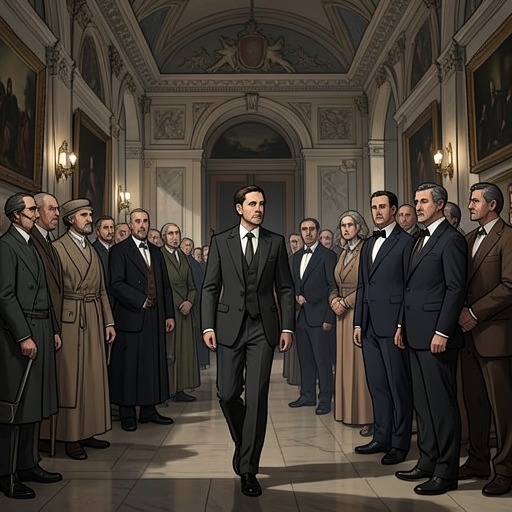
M. de Bréauté
In Search of Lost TimeM. de Bréauté is a well-connected figure in Guermantes society whose importance lies less in sustained action than in the social work he performs: he recognizes people, makes introductions, and circulates reports. At a gathering hosted by the Prince and Princess de Guermantes, he helps the narrator gain access to the Prince; later, his account of Swann’s estrangement from the host is challenged by Colonel de Froberville. These scenes make him a small but revealing hinge in a world where news, rank, and access are constantly negotiated.
Social Presence and the Introduction
At the party, M. de Bréauté approaches the narrator after the narrator has failed to secure an introduction through Palamède de Charlus. The narrator hears him before seeing him: a sniffing sound advances through the open doors from the gardens, and the greeting that follows seems to offer a possible rescue from social exclusion. Bréauté is not the most powerful person in the circle, but he is more at ease with the Prince than Mme d’Arpajon and appears willing to use that access on the narrator’s behalf.
His manner of presentation is itself a performance. Turning from one direction to another and peering through his monocle, he surveys the gathering as though it were a collection of masterpieces. Once the narrator makes his request, Bréauté leads him to the Prince and presents him with ceremonious enthusiasm, but with a vulgar, almost demonstrative relish. The combination of access and theatricality marks his social usefulness: he can open a door, yet he does so in a way that draws attention to his own role as intermediary.
The introduction gives the narrator a chance to compare the Prince with the Duc de Guermantes. The Prince greets him stiffly and addresses him as “Sir,” whereas the Duke’s manner is more familiar and apparently companionable. The narrator comes to see that the Duke’s easy manner can conceal a deeper hauteur, while the Prince’s formal reserve may contain a more genuine consideration for someone below him in rank. Bréauté’s intervention thus produces an unexpected result: the narrator’s social access leads not to confirmation of his assumptions, but to a reassessment of how aristocratic simplicity and disdain can be disguised.
Reports About Swann
M. de Bréauté also serves as a transmitter of information about Swann. At the gathering, he tells the Duc and Duchesse de Guermantes that Swann’s conversation with the Prince concerned a small play performed at Swann’s house. According to this account, the actor had been made up to resemble Gilbert, although Bergotte had intended the performance to depict him; Swann reportedly answered Gilbert’s demand for an explanation by saying that the impersonation was not like him, since Gilbert was much funnier. The Duchesse responds with interest in the performance and surprise that Mme Molé attends Swann’s house, immediately interpreting such attendance as evidence that a once-avoided social circle is attracting people.
That version is not the only one in circulation. Colonel de Froberville contradicts Bréauté, claiming that the Prince reprimanded Swann and asked him not to return because of his publicly expressed Dreyfusard views. The disagreement matters because it reveals how political conflict and social exclusion are entangled: the same rupture can be explained as a comic dispute over a private theatrical performance or as a consequence of Swann’s political position. Bréauté does not settle the matter; his account is part of the uncertain gossip through which the guests try to understand what has happened.
When Froberville challenges him, Bréauté does not simply withdraw his story. He says that he does not question Froberville’s account, but that his own information came from a good source, the Prince de La Tour d’Auvergne. The Duc de Guermantes immediately corrects the title, explaining that the man is not a prince and that the only surviving member of the family is Oriane’s uncle, the Duc de Bouillon. The exchange exposes a weakness in Bréauté’s authority: he can invoke a source, but the status attached to that source is itself subject to correction by people who know the genealogy better.
Taste, Rank, and the Work of Gossip
Bréauté’s social presence is not confined to reporting. Palamède de Charlus jokes that Bréauté was responsible for placing lamps around the fountain at the party, an idea that, in his view, could not truly spoil a great work of art but showed that Bréauté was no match for Hubert Robert. The teasing connects social reputation to aesthetic judgment: Bréauté is treated as someone who has influence over the setting, but whose taste can be mocked by a more confident arbiter. The fountain becomes a measure of competing claims to discernment rather than merely a decorative feature of the gathering.
Across these episodes, Bréauté’s role is episodic but structurally useful. He provides a route into the Prince’s company, contributes to the guests’ knowledge of Swann, and becomes the subject of criticism about his judgment. His speech and manners help show how social authority is assembled from introductions, sources, titles, and displays of taste—and how readily each can be challenged. The narrator encounters not a definitive guide to the Guermantes world but a participant in its continuous circulation of access and uncertain information.