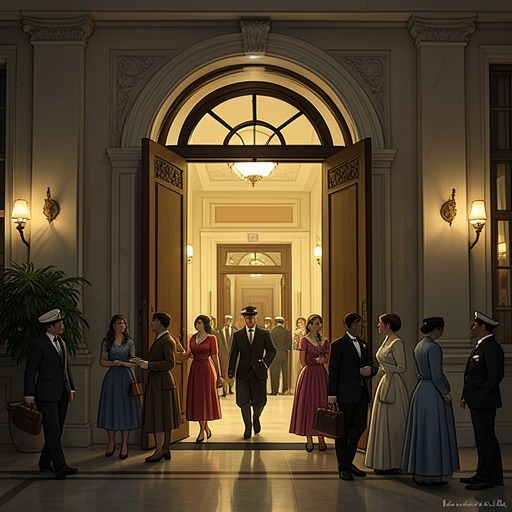
M. de Charlus and Jupien’s encounter
In Search of Lost TimeM. de Charlus and Jupien’s encounter is a chance meeting that turns an obscure exchange of looks into an enduring relationship. In the courtyard of the Hôtel de Guermantes, the First-person narrator watches the two men recognize and answer one another through gesture before either speaks. Their meeting changes Jupien’s circumstances: M. de Charlus recommends his work to wealthy clients and eventually employs him as his secretary. The episode’s central image, an orchid met by a bee, makes private desire legible as an encounter shaped both by mutual recognition and by accident.
The Courtyard Encounter
The meeting occurs because an unusual change in routine brings M. de Charlus into the courtyard at a time when Jupien, a former tailor, is there. The two have not met before. M. de Charlus stops to look at Jupien, who in turn fixes his attention on the Baron; as the Baron alters his posture, Jupien seems at once to adjust his own. The narrator, who has just observed M. de Charlus’s gentler expression at rest, is struck by the contrast between that unguarded softness and the Baron’s customary forceful manner.
Their silent exchange gathers meaning through a series of complementary gestures. M. de Charlus affects indifference but seems reluctant to leave; Jupien, shedding the kindly manner the narrator associates with him, adopts a calculated pose. Each appears to be answering the other before conversation begins. The narrator initially finds this pantomime difficult to understand, but recognizes how completely their movements fit together: the encounter seems less like an introduction than the discovery of a shared means of communication.
M. de Charlus follows Jupien when he leaves through the carriage gate, looking back as he goes. Jupien soon returns, with the Baron behind him. M. de Charlus asks for a light, then explains that he has left his cigars at home. Jupien invites him inside, and the shop door closes. The narrator cannot hear what follows, so the encounter’s private continuation remains outside his view.
Chance, Recognition, and the Flower Metaphor
The narrator gives the meeting its larger significance retrospectively. For years M. de Charlus had visited Mme de Villeparisis only at hours when Jupien was absent. It is Mme de Villeparisis’s indisposition, rather than a planned introduction, that places them together. The narrator treats this coincidence as a providential opportunity, while explicitly distinguishing his comparison from any claim that botanical laws explain human desire.
The orchid-and-bee image grows out of the scene’s visible details: Jupien’s poised gestures suggest a flower responding to a pollinator, and a real bumblebee enters the courtyard just after the Baron leaves with him. The comparison supplies a way to describe an encounter whose meaning the narrator does not immediately know. It also holds together two features of the episode: the appearance of spontaneous mutual understanding and the dependence of that meeting on an unlikely change of circumstance.
The narrator later broadens the metaphor through reflections on self-fertilization and the relations between different forms of desire. He also revises his first impression of the pair as an exceptionally exact match: men of M. de Charlus’s kind, he comes to understand, are numerous, and their prospects of finding a suitable partner do not follow the simple pattern suggested by the courtyard scene. The metaphor therefore opens onto a wider subject without making this particular encounter representative in every respect.
From Meeting to Patronage
The encounter continues beyond the courtyard in both memory and practical consequence. M. de Charlus changes the time of his visits to Mme de Villeparisis, not because he cannot see Jupien elsewhere, but because the afternoon light and the flowering plant have become linked to the memory of their meeting. The event thus alters the routine that had made their first encounter unlikely and gives the setting an enduring place in their shared history.
M. de Charlus also uses his social influence on Jupien’s behalf. He recommends the Jupiens to Mme de Villeparisis, the Duchesse de Guermantes, and other affluent clients. The narrator connects this patronage with the Baron’s efforts to punish ladies who resist or delay accepting Jupien’s young seamstress as a dressmaker. Jupien’s business becomes increasingly lucrative, and M. de Charlus eventually takes him on as his secretary, securing him a substantially improved position.
Françoise regards both men as good potential husbands, speaking warmly of their character and generosity without understanding the nature of their relationship. Her remarks register how the visible consequences of the encounter—M. de Charlus’s support and Jupien’s improved circumstances—can be read differently by someone outside it. The relationship’s development is not narrated as a continuous courtship; instead, the first meeting, the changed visiting routine, and the later patronage establish its progression through distinct consequences.
Narrative and Social Significance
The episode is first presented from the First-person narrator’s limited perspective: he sees the exchange but cannot initially interpret it, and the shop door’s closing prevents him from hearing the conversation. Later reflection supplies the context that makes the scene intelligible. This gap between observation and understanding turns the encounter into an example of how a private reality may remain invisible until chance and subsequent knowledge disclose its significance.
The scene also sets the two men’s personal connection against the social structures through which it develops. Their first communication takes place without formal introduction, but the relationship soon has effects within Mme de Villeparisis’s and the Duchesse de Guermantes’s circles. M. de Charlus’s patronage converts his status into professional opportunity for Jupien. The episode consequently links private recognition to material support, while keeping the encounter itself distinct from the broader social arrangements that follow it.