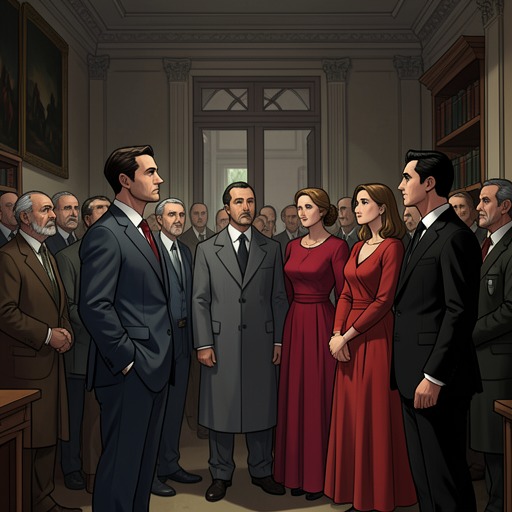
M. de Charlus’s self-deception about his situation
In Search of Lost TimeM. de Charlus’s self-deception is not simply a failure to notice gossip: it is a structure of misreading that lets him take discretion for ignorance and his own hopes for another person’s intentions. At Balbec, he assumes that only a handful of people know about his desire for Morel, while the Verdurins and their guests understand the attachment he explains away. His most revealing misinterpretation comes when Morel responds without enthusiasm to the Baron’s offer to take him home: Charlus reads the young violinist’s reluctance as joy at being claimed as a spiritual son. The contrast between what others know, what they politely conceal, and what Charlus believes gives the episode its comic surface and its sharper account of isolation.
The Conditions of His Blindness
The narrative first explains Charlus’s position through a general reflection on knowledge and recognition. Before a person’s concealed nature has been disclosed, observers may fail to see what becomes unmistakable once an explanation is supplied: understanding does not merely add a fact but changes the field of vision. The narrator recalls how the encounter between Charlus and Jupien made Charlus’s previously hidden character newly legible to him. What had been present all along now seemed to announce itself.
That recognition belongs to a wider account of a stigmatized, secretive social world. Its members may identify one another through shared tastes, habits, dangers, and signs, even when they do not openly acknowledge one another. Secrecy is therefore unevenly distributed: some people know, some suspect, some misidentify, and others remain unaware. The account also stresses that ostracism and public disgrace help shape the community they condemn, while concealment can make its members especially alert to the possibility of recognition. Charlus’s self-deception takes place within this network of partial knowledge; it is not proof that no one sees him, but an inability to imagine how widely others may have understood him.
A Polite Circle and a Private Explanation
On the Normandy coast, Charlus speaks freely about what he calls immoral practices, presenting himself as an impartial observer rather than a person implicated in the subject. He believes the faithful around him do not suspect his own inclinations. Though he knows that several people may be “in the know,” he imagines there are no more than three or four and does not believe any are then on the coast. Even when he suspects that someone has inferred something, he thinks the knowledge vague enough to be neutralized by denying particular details.
His assumptions do not match the social evidence. When he brings Morel’s name into invitations, his hosts may politely accept the various artistic or humanitarian reasons he gives for wanting the violinist present, yet silently substitute one consistent explanation: Charlus is in love with him. Madame Verdurin thanks the Baron for his supposed kindness toward Morel without sharing his understanding of what that kindness means. At La Raspelière, Charlus’s place among the faithful and his access to adjoining rooms with Morel make his position seem secure to him; his hosts’ consideration, however, does not mean that they accept his account of himself. Politeness keeps the discrepancy out of the open while allowing him to mistake tact for belief.
Gossip as a View of the Hidden Side
The narrative presents gossip as an imperfect but consequential form of knowledge. Ski, the maestro, understands the nature of Charlus and Morel’s relationship and asks how long they have been together, while remaining too socially practiced to expose that understanding to them. His conduct contrasts with Charlus’s conviction that no one knows: the truth circulates behind the Baron’s back even as those who possess it continue to treat him courteously.
For the narrator, such talk can overturn the tidy outward picture people hold of one another. Gossip may disclose a hidden relation or an unsuspected corner of social life, turning what seemed settled into something newly legible. The image of the reverse side of a fabric captures the danger for Charlus: he retreats into an imagined, welcoming bower built from the gestures he sees, without realizing that an opposing version of that social world exists beyond his awareness. The aquarium image sharpens the asymmetry: Charlus moves within an environment he believes extends beyond its limits, unaware of the watcher just outside. His blindness is consequently relational. It depends on the gap between the self he imagines others recognize and the self they privately discuss.
The Misreading of Morel
Charlus’s most personal delusion emerges after a reconciliation with Morel. He tells the violinist that when military service ends he must take him back to his father, comparing himself to the Archangel Raphael guiding the young Tobias. The remark also serves as a tentative way to discover whether Morel will agree to accompany him to Paris. Morel’s wry expression gives no clear support to the Baron’s hopeful reading, and Charlus leaves him alone in the café.
Once apart from Morel, Charlus tells the narrator that the young man was delighted by the comparison. He decides that Morel understood the “father” to mean Charlus as a spiritual father, not his father by birth, and imagines that Morel will repeat a prayer asking for the Archangel’s protection. The narrator makes plain the distance between this interpretation and Morel’s visible response: Charlus’s pride and love—or self-love—supply the meaning the violinist has not expressed. Calling the supposed reaction a triumph, the Baron raises his hands and cries, “Alleluia!” His certainty turns a strained gesture into evidence for the relationship he wants.
Narrative Significance and Limits
Charlus’s confidence does not erase the practical pressures of his attachment. Morel later writes desperate, affectionate letters when military manoeuvres take him too far away for a visit, claiming he must end his life because he needs twenty-five thousand francs. Charlus is willing to send the money, but fears that doing so would make Morel independent of him and free to receive favors from someone else. He refuses, and his telegrams take on a dry, cutting tone. The letters and the refusal reveal an unequal bond shaped by Morel’s appeals and Charlus’s fear of losing his hold; they do not confirm the Baron’s grander belief that Morel experiences him as a spiritual father.
The self-deception is therefore both comic and consequential. Charlus’s social world protects him from direct humiliation by withholding what people say in his absence, but that same courtesy leaves him enclosed in a false account of their regard. The novel’s larger reflections on recognition make his error more than a private eccentricity: knowledge of another person is indirect, shaped by signs, rumor, social position, and the desire to believe. Charlus may correctly sense that information is being concealed, yet repeatedly misjudges what others know and what Morel feels. His imagined security persists precisely because the surrounding circle lets him continue to mistake silence for confirmation.