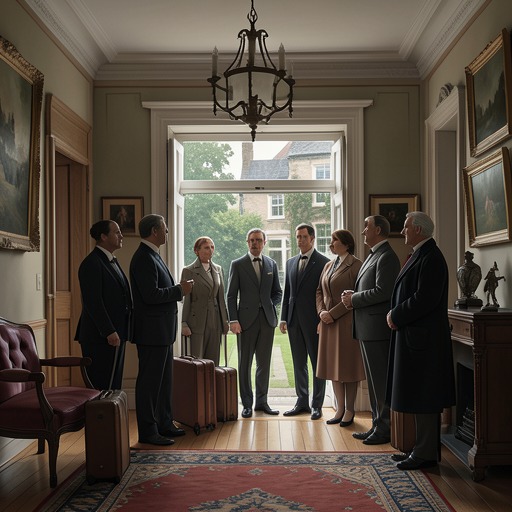
Marquise de Cambremer
In Search of Lost TimeThe Marquise de Cambremer, Legrandin’s sister and the wife of the Marquis de Cambremer, is a socially ambitious woman whose learning does not overcome her longing for aristocratic recognition. At the Verdurins’ rented estate, La Raspelière, cultivated speech, keen attention to social opportunity, and awkward performances of rank meet in a character whose aspirations shape both her relationships and her eventual break with the Verdurins.
Identity and Social Ambition
The Marquise is described as highly cultivated, but her intellectual interests coexist with a persistent effort to improve her social position. At La Raspelière she tells the narrator that Morel interests her and asks him to complete her education; she also professes interest in Brichot, while hoping that drawing Morel into her own circle might bring her closer to Palamède de Charlus. Her questions therefore serve more than a cultural purpose: they are part of a project of forming connections she regards as more distinguished than those available through her girlhood friends.
The narrator presents this effort as a disjunction between thought and social desire. The Marquise reads philosophy and pursues increasingly esoteric music, yet these studies do not redirect her ambition toward an inward or intellectual end. Instead, her pursuit of duchesses and elevated acquaintances remains urgent. Her cultivated manner is real as a style, but it coexists with a social appetite that learning has not subdued.
Marriage and the Visit to La Raspelière
The Marquise arrives at the Verdurins’ dinner reluctantly. She has come at the insistence of her mother-in-law and her husband, partly in the interests of renewing the lease on La Raspelière. Rather than conceal this practical reason, she has joked to her women friends that dining with their tenants might be worth an increased rent. She speaks possessively of the estate as her old home, although she is not presented as having been born there, and imagines the Verdurins’ changes as an intrusion into a place associated with her family.
Her conduct at the dinner reveals the strain between social aspiration and habitual pride. When Brichot is introduced, she means to present him to her husband in the fashionable manner she has observed, but instead says, “I present you to my husband.” The gesture asserts the Cambremer family’s standing, yet her husband bows readily to Brichot, frustrating the effect she intended. Her resentment toward the Verdurins’ alterations to the house and her self-conscious performance of rank make the dinner a negotiation over both property and social precedence.
The Marquise’s view of her husband is also bound up with family expectations. She has adopted the household’s ethos and refers to him by the nickname Cancan, given to him by army messmates because his surname was too long to pronounce. At the dinner, however, she is irritated by his inherited good nature and anticipates that he will be flattered by the Verdurins’ company. Her efforts to appear worldly thus coexist with impatience toward the very amiability that shapes his response to their hosts.
Learning, Taste, and Social Performance
The Marquise’s interest in art and ideas provides her with a vocabulary for distinction, but the narrator emphasizes how readily intellectual fashions can themselves become social signals. She says that she values natural gifts over acquired knowledge, even though the narrator characterizes her own quality as precisely imitated and acquired: at that moment, the idea that knowledge mattered less than originality was itself something one was expected to know. Her claim to prize spontaneity therefore exposes, rather than resolves, the tension between cultivated aspiration and social imitation.
Her preferences in art likewise combine an articulated theory with strict social limits. She admires realism and accepts humble subjects such as Tolstoy’s peasants and Millet’s figures, but the social boundary she most wants to cross is the one separating her from duchesses. The narrator’s contrast is pointed: artistic study does not loosen her fixation on status. Her refinement of expression can make her seem superior to dinner companions, yet it also renders her legible to the narrator as someone shaped by a recognizable social type.
Palamède de Charlus and the Limits of Access
The Marquise is especially pleased when she discovers Palamède de Charlus at the Verdurins’ gathering. She had previously failed to secure an introduction to him, even during her liaison with Swann. His earlier refusal to meet her had followed his public role as a defender of women’s domestic claims and his protection of Odette against other women in Swann’s life. The unexpected encounter at La Raspelière grants the Marquise access she had long sought, and her husband recognizes how much her decision to attend has pleased her.
Her interest in Morel is linked to this opportunity. She hopes that inviting the violinist to her house may help her establish a relationship with Palamède de Charlus, but she disguises that aim by saying that Brichot interests her too. The scene shows her social manoeuvres as deliberate but not all-powerful: access depends on intermediaries, introductions, and the changing alignments of others. Her cultivated talk becomes one means of pursuing connections whose value lies partly in their distance from her existing circle.
Estrangement from the Verdurins
The Marquise later explains the break with the Verdurins as a dispute about the boundary between renting a house and acquiring social intimacy with its owners. She says they were willing to let the Verdurins use La Raspelière, but that the lease did not entitle Madame Verdurin to make a friend of her or to call on her in Paris. She also objects to the Verdurins’ treatment of items and privileges that, in her view, were not included in the agreement. Looking ahead to a visit from an aunt, she imagines the embarrassment of the older Madame Verdurin appearing at one of her days in Paris. The Marquise says that the Cambremers should have handled the arrangement through a lawyer or an agency, rather than allowing property business to become a claim on personal relations.
Her account follows a broader estrangement: by the time the narrator sees the Marquis at a railway stop, he is completely separated from the Verdurins. He nevertheless offers to take the narrator to Féterne, where the Marquise and other hosts would entertain him, and promises to lend him to the Verdurin dinners as well. The contrast preserves the difference between the Marquise’s effort to police social access and her husband’s more accommodating approach. Across the episodes, she appears neither simply as a snob nor merely as a scholar: her cultivated interests, marital setting, and pursuit of elite connection continually meet in a social world where even a lease can become a test of who is entitled to enter whose circle.