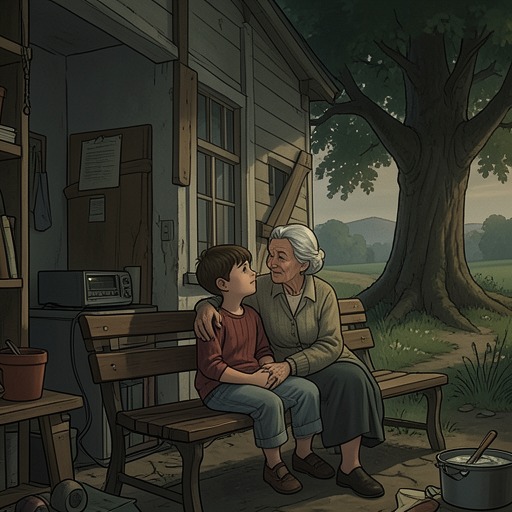
Narrator's grandmother's death
In Search of Lost TimeThe narrator’s grandmother’s death is not fully felt when it happens. More than a year after her burial, a return to the bodily circumstances of an earlier evening at Balbec restores her to the narrator as a living presence—and makes her permanent absence newly undeniable. The episode turns bereavement into a conflict between memory and knowledge: tenderness returns intact, but so does the fact that the person who inspired it can never return. It also shows grief passing into the narrator’s mother, whose mourning alters her appearance and conduct, and later into the narrator’s understanding of other painful revelations.
The delayed return of the dead
On his first night at Balbec, physically fatigued, the narrator bends to take off his boots. The familiar posture and circumstances unexpectedly release an involuntary memory of his grandmother leaning over him on an earlier arrival. The recollection does not bring back the distant, abstract figure he had spoken of since her death; it restores the living grandmother whose attentive presence had once comforted him. The suddenness of that return overwhelms him, and he understands that his earlier apparent lack of grief had not been a true encounter with the person he had lost.
The memory restores not only her face but the narrator’s former self: the grandchild who had needed refuge in her arms and believed that he could wait for her care. For that recovered self, the old evening follows directly after the earlier day at Balbec, without the intervening year. The narrator’s present knowledge cannot prevent the past from feeling immediate, but it changes its meaning. Only when he again feels his grandmother as alive does he grasp that she is dead. His recognition of the loss is therefore belated not because the fact was unknown, but because the emotional reality of the person had not yet been recreated in him.
Tenderness and painful recollection
The recovered affection brings an unbearable contradiction. The grandmother’s love had made the narrator its constant object, yet death has ended the relation that once seemed to give their lives a shared purpose. The memory makes her tenderness present within him at the same moment that it reveals its irrecoverability. Rather than soften that conflict by imagining her merely absent, he insists on experiencing the pain in the form in which it has returned. The suffering is evidence that the memory has become real to him again, not simply a conventional thought about a dead relative.
That return also exposes the narrator’s own past conduct. He remembers how he sometimes displayed or exaggerated his suffering, assuming that her distress would be undone by his kisses. Most painfully, he recalls the occasion when Saint-Loup photographed his grandmother wearing a broad-brimmed hat. Irritated by what he took to be her childish vanity as she posed in flattering light, the narrator made impatient, wounding remarks. He now remembers the contraction of her features and can no longer imagine that later affection could erase the hurt. The photograph, once associated with his criticism of her pose, becomes bound to remorse: he cannot repair the moment, and her death has made reconciliation impossible.
The narrator understands that recalling the injury means injuring himself anew. The dead persist in the living not as independent, unchanged presences but through acts of memory that recreate them, including memories of harm. He chooses not to diminish his pain by speaking to the photograph as if its subject could hear him. Instead, he tries to preserve the involuntary impression in its uncompromised form, hoping that it may disclose some truth about loss. His earlier forgetfulness, by contrast, had been only an absence of thought, unable to restore a real moment of their life together.
A mother becomes her mother’s successor
When the narrator’s mother arrives at Balbec, his newly awakened grief enables him to speak with her as though his sorrow had been present all along. Seeing her in mourning, he recognizes that she too lives with the contradiction between memory and non-existence. Her grief has altered her: the former gaiety has given way to a restrained, imploring manner, as if she fears disturbing the sorrowful presence that remains with her. The narrator is struck by a change he had not perceived in Paris: before him is not simply his mother, but someone who has begun to resemble his grandmother.
The resemblance is more than appearance. The narrator describes the dead as annexing the living: a bereaved daughter can become her mother’s successor, carrying forward the dead woman’s ways and traits. In his mother, the grandmother’s influence appears alongside the fading of qualities associated with her father, including common sense and mocking gaiety. Grief changes what the living permit themselves to express; admiration and regret draw forward features that had already existed but had been balanced by other parts of the self. The grandmother’s continuing influence is thus neither supernatural return nor mere likeness: it takes form through the mother’s transformed conduct and the memories that guide it.
That inheritance is tangible in the things his mother keeps and repeats. She cannot bear to part with her mother’s bag, muff, and clothes, which intensify their physical resemblance, or with the copies of Madame de Sévigné that the grandmother carried everywhere. Letters the mother sends the narrator quote the same writer, as though the words had passed through her mother’s voice. At the beach, she carries her mother’s parasol and walks over the sand her mother had known; afterward she sits there to read the grandmother’s favorite books, the memoirs of Madame de Beausergent and the letters of Madame de Sévigné. Objects, reading, and repeated gestures make mourning into an enacted continuation of the dead woman’s life.
Grief’s different calendars and later returns
The episode distinguishes the date of a death from the time at which its loss becomes emotionally intelligible. The narrator’s grief comes slowly and arrives through involuntary memory; he contrasts it with his mother’s profound, sustained bereavement. His own experience is not presented as equivalent to hers. It is a delayed recognition that helps him see what her tearless gaze has been confronting, while his mother’s mourning has already shaped her daily existence. The two responses reveal different tempos of loss rather than a single standard form of grief.
The grandmother’s death also remains active in the narrator’s later understanding of events. When Albertine tells him of her closeness to Mlle Vinteuil and her friend, the narrator links the revelation to the old scene at Montjouvain, where he had watched without understanding the significance of what he saw. He imagines the stored memory returning as punishment for having allowed his grandmother to die, and the new knowledge opens a more painful phase of suspicion and suffering. The association is the narrator’s own moral and emotional interpretation, not a new fact about the circumstances of his grandmother’s death; it shows how bereavement and guilt persist as a framework through which later experience is read.
That inheritance surfaces again when the narrator, distraught over Albertine, sees his mother enter at dawn in his grandmother’s dressing gown. For an instant, her dishevelled appearance and resemblance make him think of the grandmother’s return; his mother gently identifies the likeness. He takes her head in his arms and admits that he has been unfair in what he said about Albertine. Even as his mother points out the sunrise, the scene of his earlier anguish over Mlle Vinteuil remains superimposed on the view. The grandmother’s absence does not end the episode’s effects: it continues through memory, likeness, remorse, and the altered relationships of the living.