Saint Louis abandons support for Dreyfus
In Search of Lost TimeRobert de Saint-Loup’s retreat from Dreyfusardism is a political reversal shaped by the conflict between his earlier involvement in the Dreyfus case and his identity as a soldier. Swann expects his support; Saint-Loup instead says that he regrets having entered the dispute and would keep clear of it if he could begin again. His withdrawal illustrates how the case’s public divisions could make political conviction answer to institutional loyalty and changing social pressures.
The confrontation with Swann
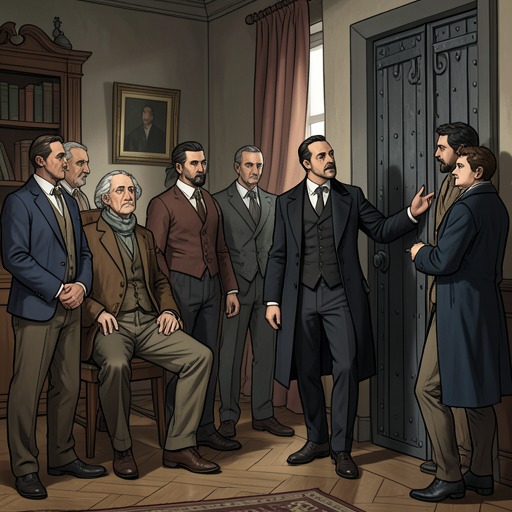
At a gathering, Swann quietly tells Saint-Loup that President Loubet is on their side, adding that he speaks because he knows Saint-Loup is with them wholeheartedly. Saint-Loup immediately corrects him: Swann is mistaken. He calls the affair a bad business, says he is sorry he ever became involved, and insists that it was not his concern. The exchange makes the reversal explicit: Swann’s confidence in his ally meets Saint-Loup’s refusal to continue in that role.
Saint-Loup explains his decision through his military allegiance. He says that he is a soldier and that his first loyalty belongs to the Army. He then leaves to speak with his aunt, though the narrator observes that he goes to Mlle d’Ambresac instead. That detail does not explain his political change, but it places the conversation within a social gathering where political commitments, family connections, and personal encounters overlap.
The pressures behind the reversal
The wider political atmosphere had become more charged. The Duke of Guermantes regards Swann’s support for Dreyfus as a grave breach of social and national expectations, and the narrator contrasts his reaction to Swann with his earlier response to Saint-Loup: the Duke had treated his nephew as a young man who had gone astray, from whom almost anything might be expected until he changed course. The contrast suggests that Saint-Loup’s political alignment was already understood within his family as a departure from its norms.
Saint-Loup’s stated reason is not a newly reported judgment about the evidence in the case, but his sense that a soldier’s primary obligation is to the Army. The episode therefore frames his retreat as a response to competing loyalties rather than as a reasoned account of the trial. The political dispute had also grown beyond a disagreement over the case: anti-Dreyfusard opposition had intensified and acquired a social character, entangling the question with patriotism and the standing of the military.
Swann’s reading of the change
Swann recounts the Prince de Guermantes’s own turn toward doubt about the trial, including his suspicion that grave illegalities had occurred. Swann presents the Prince’s change as evidence of moral uprightness. The narrator points out that Swann had earlier explained political opinions through inherited predispositions, making an exception for intelligence when he considered Saint-Loup a Dreyfusard. Now that Saint-Loup has retreated, Swann assigns moral integrity a role that he had previously given to intelligence.
The narrator treats this shifting explanation as a revealing habit of political judgment: people tend to find admirable causes for the views of those who agree with them, while the grounds of an opponent’s position are explained away. Saint-Loup’s reversal thus serves not only as a change in allegiance but also as a test of how Swann interprets allies and adversaries. Swann still sees the Prince’s conversion as valuable to the Dreyfusard cause, but refuses to let Bloch solicit the Prince’s signature for an appeal on behalf of Picquart, judging that such a request would demand too much of him.
Political change and social influence
Elsewhere, the Duke of Guermantes undergoes his own reversal after meeting three women at a spa who support a new trial and challenge his arguments. He returns to Paris a Dreyfusard, a change the narrator relates to the influence of his new social circle. The episode broadens the novel’s account of political shifts: conviction can be reworked through personal contact, social imitation, and persuasion, rather than following a simple progression from evidence to conclusion.
These reversals do not amount to one uniform movement. Saint-Loup withdraws because he places the Army first; the Duke moves toward Dreyfusardism after sustained encounters with persuasive companions; and the Prince’s doubts emerge from his own reflections on the trial. Their different paths make political allegiance appear contingent on the social and personal relations through which a public crisis is experienced. In Saint-Loup’s case, the decisive statement is not that the dispute has been settled, but that he would now prefer never to have entered it.