Saint-Jean-de-la-Haise Church
In Search of Lost TimeSaint-Jean-de-la-Haise Church is an isolated, little-visited monument that Albertine chooses as the subject of her return to painting. The journeys to it reveal as much about the narrator’s desire to manage intimacy as about the church itself: first treated as a remote destination that demands separation, it becomes one stop in a motor-car circuit whose speed redraws the map of the coast. When the narrator later finds Albertine painting there, the church’s carved angels, her brushwork, and the surrounding quiet make it a place where artistic attention briefly takes precedence over his plans for her company.
Setting and Approach
The church is little known even locally, difficult to find without a guide, and laborious to reach in its isolation. It lies beyond Quetteholme, more than half an hour from Epreville station, after the last houses of the village have been left behind. The distance is not merely a matter of mileage: the church belongs to a secluded landscape reached by a journey through country lanes, in contrast to the everyday routes and settlements nearby.
The narrator and Albertine first set out in the dog days, taking the one o’clock train toward Grattevast. The heat makes the outing physically taxing: Albertine grows hot in the carriage and hotter still on the long walk across country, while the narrator worries that she will catch cold when she later has to sit in the damp hollow where the sun does not reach. On subsequent outings, he arranges for a carriage from a Balbec livery stable, both to spare her some discomfort and to provide the degree of comfort he knows she appreciates.
Their route through the forest of Chantepie offers a contrast to the exposed heat. Birds, including sea-birds, remain invisible among the trees, their calls creating an impression of repose. The narrator listens beside Albertine in the carriage, but the rare sight of a bird moving from leaf to leaf does not seem to explain the music that comes from it. The passage makes the approach to the church an exercise in looking and listening, in which the living landscape can resist easy interpretation just as art can.
Albertine’s Painting and the Church’s Art
Albertine has decided to take up painting again, and Saint-Jean-de-la-Haise is the subject of her first attempts. She wants to see monuments and pictures with the narrator, but he believes that artistic sensation cannot be communicated while he speaks or accompanies someone else: he experiences beautiful things only alone, or while pretending to be alone. He therefore tells her that he must leave her at Quetteholme and return later, claiming he has calls to make at La Raspelière or elsewhere. His arrangement allows her to paint while keeping their time together under his control.
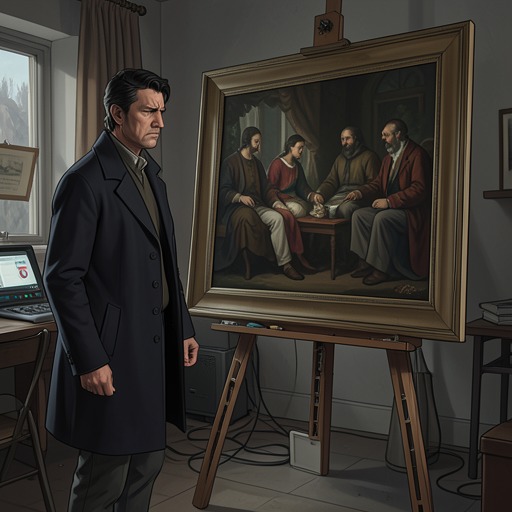
When the narrator eventually gets out at Quetteholme and runs down the sunken lane, he finds Albertine painting in front of the church. Its pinnacles are described as thorny and red, flowering like a rose bush. The tympanum, by contrast, is smooth; angels seem to bloom across the stone, holding candles as they continue a thirteenth-century ceremony before the couple from the twentieth century. Albertine works to capture those figures on her prepared canvas, using broad brushstrokes in an effort to follow the noble rhythm Elstir had taught her to recognize in the angels.
The scene gives the church a double presence: a building with a particular medieval form, and an image being remade through Albertine’s act of looking. Her painting is not presented simply as a copy of its decoration. She tries to translate into brushwork a rhythm she has learned from Elstir, bringing artistic instruction into contact with the church’s carved figures. When she has finished, she gathers her materials, and she and the narrator walk back leaning on one another. The church remains behind, quiet, as if it had never seen them, while the brook continues its perpetual murmur.
Distance Recast by the Motor-Car
The narrator’s original separation of the church from other destinations does not last. When Albertine complains that nature has placed Saint-Jean-de-la-Haise in one direction and La Raspelière in another, leaving a visitor imprisoned for the day at whichever place has been chosen, the narrator responds by arranging a motor-car. He keeps this plan from her until she comes to call for him and hears the engine outside the hotel. She is delighted to discover that the car is for them; the narrator brings her to his room and gives her the toque and veil he has hidden for the outing.
The car makes the day’s geography newly negotiable. Its driver says Saint-Jean can be reached in twenty minutes and that the excursion can continue to La Raspelière, a further thirty-five minutes from Quetteholme. A route that the narrator had represented as requiring separate days can now be combined in a single afternoon. The contrast is not just between walking and motoring: the vehicle changes what the distances mean, turning places that had seemed mutually inaccessible into neighboring stops.
The narrator makes the point explicitly through the relation between space and time. The miles or kilometres used to express difficulty become false when the difficulty decreases; altered travel time changes the landscape as art changes a view. The villages of Douville, Quetteholme, Saint-Mars-le-Vieux, Saint-Mars-le-Vêtu, Gourville, Balbec-le-Vieux, Tourville, and Féterne had been sealed into distinct days, much as Méséglise and Guermantes had once seemed impossible to see on the same afternoon. The motor-car gathers their towers, steeples, and old gardens around tea-time, as if the neighboring wood had drawn back to reveal them.
The new mobility also makes the church part of a social itinerary. On the first motor outing, Albertine accompanies the narrator toward La Raspelière rather than being left to paint while he visits elsewhere. Aimé admires her smart clothes and their unusual means of transport; when the chauffeur mistakenly says he is engaged for Mlle Simonet and cannot take the narrator, Aimé corrects him and boasts of the passenger’s appearance. The change in travel is therefore also a change in how the excursion is displayed and shared: what had been an isolated artistic destination becomes part of a conspicuous journey together.
Return and Aesthetic Judgment
On a later visit, the narrator again leaves the car at Quetteholme and runs down the sunken lane to find Albertine at her easel. The church’s isolation is renewed in the walk itself, even though the motor-car has made the broader landscape easier to traverse. After they leave, the car takes them home by another route, and they stop to look at the church at Marcouville-l’Orgueilleuse. Its partly new, partly restored fabric prompts Albertine to object that she does not like it because it has been restored. She recalls Elstir’s praise of the inimitable beauty of old stone and shows, in the narrator’s view, a sure architectural taste.
That contrast clarifies what Saint-Jean-de-la-Haise offers in the episode. Its medieval angels and ceremonial carvings invite Albertine’s attentive, technically guided work, while the later encounter with a restored church allows her to distinguish old material from modern intervention. The narrator’s account moves between the church as a physical destination, the image Albertine makes of it, and the judgments through which she learns to see architecture. At the same time, the place’s changing accessibility demonstrates how travel can revise an imagined landscape: the church remains remote in character, but no longer has to consume the whole day.
Narrative Significance
Saint-Jean-de-la-Haise Church gathers together two different kinds of distance. Its isolation tests bodies and plans through heat, walking, and the dampness of the hollow; the motor-car then converts that practical distance into a flexible measure of time. Yet increased speed does not erase the church’s distinctiveness. Albertine still approaches it on foot with her painting materials, and the narrator still finds her there in a quiet scene that resists the car’s momentum.
The episode also places artistic perception beside the narrator’s habits of possession and concealment. He knows Albertine wants to share artistic experiences but insists that such experiences require solitude; he first arranges to leave her, then secretly prepares a motor-car and clothes for a joint excursion. The church thus becomes a point around which his competing wishes—allowing her independent attention and keeping her close—take practical form. Its angels, her deliberate brushstrokes, and the brook’s uninterrupted murmur offer a measure of continuity, while the narrator’s routes and arrangements continually alter the relations among place, time, art, and companionship.