Swann’s terminal illness
In Search of Lost TimeSwann’s terminal illness makes approaching death visible in his altered body, yet its deepest narrative force lies in the changes it exposes around him: the narrator’s vanished youthful awe, the social gaze fixed on a dying man, and the return of a Jewish solidarity shaped by illness and the Dreyfus case. Swann’s decline unfolds in company, under observation, and alongside his stubborn wish to live long enough to see political justice done; elsewhere, the narrator’s belated grief for his grandmother reveals how differently death may be felt before and after memory restores the lost person to the heart.
The Illness Made Visible
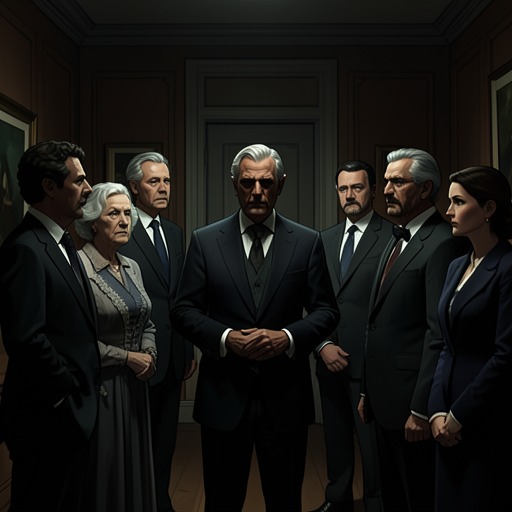
When Swann enters the vast reception room, the narrator feels pleasure at seeing him, but that pleasure is mixed with sadness. The other guests seem fascinated by signs of approaching death written on Swann’s face. Their attention is not simple compassion: it carries curiosity, cruelty, relief, and anxious self-scrutiny. The room turns illness into a spectacle, with Swann’s body silently announcing what its onlookers would rather contemplate at a distance.
His face has been radically altered. Illness has eaten away his cheeks until they seem almost flat, like scenery whose depth depends on an optical illusion. Without them, his nose appears enormous, swollen, and crimson; the narrator also notices the effects of arteriosclerosis and the thinning of Swann’s hair. The description does not treat decline as an abstract diagnosis. It records the visible particulars through which a familiar face becomes strange, and through which the prospect of death intrudes into a social gathering.
The change is not confined to a single evening. Only a few hours earlier, Swann had been in the Duc de Guermantes’s study; by the reception, he looks markedly worse. The narrator wonders whether a painful scene with the Prince had upset him, then recognizes that illness itself can make ordinary demands excessive: a tired man exposed to the heat of a crowded drawing room may alter dramatically within hours. Bodily decline has its own pace, visible in abrupt shifts that can be mistaken for the consequence of some social crisis.
The Social Gaze and the Changed Swann
Swann’s appearance brings the company’s awareness of mortality into the open, but it also unsettles the narrator’s private history with him. As a boy, the narrator had invested Swann with mystery. Seeing him in the Champs-Élysées in his silk-lined cape could make the narrator’s heart race; merely approaching the door of Swann’s home had once filled him with alarm. Now the thought of speaking with him produces no comparable nervous response. Swann has changed physically, but the narrator is struck even more by how thoroughly his own relation to Swann has changed.
That contrast gives the encounter its particular sadness. The narrator still finds Swann cultivated and worth seeing, yet the aura that once made him seem almost inaccessible has disappeared. What illness makes plain in Swann’s body, time has already done to the narrator’s earlier self: the old intensity survives as something he can remember but no longer inhabit. The scene therefore measures two transformations at once, the visible erosion of a sick man and the quiet extinction of an earlier fascination.
The narrator is trying to cross the room to speak with Swann when Saint-Loup interrupts. Later, when the narrator reaches him, Swann’s exhaustion is extreme: his body seems like a retort for observing chemical reactions, his face is mottled with tiny Prussian-blue spots, and it gives off an unpleasant smell that recalls a school science classroom after experiments. The clinical, laboratory-like imagery makes the body seem at once still present and already estranged from ordinary life. Yet Swann remains able to speak with the narrator and to direct him elsewhere briefly, a social gesture that persists amid physical debility.
Illness, Jewish Identity, and Political Hope
The narrator connects Swann’s changing appearance with a change in identity. He suggests that the physical type associated with Swann’s Jewish ancestry has become more pronounced, while a moral solidarity with other Jews—apparently forgotten for much of Swann’s life—has been awakened by mortal illness, the Dreyfus case, and antisemitic propaganda. The illness does not appear in isolation from public life: it coincides with a political crisis that makes communal belonging newly consequential to Swann.
The narrator casts this altered Swann in the image of a prophet. In his account, a man of refinement and social delicacy may carry latent possibilities of both the cad and the prophet, ready to emerge at a decisive moment; Swann, he says, has reached the age of the prophet. The metaphor is the narrator’s interpretation, not a neutral medical description. It renders the illness a threshold at which physical exposure, political solidarity, and a changed sense of self converge.
Swann does not speak as though death has already emptied the future of meaning. He tells the narrator that his condition is not as bad as that, while acknowledging that he is worn out and resigned to whatever may await him. What troubles him is the possibility of dying before the Dreyfus case is resolved. He believes Dreyfus’s opponents are powerful and widely supported, even as he expects their eventual defeat; he wants to live long enough to see Dreyfus rehabilitated and Picquart become a colonel. His hope is specific and political: continued life would allow him to witness vindication.
Mortality and the Work of Memory
Swann’s visible deterioration forms a pointed counterpoint to the narrator’s loss of his grandmother. At Balbec, the narrator’s memory suddenly restores her as a living presence, and only then—more than a year after her burial—does he fully feel that she is dead. The contrast is not simply between a dying person and a bereaved survivor. Swann’s body makes approaching death legible to a room of spectators, whereas the grandmother’s death becomes emotionally real to the narrator through an involuntary return of the tenderness he had failed to feel at the time of her burial.
The recollection brings together incompatible certainties: the grandmother’s love remains vivid within the narrator, while her absence is irreversible. He experiences the recovered affection as if it had been made for him alone, yet the fact of her death transforms that once intimate bond into a relation that chance, rather than destiny, allowed to exist. The illness and death in this narrative are therefore not interchangeable experiences. Swann’s disease is registered in changing features, exhaustion, and the awareness of limited time; the narrator’s grief arrives belatedly, as memory restores a past self and makes loss newly knowable.
The mother’s mourning deepens that contrast. At Balbec, the narrator sees her in black, carrying her mother’s parasol and walking across the beach with timid, reverent steps. She has brought her grandmother’s bag, muff, and clothing, as well as the books her mother loved, especially the works of Madame de Sévigné and Madame de Beausergent. These belongings matter not as decorative relics but as objects through which the daughter sustains the dead woman’s habits and presence. In the narrator’s account, the dead continue to act on the living because remembrance can draw forth qualities and attachments that ordinary life leaves dormant.
The juxtaposition clarifies the different temporalities of the two states. Swann’s illness makes the prospect of death immediate to those who look at him, even as he holds to the hope of a future political outcome. The grandmother’s death, by contrast, is a settled fact that the narrator initially fails to experience as such; only the returning sensory context of Balbec reunites him with the self who loved her and makes the loss pierce that renewed bond. Between the dying face and the resurrected memory, the narrative shows that mortality is not known by sight alone: it becomes intimate through the changing, sometimes delayed work of recognition.