The Verdurin ‘little nucleus’
In Search of Lost TimeThe Verdurin ‘little nucleus’ is the intimate, tightly governed circle Madame Verdurin gathers around her salon. More than a group of guests, it is a social order with its own tests of loyalty and taste: the hostess demands regular attendance, decides who counts as one of her kind, and tries to make people, art, and even the local countryside belong to the circle. Its comedy lies in the mismatch between its claim to be a refuge for genuine intelligence and its reproduction of the exclusions and status games it professes to disdain.
Membership and the Cost of Belonging
The circle’s most reliable member is Princess Sherbatoff, whose fidelity seems to Madame Verdurin almost impossibly complete. Estranged from her family and exiled from her native land, the Princess has few connections beyond Baroness Putbus and Grand Duchess Eudoxie; she visits those households only at hours that keep her apart from their other friends. By contrast, she lives wherever the Verdurins live, follows them on holiday, and treats them as her family. Even New Year’s Eve does not interrupt her attendance: when Madame Verdurin asks whether she will stay the night, the Princess makes clear that she could do so on any day of the year, since the following day is one for remaining at home with family and the Verdurins are hers.
This devotion answers a recurring anxiety in Madame Verdurin’s rule. Even her most assiduous followers may travel, fall ill, perform military service, or leave to attend a dying parent. She reproaches them by casting herself as the sole authority her “legion” must obey, and invokes the demand that a follower leave father and mother for her. The language turns ordinary obligations into tests of allegiance. The Princess’s unusual constancy is therefore not merely affection; it supplies the hostess with an ideal member against which the absences of everyone else can be measured.
Membership also operates through exclusion. Madame Verdurin can denounce a person as a bore, dismiss a rival’s taste, or refuse entry to someone whose presence threatens the circle’s preferred account of itself. Her claim to welcome people of “real intelligence” is thus inseparable from her power to decide who qualifies. The little nucleus offers belonging, but on terms set by its hostess.
A Circle That Claims to Recognize Its Own
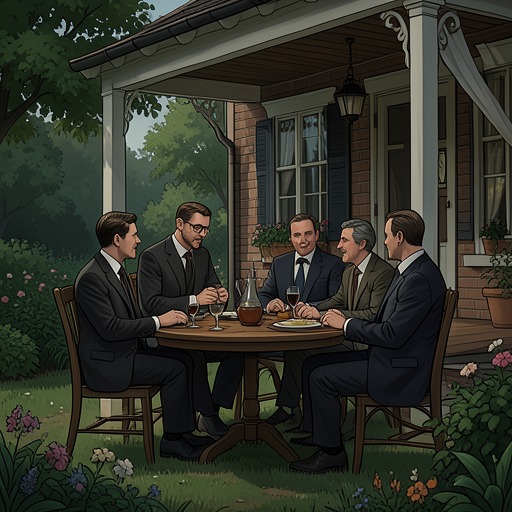
At a dinner with the Cambremers and Baron de Charlus, M. Verdurin tries to establish an affinity with his aristocratic guest by declaring him one of the people who are “really of our sort.” He distinguishes this fellowship from mere social rank: some people practise the arts without belonging to the group, while a virtuoso such as the recently deceased Dechambre could play with great force and still, in M. Verdurin’s judgment, not be one of them. Brichot is excluded by the same standard, while Morel and Madame Verdurin are counted in. Artistic work alone is not enough; membership depends on an asserted sensibility that the hosts claim to recognize immediately.
Charlus initially misunderstands the phrase as an allusion to a different kind of shared identity. M. Verdurin’s confidence therefore exposes how unstable the group’s vocabulary can be: the same declaration of being “one of us” carries distinct meanings for speaker and listener. The moment is comic, but it also reveals the circle’s dependence on interpretation. Its boundaries are not established by a formal list; they are made and remade through hints, judgments, and the assumption that insiders can recognize one another.
The group’s judgment of artists likewise combines aesthetic conviction with personal grievance. Madame Verdurin disparages Elstir as a dutiful painter unable to leave his work, and elevates Ski, whose freedom to follow his fancy she presents as the mark of greater talent. Yet her treatment of Elstir’s wife makes the salon’s exclusions unmistakable. Before the marriage, Madame Verdurin tried to separate the couple by telling Elstir that the woman he loved was stupid, dirty, immoral, and a thief. The attempt failed, and Elstir broke with the salon. Later, Madame Verdurin claims she will not open her doors to a woman she calls a trollop, while also insisting that Elstir is out of date and can no longer draw. Her aesthetic verdict and her personal hostility reinforce one another: the language of taste gives exclusion a respectable explanation.
Patronage, Influence, and Social Performance
The circle’s reach is practical as well as conversational. Madame Verdurin wants guests to travel by the same trains and arrive at the times when her carriages can meet them. She fears that people who come independently might claim they could find no carriage at Douville-Féterne, or be unwilling to make the steep climb to La Raspelière on foot. Her rules of arrival turn transport into a measure of participation: to enter the circle’s gathering is also to accept its arrangements.
That influence can extend into patronage. After Charlus’s encounter with Jupien, he recommends the Jupiens to Madame de Villeparisis, the Duchess of Guermantes, and a brilliant clientele whose patronage makes the young seamstress’s position increasingly lucrative. He also retaliates against ladies who resist or delay their submission to his influence. This is Charlus’s power, not a policy formally administered by the Verdurins, but the episode illuminates the social world in which the salon operates: access, recommendation, and reprisal can shape livelihoods as well as invitations. The circle’s connections matter because they link private allegiance to public advantage.
The group’s claim to be above social distinctions is equally performative. M. Verdurin tells Charlus that middle-class minds care about such trifles, whereas artists and people “of our sort” do not. Yet he is eager to explain the distinctions he has just dismissed, and to demonstrate that he understands the place society assigns a man of title. Madame Verdurin, too, sorts guests by whether they are entertaining, intelligent, or tedious, and worries that fashionable society will not feel at home among her regulars. The salon rejects conventional rank in speech while continually arranging its own hierarchy of taste, usefulness, and access.
Beyond the Drawing Room
Madame Verdurin’s social claim reaches into the landscape around La Raspelière. After lunch, she sends guests on excursions to nearby beauty spots, as though the scenery were an annex of her house that visitors would not have known without her hospitality. The outing is designed to complete the meal: once guests have been carried out in carriages, the fresh air and views become part of the entertainment. What appears to be a hostess’s extravagant sense of ownership also has a basis in experience. The Cambremers, despite living in the district, often follow familiar routes; M. Verdurin can take visitors through a gap in a fence or along a narrow path that cannot accommodate a carriage, and reward them with views their hosts might not have found.
Madame Verdurin’s criticism of the Cambremers’ garden and excursions is therefore both possessive and perceptive. She insists that La Raspelière is only becoming what it should have been now that it shelters the little nucleus, and that its owners do not truly know the surrounding country. The garden itself gathers several possible excursions into a series of viewpoints: from different benches one sees Balbec, Parville, or Douville, and a path leads from a nearer prospect to a wider view of the sea. By absorbing these views into the salon’s hospitality, the Verdurins turn landscape into another form of cultural property. The circle does not simply meet in a place; its host claims to teach her guests how to see it.
Exclusivity, Fracture, and the Circle’s Meaning
The little nucleus is held together by an opposition between the supposedly insightful insiders and the people who cannot appreciate them. Madame Verdurin imagines that placing society people beside people of genuine intelligence would make the former seem like one-eyed men in a kingdom of the blind, while also paralyzing the less confident guests. She considers arranging special evenings for the bores so that the circle can enjoy its own members without interference. The fantasy of protecting a singular gathering thus tends toward a sharper separation: outsiders are not merely unwelcome but are assigned a different, deliberately inferior social space.
The narrator’s experience of Brichot’s conversation reveals how this boundary can distort judgment. The narrator values the etymologies Brichot shares, including details that other guests dismiss or ridicule, and recognizes that such impressions may appear insignificant or foolish to people whose standards differ. Because the narrator is not one of the little clan, the salon’s apparent friendliness toward Brichot does not straightforwardly disclose its real attitude. In a group, conversation can be heard through a specialized, almost perverse facility for detecting faults invisible to the uninitiated. Belonging changes what counts as wit, just as exclusion can leave a sincere response looking naïve.
The Verdurin ‘little nucleus’ is consequently both a source of genuine affiliation and a machinery of social discipline. The Princess’s loyalty gives the group the warmth of a chosen family; the hostess’s demands, aesthetic verdicts, and logistical arrangements make that family conditional. Its insistence that true fellowship lies beyond conventional society does not free it from hierarchy. Instead, it invents a smaller hierarchy of its own, extending from the dinner table to artistic reputation, patronage, and the countryside itself.