The grand hotel as theatre
In Search of Lost TimeThe grand hotel as theatre is the narrator’s governing image for the Grand Hotel at Balbec: not merely a luxurious setting but a stage whose guests, employees, and visitors continually enact social roles. The analogy gives the hotel’s daily routines the scale of a performance, yet also makes visible the labor and unequal relations behind its spectacle. The narrator is at once a spectator of the scene and one of the people drawn into it.
A hotel arranged as a stage
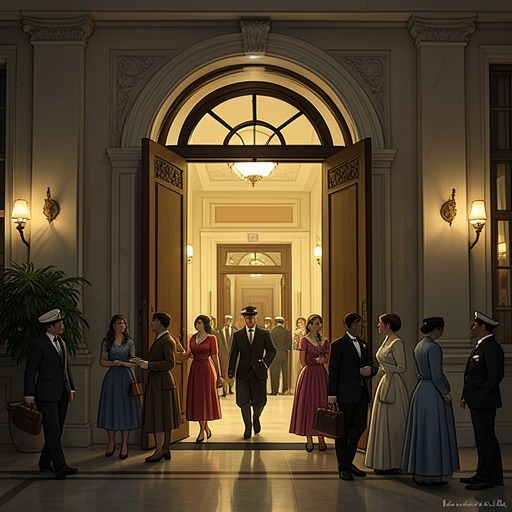
The hotel seems to contain a cast large enough to fill a theatre “to the flies.” Its visitor may imagine himself a spectator, but the performance does not remain at a distance: the guest’s own life unfolds among the stage’s splendors. A tennis-player in a white flannel blazer receives his letters from a porter in a blue frock-coat trimmed with silver braid; if he takes the lift, its attendant is costumed no less richly. The guest’s ordinary movements become part of an elaborate public display.
The stage has its own population and choreography. Corridors gather chambermaids and female couriers, while the ground floor is dominated by young male employees. At the hotel doorway, especially around tea-time, pages assemble like a chorus. Their movements are described as respectful and decorative, yet purposeless: apart from approaching an important guest now and then, they interweave their daily routines without any clear work to perform. The narrator compares them to the young Israelites in Racine’s Athalie and wonders whether he is entering a hotel or the Temple of Solomon. The classical allusion magnifies the scene while making its apparently solemn order seem conspicuously theatrical.
The audience inside the performance
The visitor is not simply watching other people perform. The hotel’s formal service brings him into the action, with attendants, porters, and lift-boys furnishing the roles that make his own position legible. Even an exchange that appears private can become a small performance governed by rank and expectation. The theatrical model therefore describes not just the building’s sumptuous appearance but its social organization: people occupy parts, recognize one another’s standing, and act within a shared choreography.
The narrator’s encounters elsewhere show how readily this performance extends beyond the hotel. At a gathering hosted by the Princess de Guermantes, a usher’s announcement turns a guest’s name into a public event. The usher recognizes the Duc de Châtellerault and announces him with a full princely style; when the narrator is announced, the same booming ritual makes him dread the attention it will attract. The contrast makes social ceremony resemble staged entrance: a person’s reception is shaped by the name and status proclaimed before the assembled company.
At another gathering, Mme de Souvré’s apparent kindness functions as careful social direction. She signals that she remembers the narrator from the Duchesse de Guermantes’s circle, then seems to introduce him to the Prince de Guermantes while arranging the gesture so it cannot commit her. Her influence depends on an ambiguous performance, visible to the petitioner but deniable to the person whose favor is sought. Such scenes help clarify the hotel’s theatrical logic: social life is made of gestures that both communicate and conceal.
Service, patronage, and the backstage
The spectacle depends on employees whose working lives are not as free or decorative as their appearance suggests. The hotel staff have been transferred from resorts including Biarritz, Nice, and Monte-Carlo; they are not locals, even where the surrounding community knows the Cambremers well. The narrator’s contrast between the hotel’s imported staff and the familiar people of the district shows that the hotel’s stage is assembled from a mobile service workforce.
The lift-boy’s anxiety makes the unequal terms of one relationship especially plain. The narrator is accustomed to slipping him five francs on a journey upstairs, but, because Albertine is present, omits the tip. The boy interprets the omission as a sign that the narrator will never reward him again, and the narrator recognizes that the boy’s habitual smiles may not signify the personal devotion he had imagined. A small interruption in the ritual exposes its material basis: apparent affection is entangled with money, dependence, and the employee’s fear of losing a source of income.
Aimé occupies a more complicated position between employee and theatrical manager. He supervises young hotel workers and helps arrange a protégé’s advancement, maintaining relations with the hotel director so the young man might become an under-waiter or take charge of tables. M. Nissim Bernard returns to Balbec in part to see this favored server, whose appearance carrying fruit or cigars at lunch becomes the expected entrance of the object of his affection. Bernard’s annual visit combines attachment to the coast and its view with a routine of watching the young man at the hotel; he resists a cellar post for his protégé because it would keep him from appearing in the dining room. In this strand of the hotel’s theatre, the stage is sustained by access, promotion, and the distribution of attention.
Desire and role-playing
The theatrical image also frames relationships in which the hotel serves as a setting for private aims concealed within ordinary service. Bernard’s relatives misread his annual returns as a preference for the coast or an eccentric dining habit; he himself does not fully recognize how much his affection for the beach and view contributes to his attachment to keeping a young server near him. His haste to arrive for lunch, and his dread of an illness that might confine him at home, give the daily hotel routine the force of an anticipated encounter. The dining room is simultaneously a place of public service and the scene where he expects to see the person he favors.
M. de Charlus’s arrival with Morel at a Verdurin dinner is another performance of role and feeling. In the doorway, Charlus’s desired image of himself as virile and cold gives way to marked deference toward his hostess; the narrator attributes this shift to the shyness that makes habitual politeness surface beneath a cultivated pose. The moment is not at the hotel, but it echoes the same dramaturgy: public manners can disclose a role that the person’s preferred self-presentation tries to suppress. The grand hotel as theatre thus belongs to a broader account of social life, in which entrances, uniforms, favors, and gestures reveal how unstable the boundary is between a person’s part and the relations that sustain it.
The theatrical image and social knowledge
The comparison does more than turn the hotel into an attractive spectacle. It directs attention from luxury toward the organization behind it: the attendants who propel the lift, the staff recruited from other resorts, the tip that changes the meaning of a smile, and the patronage that determines where a favored employee may work. The hotel’s visible elegance depends on service labor and unequal access, even as the employees themselves become part of its display.
At the same time, the narrator’s theatrical language insists that no observer is wholly outside the scene. Guests watch one another, but they also rely on the hotel’s ceremonies and staff to play their own parts. The analogy therefore joins spectacle to participation: the Grand Hotel at Balbec is a stage where social rank is performed, private desire travels through public routines, and the apparent unity of the show rests on many distinct interests.