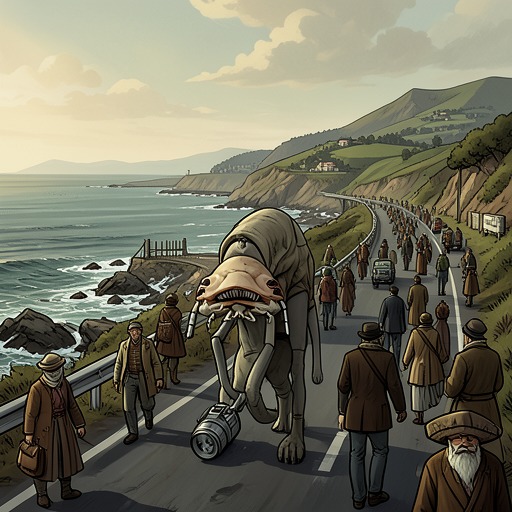
The motor car and the perception of space
In Search of Lost TimeThe motor car and the perception of space are linked through a paradox: the car makes distant places practically close and strips them of some of the mystery created by slower travel, but its moving viewpoint also reveals the landscape as newly intricate and discoverable. In the narrator’s journeys with Albertine, this altered mobility changes not only travel time but the imagined geography of the Balbec district, bringing places once segregated in memory and routine into a single afternoon’s view.
Distance Recalculated
On the way to La Raspelière, the driver explains that Saint-Jean-de-la-Haise can be reached in twenty minutes and that Quetteholme and La Raspelière are only thirty-five minutes apart. The narrator had thought of the church excursion and the visit to the Verdurins as journeys belonging to different days and directions. Once the car sets off, covering twenty paces in a single bound, that division gives way to practical possibility: both destinations can be visited in one afternoon. Albertine is astonished less by some radical alteration of physical reality than by the collapse of the distances she had taken for granted.
The episode leads the narrator to treat distance as relational rather than fixed. Miles and kilometres, he argues, become misleading measures when the difficulty of reaching a place changes. A village that seemed to inhabit another world can become a neighbour in a landscape whose dimensions have been rearranged by speed. The car therefore changes more than the rate of movement: it makes the traveller revise what counts as near, far, separate, or reachable, and it gathers places formerly divided by habit into the same itinerary.
This new geography has its own names and landmarks. Douville and Quetteholme, Saint-Mars-le-Vieux and Saint-Mars-le-Vêtu, Gourville and Balbec-le-Vieux, Tourville and Féterne had seemed sealed in distinct days, just as Méséglise and Guermantes had once seemed impossible to see in the same afternoon. The car brings their towers, steeples, and old gardens together around tea-time, as though a giant in seven-league boots had released them from separate compartments. The places have not moved; what changes is the scale of the traveller’s world and the sequence in which its parts can be experienced.
From Enchanted Isolation to Accessible Country
Before the car reorganizes the district, the narrator’s sense of place is shaped by slow, restricted routes. On the old road to Beaumont, Mme de Villeparisis’s carriage climbed at a crawl beneath old trees, reached a hill from which the sea and woods could be seen, and returned by the same road without passing a village or country house. Because the journey led nowhere else, Beaumont acquired a kind of extraterritoriality in his mind: he knew it belonged to the same district as Balbec, yet could not place it in relation to ordinary routes or other settlements. Slowness and isolation had given the hill a special, almost self-contained existence.
The motor car punctures that separation. Passing through Incarville and descending a by-road towards Parville, the narrator glimpses the sea from a natural terrace and recognizes Beaumont before the chauffeur can name it. The place he had imagined as remote turns out to lie close to Parville, within two minutes of it by the little train. Like a person whose mysterious distinction disappears on discovering a familiar family connection, Beaumont loses its exceptional status and takes its place in the district. The revelation unsettles the narrator: a place’s remoteness, he realizes, can depend less on geography than on the habitual route by which it has been approached.
The contrast is also between two forms of access. The railway journey from Paris to Balbec had made arrival at the station feel almost magical: the station condensed the town into its name and seemed to promise access to a place still held apart from ordinary life. A motor car does not deliver the traveller in that theatrical way. It takes him behind the scenes, into streets, where the driver may have to ask an inhabitant for directions. What it removes is the illusion of a town as a single, ideal destination, untouched by the contingencies of everyday movement.
The Moving Viewpoint
The loss of mystery is not the whole effect. A motor-car journey can be uncertain and indirect: the chauffeur gropes for the way and sometimes retraces his tracks. As the car circles nearer, perspective makes a castle seem to dance with a hill, a church, and the sea; the approaching town appears to dart away in every direction, huddling beneath its old foliage, until the car swoops down upon it in the valley. This mobile, unsettled view replaces the railway’s apparently magical arrival with a sequence of changing angles, in which the destination is approached, lost, and found again.
The narrator regards this as a compensation for the car’s homelier mode of progress. A railway station can preserve the destination as an idealized name, but the car lets the traveller feel that he is discovering and pinpointing the place himself. Its circling and corrections make visible the relation between a site and the surrounding land; the journey becomes an exploration of the earth’s geometry and proportions, not simply transit between endpoints. The vehicle thus diminishes one kind of enchantment while producing another, grounded in the gradual, searching apprehension of a particular place.
This transformation appears in the view from La Raspelière as well. Its garden contains a series of benches known as “views”: one looks towards Balbec, another towards Parville or Douville, and each position frames a different horizon. A bench set farther back offers foreground foliage and an immense prospect; a path to the next opens onto the whole amphitheatre of the sea, where waves can be heard. The organization of these vantage points makes landscape itself a set of situated perspectives. The motor car’s moving view extends the same principle beyond the garden, altering the observer’s position and, with it, the apparent dimensions and connections of the countryside.
Landscape, Memory, and Embodied Travel
The changing perception of space is inseparable from bodily conditions, weather, and memory. In the heat of the dog days, the narrator and Albertine take the one o’clock train towards Grattevast for her painting excursion to Saint-Jean-de-la-Haise. The hot carriage and the long walk across country make him fear that she will catch cold later in the damp hollow where sunlight does not reach. He arranges a carriage from a Balbec livery stable so that she can travel in greater comfort, and they take the forest road through Chantepie to escape the heat. Here mobility is not an abstract measure: it responds to temperature, fatigue, and the bodily strain of reaching a secluded church.
On another journey, the landscape’s appearance is changed by season and by memory. After escorting Albertine towards Epreville on a cold, rainy day, the narrator takes the road he had travelled with his grandmother. Where he remembers the green leaves and arrangement of apple trees in August, he now sees them in luxuriant pink blossom, their branches set against the sea and a vivid blue sky. Rain then draws a grey net across the horizon, but the blossoms continue to hold their color in the icy wind. The same district is not a stable picture: season, weather, route, and personal recollection give it successive forms.
The narrator’s remembered journeys also make the land available through art. Riding along a wooded cliff path once praised by the Verdurins, he recognizes the rocky marine landscape from Elstir’s watercolours, “Poet meeting a Muse” and “Young Man meeting a Centaur.” The painted scene transports the actual path beyond the familiar world; for a moment, the remembered images make a mythological encounter seem possible. The motor car’s reconfiguration of place belongs to this broader account of perception: routes and views are not merely recorded but continually remade by memory, artistic vision, season, and the traveller’s changing position.
Practical Mobility and Hidden Connections
The car also organizes social life and practical arrangements. The narrator can use it to move between Albertine’s painting excursion and the Verdurins’ gathering at La Raspelière, and the vehicle makes that combination seem easy where it had seemed impossible. Mme Verdurin’s own excursions turn travel into part of entertaining: after lunch, guests may be taken, whether willing or not, to local beauty spots. Her garden’s carefully arranged viewpoints and the Verdurins’ routes through the countryside give travel a social as well as perceptual function, bringing guests to scenic places and making the landscape part of the household’s hospitality.
Yet the motor car’s apparently straightforward accessibility can conceal relationships and consequences. The narrator later learns that M. de Charlus had been one of the chauffeur’s customers, and that Morel, who was instructed to pay him but kept some of the money, had become friendly with him and used his car for long journeys. Morel concealed this connection in public, and inflated mileage charges. The narrator recognizes in retrospect that knowledge of the arrangement—and of the source of the Verdurins’ confidence in the chauffeur—might have spared him much of his later trouble over Albertine. The car’s routes had made places easier to reach, but the network of people moving through them remained partly invisible to him.
The concept therefore holds together two opposed effects. The car breaks the old separation of places, turning apparently distant worlds into neighbours and making the countryside available through direct, sometimes awkward approach. At the same time, its changing perspectives renew attention to the ground, the route, and the site itself. Mobility demystifies space without making it empty: it replaces fixed distance and isolated destinations with a geography continuously revised by speed, viewpoint, bodily circumstance, memory, and the concealed movements of other people.