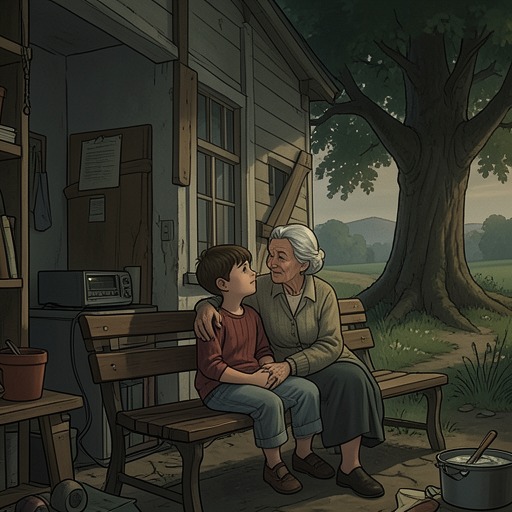
The narrator and his grandmother’s relationship
In Search of Lost TimeThe narrator’s relationship with his grandmother is at once an intimate bond of care and a belatedly understood source of grief. Her death does not immediately make her emotionally real to him: only when a memory restores her living presence does he recognize what he has lost. That delayed recognition turns recollection into both a continuation of their intimacy and an encounter with the pain and failures that had gone unacknowledged while she was alive.
A bond rediscovered through memory
On his first night back at Balbec, suffering from cardiac fatigue, the narrator bends to remove his boots and is suddenly overcome by sobs. The remembered figure who comes to his aid is his grandmother, stooping over him on the first evening of their earlier visit. The physical circumstance of the present moment has reopened the past: he does not merely think about her but recovers, involuntarily, the living reality of the grandmother whose tenderness he had not consciously felt since her stroke in the Champs-Élysées.
This return of intimacy exposes how little his ordinary thoughts and conversation had meant. More than a year after her burial, he had spoken and thought of his grandmother without recovering the person she had been. Now, as the old need to be held returns, he understands at once that she will never again be beside him. The discovery of her living presence in memory and the recognition of her permanent absence arrive together; his renewed longing is also the moment at which he truly knows she is dead.
The relationship had been organized around her attentive care. In the earlier memory, she stoops in her dressing-gown to unfasten his boots, responding to his distress as she had once offered refuge to him. The narrator recalls that, before that moment, he had wandered past a pastry-cook’s and felt he could not endure even an hour without her arms around him. The present recollection reunites that childhood dependence with adult knowledge: the need remains, but the person who answered it is gone.
Tenderness, remorse, and the remembered face
The recovered bond brings not uncomplicated consolation but remorse. The narrator remembers that his grandmother had taken pains to comfort him, and that he had sometimes shown or exaggerated his suffering in the belief that his kisses could undo the grief he caused her. After her death, he recognizes how mistaken that belief was. The tenderness that had once seemed capable of repairing hurt cannot now reach her, and his memory preserves the harm as well as the love.
One incident becomes especially painful. When Saint-Loup took a photograph of his grandmother, she posed in a wide-brimmed hat and flattering light. The narrator, irritated by what he saw as her childish vanity, let slip impatient and wounding words. He noticed her face tighten, but could not then understand the lasting force of what he had done. In retrospect, the moment returns as a hurt he can no longer repair. The photograph holds both the image she had wished to leave him and the memory of his failure to treat her gently.
The narrator’s pain is therefore more than a sign of absence: he regards it as evidence that the memory itself is present. He does not try to soften the loss by addressing the photograph as though its subject were merely elsewhere, still able to hear and respond. Instead, he wants to retain the pain in the form in which it came, because that particular impression is the only route he can see toward understanding what her death means. Remembering her entails confronting both the tenderness he received and the injuries he inflicted.
Signs of suffering and the limits of what he knew
As the narrator continues to remember, details that were once obscured by habit take on a different weight. He recalls his grandmother’s illness and imagines her suffering with a pity that may intensify what she herself had consciously felt. He also learns, only after her death, that on the eve of it she had pressed her fevered lips to his mother’s hand and said goodbye for ever, after making sure the narrator was not in the room. The fact that he did not witness this farewell marks the limits of his knowledge of her final hours and gives his mother’s grief a memory to which he himself had not been privy.
Another late disclosure concerns the syncopes his grandmother had suffered at the hotel without telling him. The manager explains that she had asked him to say nothing and had promised that, if she had another, she would leave. She had a further episode, but the hotel kept quiet because the family were longstanding guests and no one had complained. The narrator imagines that she may have been trying to appear well and good-humoured when he was least considerate, rather than risk disturbing or inconveniencing him. The manager’s mispronunciation of the word for her fainting spells remains painful to the narrator, attaching an unfamiliar sound to the revelation that she had concealed her illness.
Her photograph also changes as his understanding changes. At first, Françoise’s account of how ill his grandmother had been makes the image seem a record of suffering that the grandmother had tried to hide. A few days later, as the narrator grows accustomed to the disclosure, he can look at the photograph with pleasure. Her elegance beneath the hat still reflects the success of her efforts to conceal her condition, but the image no longer carries precisely the same force. For his mother, by contrast, it remains inseparable from the disease and from the altered expression in her mother’s face. The same object thus holds different stages and forms of grief for the two survivors.
Gestures, places, and the persistence of absence
The narrator’s grief is repeatedly awakened by familiar surroundings. The sea views at Balbec, which his grandmother had once watched for hours, become painful because she can no longer see them. When he turns away from the landscape, the partition that had once served as a kind of morning messenger recalls their intimate routine: he had feared either waking her or failing to reach her, and the wall had seemed to answer the changing feelings of that exchange. He now knows that no knock can bring her again.
What he longs for is not an abstract reunion but the return of a shared signal. He remembers three little raps that she would recognize and the answering knocks that used to reassure him that she was coming. The modest gesture concentrates their old closeness: it had let him feel her presence without needing to see her, whereas the same wall now makes the finality of her absence unmistakable. His wish to repeat that exchange eternally imagines paradise in the most personal terms available to him—not as a new life, but as the continuation of a familiar bond.
Memory also interrupts his attempt to turn toward other people and plans. On a journey toward Incarville, the narrator sees his grandmother in memory as she had sat in the train leaving Paris for Balbec, closing her eyes rather than watch him drink beer, which she considered harmful. He recalls that he had pressed her with anger and breathlessness until, in resignation, she advised him to do as he wished. The renewed memory makes his attention to his intended visit impossible: he leaves the train at Maineville-la-Teinturière and abandons his plans. The past is not merely recalled as an episode; it reclaims the present and changes what he can do in it.
Grief, inheritance, and the changing self
The relationship continues to act on the narrator through a sequence of selves rather than as an uninterrupted feeling. The person who now recovers his childhood dependence is, he observes, a self that had disappeared for a long time. Once this self returns, the narrator cannot simply reproduce the desires or feelings of the versions of himself that had lived in the intervening period. His grief reveals how affection can remain latent until the sensations that once accompanied it bring it back into consciousness.
The narrative extends this account of loss to his mother. When she arrives at Balbec in mourning, the narrator recognizes the depth of her sorrow more fully because his own grief, though lesser than hers, has made the contradiction between memory and nonexistence vivid to him. He sees her not simply as herself but as resembling his grandmother, as though the dead continue their interrupted life through those who remain. His mother’s attachment to his grandmother’s bag, muff, clothes, and books by Mme de Sévigné gives that inheritance material form: objects and habits preserve affinities that death has made newly significant.
In this relationship, mourning does not restore the grandmother as a living person, nor does it leave the survivors unchanged. The narrator’s belated recognition makes their love newly real precisely when it can no longer be answered. His memories preserve care, shared gestures, hidden suffering, and his own remorse; his mother’s grief carries forward a resemblance to the woman she has lost. The grandmother persists through the inner lives of those who loved her, but that persistence is inseparable from their knowledge that she is gone.