
Knocknaree Wood as an Uncanny Presence
In the WoodsThis thread follows how Knocknaree wood shifts from childhood territory to a threatening and possibly supernatural presence, while the book leaves its strange signs unresolved.
increasing Bearing strength in each event
 decreasing
Bearing strength in each eventdecreasingThe Children’s Domain
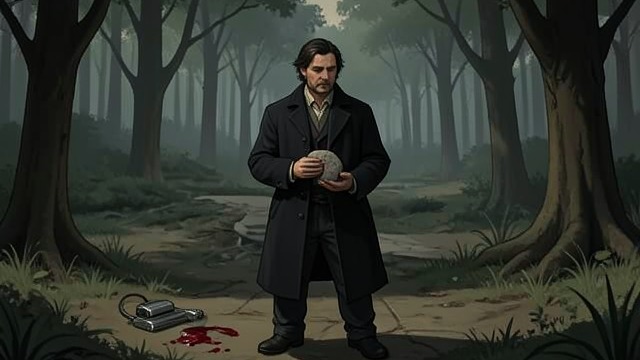
A wood shaped by childhood
Familiar wilderness
The opening presents Knocknaree wood as a living world of animals, insects, ruins, and half-seen movement. Peter Savage, Germaine Elinor Rowan, and Adam Ryan know its paths intimately, treating it as a domain in which they can roam beyond the supervision of adults.
Imagination at the border
The wood is both real terrain and a generator of stories. Children imagine watchers, secret places, and presences in the undergrowth, while the narrative gives ordinary noises an almost mythic charge. The border wall does not quite divide the safe estate from danger; it is the threshold through which the children enter a world of their own.
That early sense of freedom gives the later horror its force. The wood is not simply a threatening setting imposed on the children. It is the place they love, where friendship and play have accumulated meaning, and where something they cannot explain eventually breaks the security of their shared world.
A Cry Beyond Explanation
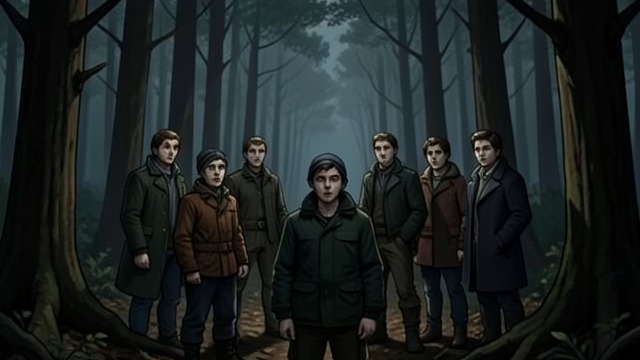
A sound in the trees
After the assault
Rob Ryan remembers Peter Savage and Germaine Elinor Rowan witnessing the rape of Sandra Scully in the wood. After the children flee, the young men hear a large, strange laugh or voice coming from among the trees. The sound is frightening enough to leave them shouting and frozen, but no one sees its source.
Competing interpretations
Sandra later recalls something like a huge bird beating its wings, accompanied by an animal smell and movement in the darkness. Jonathan Devlin remembers a voice that sounded like a young man rather than a child. The conflicting accounts make the sound feel both material and elusive: it may belong to a person, an animal, a misperception, or an event altered by fear and intoxication.
Rob is drawn to Cassie Maddox’s interest in the possibility of untamed animals, but he resists that interpretation. The novel provides no decisive identification. The unexplained sound instead marks the limit of what witnesses can say about a place that seemed to hold more than they could see.
The Torch in the Dark
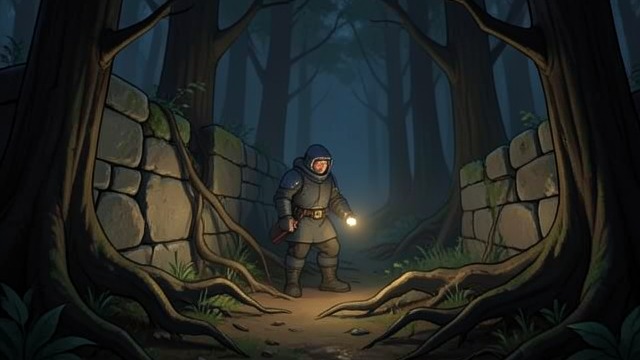
A moving light
An uncertain witness
While camping in the wood, Mark Hanly sees a small torch beam move slowly across the archaeological site from the estate toward the road. It is too dark for him to identify the person carrying it, and he initially treats the sight as unimportant. The light becomes significant only when detectives reconstruct the likely movements of Katharine Devlin’s killer.
The landscape as cover
The site’s trenches, walls, and trees make even a familiar location difficult to navigate at night. The torch could mark someone carrying a body, but it might equally belong to an ordinary person crossing the site. Mark’s observation narrows a possibility without resolving who moved through the darkness or why.
The scene extends the wood’s double character. It remains a workplace and a route between homes, yet to a nighttime observer it becomes a maze of shadows where a single beam can suggest either practical purpose or menace. The light illuminates only a small part of the truth and leaves the rest hidden.
A Night Lost to Fear
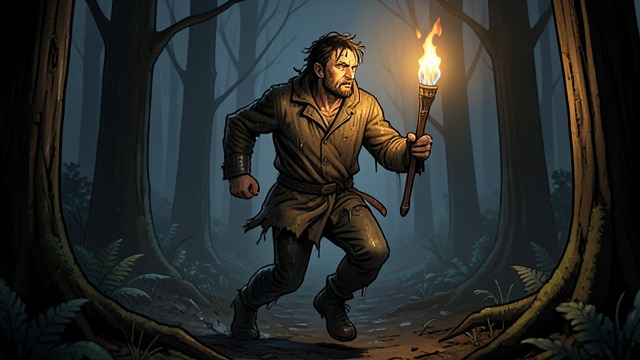
The wood answers back
Fragments of recognition
During Rob Ryan’s later return, the wood seems to awaken his childhood recollections: familiar paths, shifting shadows, remembered running, and a golden-eyed presence near the river. The scene appears to move between remembered landscape and immediate perception, as the forest’s ordinary sounds acquire an unnerving, directed quality.
Escape without explanation
Rob’s response is panic. He tears free of his sleeping bag, crashes through the undergrowth, and reaches the archaeological site without knowing whether he has encountered an animal, relived a fear, or suffered a hallucination. The experience leaves him exhausted and shaken, but it does not deliver a stable memory of what happened to the missing children.
The episode resists a clean supernatural or psychological answer. Rob’s account is explicitly uncertain, and fatigue, alcohol, trauma, and the environment all complicate it. The wood remains uncanny precisely because the novel refuses to decide whether its apparent agency belongs to the place, to Rob’s mind, or to both.
A Land Stripped Bare
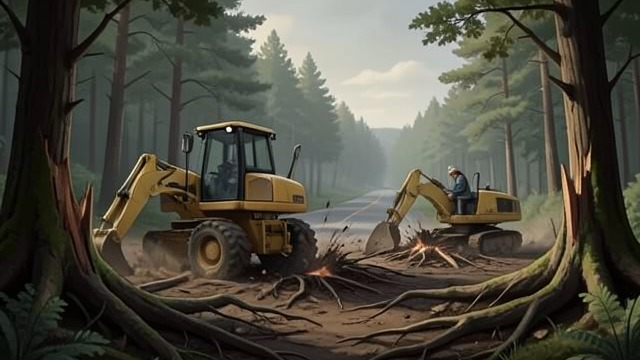
The wood’s disappearance
A landscape under machinery
Rob returns to Knocknaree after learning that construction has begun. The archaeological site is being overturned by machinery, and the remaining strip of wood is almost gone. What had once seemed vast, secret, and watchful is reduced to exposed roots, splintered trunks, and the noise of work crews.
A memory made visible
Watching the destruction brings back a vivid bodily memory of climbing the castle wall and entering the wood with Peter Savage and Germaine Elinor Rowan. Rob realizes that he had come to remember the forest mainly as a threatening presence, forgetting that it had also been their playground and refuge. Its physical destruction briefly restores its beauty to his perception.
The road proceeds despite protest, and the old landscape cannot be recovered. A workman’s unexplained fragment of carved metal hints at the site’s buried past, but even this discovery does not restore what has been lost. The ending leaves both historical and personal mysteries open as modern development transforms the place beyond recognition.
The summer of 1984 before the disappearances
During Rob Ryan’s recovered account of the 1984 summer
The night before Katharine Devlin’s body is discovered
The second nighttime return to Knocknaree wood
After the motorway construction begins
