
Heritage Against Development
In the WoodsThis thread follows the struggle over Knocknaree’s archaeological landscape, where local history, private financial interests, public infrastructure, and personal grief collide.
increasing Bearing strength in each event
 decreasing
Bearing strength in each eventdecreasingA Future Promised to the Estate
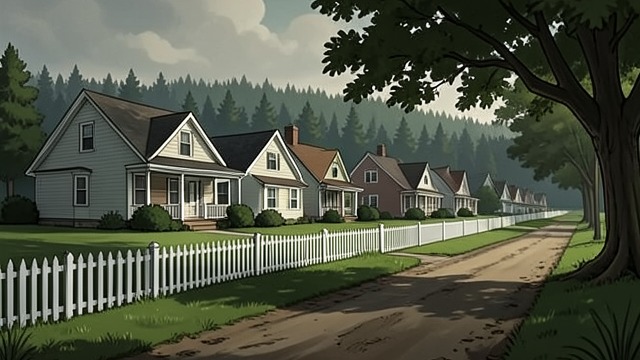
Suburbia before its promised growth
A planned community
The estate is built with the promise that government planning will turn the area into a thriving suburban center. Families move there seeking better homes and space for children, but the expected shops and community facilities fail to appear. The young settlement remains small, with farmland nearby and an extensive wood behind the houses.
The wood beyond the wall
That undeveloped landscape is both a practical reminder of the estate’s isolation and an invitation to the children who live there. The plans that describe the future as infrastructure and growth cannot account for the older, wilder world next door. The estate’s tidy domestic order ends at a wall that opens onto centuries of terrain.
The gap between what was promised and what arrived foreshadows the later dispute over the motorway. Knocknaree is shaped by decisions made elsewhere, while residents and children create their own meanings within the landscape left behind.
An Archaeological Site on Borrowed Time
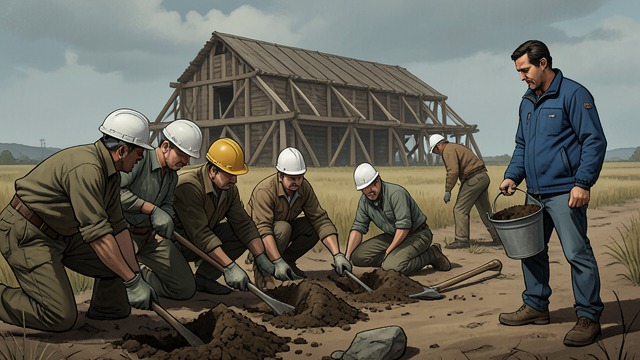
Excavation under a deadline
A limited investigation
Archaeologists discover that the site is far more significant than expected, with traces of occupation extending across millennia. They argue that the area deserves extensive study, but the excavation is constrained by a deadline imposed before construction. The team works under pressure, aware that years of archaeological labor are being compressed into a short window.
Preservation as a struggle
Mark Hanly treats the work as a commitment rather than merely a job. He resents bulldozers and the political decision to leave only a token preservation measure around the keep. His anger is grounded in the belief that the site represents a real inheritance, not a decorative symbol to be displayed after the landscape has been destroyed.
The excavation gives the novel a material history deeper than the modern crime investigation. Pottery, coins, walls, and ritual remains show that the land has repeatedly been inhabited and reinterpreted. The urgency of uncovering that history is sharpened by the knowledge that construction may soon erase its visible traces.
Land Value and Political Power

The financial map beneath the route
Acquisition and rezoning
Sam O'Neill traces how companies bought surrounding agricultural land before the motorway route was formally announced. After the road plans become public, rezoning changes the value of that land, and the developers stand to gain substantially if the chosen route remains in place.
Private gain behind public language
The paperwork points to networks of holding companies, council decisions, and political relationships. A journalist gives Sam names linking the development companies to people with a stake in the route, while anonymous threats against Jonathan Devlin suggest that the campaign to move the motorway has angered someone with money at risk.
The inquiry shows how infrastructure can be presented as a public good while its benefits are distributed unevenly. The proposed road is not only a line on a map; it is a contest over whose land, history, and objections count. Yet the financial scheme does not ultimately explain the murder, demonstrating how plausible political motives can distract investigators from other forms of violence.
Protest Without Leverage
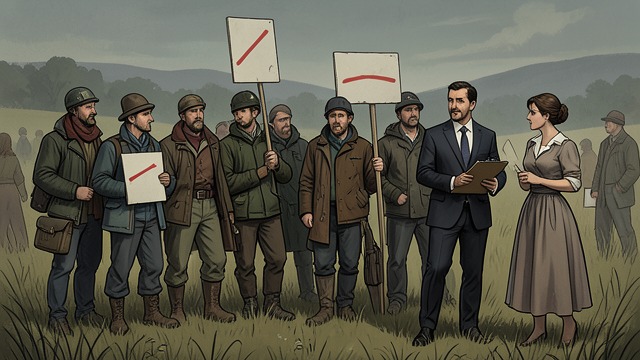
A campaign against the route
Legal resistance
The Move the Motorway campaign challenges the planned road through demonstrations, petitions, lawsuits, and injunctions. Its efforts delay construction and keep public attention on the archaeological site, but the government continues to pursue the original route. Residents who oppose the project cannot overcome the institutional and financial forces behind it.
Community under pressure
Jonathan Devlin’s campaign makes him a local public figure, and the threats to his family reveal how political disagreement reaches into private life. The investigation initially considers whether those threats are connected to Katharine Devlin’s murder. That possibility gives the detectives a concrete line of inquiry, even as its apparent plausibility proves misleading.
The campaign’s setbacks deepen the book’s contrast between collective conviction and practical power. Mark Hanly’s devotion to the dig and the protesters’ persistence are meaningful, but meaning does not guarantee victory. The road may be delayed, yet the preservationists cannot secure the future they want for the site.
Construction Erases the Landscape
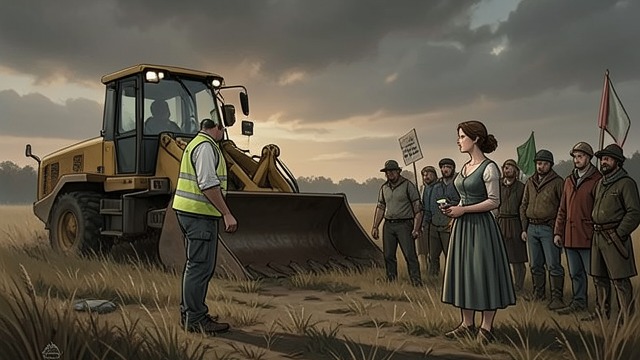
The final transformation
A site becoming roadworks
Rob Ryan returns to find machinery overturning the excavated ground and the remaining wood being cut down. The site that once seemed immense and secret is occupied by bulldozers, work crews, and exposed roots. The physical scale of the destruction exceeds what he had imagined from the political debate.
A belated recognition
The sight brings back the childhood memory of climbing the wall with Peter Savage and Germaine Elinor Rowan. Rob realizes that he had allowed fear and unresolved trauma to define the wood so completely that he forgot its beauty and its role as a beloved refuge. The threatened landscape briefly becomes vivid as a place of companionship rather than only loss.
Construction proceeds, while a small group of protesters remains at the roadside. A workman finds an ancient-looking object, but Rob does not keep it; he lets it go with the worker to the worker’s grandson. The gesture does not save the site, yet it acknowledges that history can pass through ordinary hands even as the landscape that held it is destroyed.
Around 1974, when the young families first move to Knocknaree
During the two-year excavation before the motorway is due to begin
From the land purchases of the late 1990s to the first investigation briefings
After the murder investigation and before construction begins
The day construction begins after the case has closed
