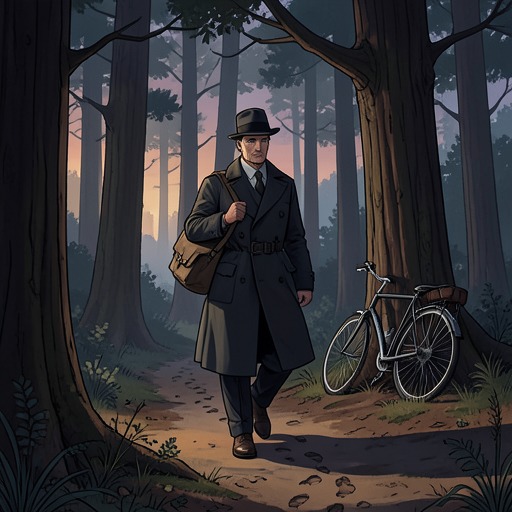
Adam Ryan’s psychological deterioration during the investigation
In the WoodsAdam Ryan’s psychological deterioration during the investigation is the escalating cost of keeping his childhood connection to Knocknaree secret while working a case that brings that past close again. His decline appears not as one sudden breakdown but as a sequence: he suppresses the history, cautiously searches his memory, loses confidence in his ordinary mental abilities, and finally finds that the memories recovered during the investigation have vanished once more.
Concealment and the return of memory
Adam Ryan has kept the Knocknaree events private, telling only a few people, including his parents and Cassie Maddox. At boarding school he stopped using Adam and began using his middle name, becoming Rob Ryan. The change helped separate the detective with an English accent from the child whose disappearance had attracted intense publicity. He knew that the new investigation might be connected to the old case, and that police rules barred an officer from working on a case in which he might be emotionally involved. Even so, he did not tell O'Kelly. He expected disclosure to remove him from the case and bring another round of questioning about the day in the wood, which he remembered as an experience of blankness and pressure rather than as a recoverable account. His decision also appealed to his pride and to the image of himself as a solitary, enigmatic detective.
The investigation gradually prompts him to make a first, tentative effort to retrieve what he had lost. Unable to sleep on nights he is not staying with Cassie, he walks for hours through the city, listening inwardly for fragments of memory. The experience is disorienting: he sometimes comes to himself in unfamiliar places, including a shopping center or a Georgian home in Dun Laoghaire, without knowing how he arrived. Yet images begin to surface. He recalls a childhood shopping trip with Peter Savage and Jamie Rowan, and a story Peter told about Mad Mick, a local man who later disappeared after being taken away by police. He also remembers the worn school desk marked with old carvings and graffiti. These fragments do not solve the investigation, but they matter intensely to someone who had treated the first twelve years of his life as effectively inaccessible.
Strain on work and memory
The deterioration becomes measurable in the contrast between Ryan’s usual working habits and his sudden inability to retrieve information. After drinking Guinness and then vodka, he tries to review the Kavanagh case but can recall vivid peripheral details—the Sacred Heart statue, the suspects’ appearance, and the wallpaper at the bed-and-breakfast—while losing the central facts, including the suspects’ names and how the investigation had proceeded. His normally reliable, if largely rote, memory had helped him manage several investigations and their paperwork, court dates, and meetings. Now even the basic information he expects to have at hand is missing, and the gap produces what he experiences as silent, animal panic.
He spends the night unable to settle. Images from the case recur, and at about four in the morning he considers retrieving his notes, only to realize that drinking has left him too unsteady and confused to make useful use of them. He eventually takes migraine tablets and falls asleep near the time his alarm is due to ring. The episode marks a change in kind: forgetfulness is no longer merely a matter of missing childhood memories but has begun to disrupt his professional competence in the present.
After a courtroom episode, he recognizes that the separate signs have become a pattern. He has been sleeping less, drinking more, and feeling irritable and distracted; he has also wondered whether he is seeing things. In a pub, he sees his exhausted appearance in a dirty mirror and is struck by the question of how he came to be in that condition. He considers taking leave and going away, but believes he cannot withdraw from the investigation without revealing his identity or damaging his career. He tells Cassie Maddox that he has a migraine, then admits that he has made a serious mistake. The gap between the explanation he offers and the crisis he acknowledges captures his attempt to keep the personal and professional consequences apart even as they converge.
Recovered scenes and renewed uncertainty
A photograph of Philomena Kavanagh becomes another source of pressure. Ryan feels that it reminds him of something, but cannot tell whether the association is trivial or connected to the childhood trauma that left a long blank in his memory. Because he has lived for years with that blank, even a small, uncertain recollection acquires disproportionate force: it might lead nowhere, or it might open the past he has depended on not knowing. The novel presents this uncertainty as a destabilizing feature of memory itself; the intensity of a fragment does not establish what it means.
In the middle of the night, a memory returns with enough force to wake him. He recalls approaching a clearing with Peter and Jamie and seeing them encounter an assault on Sandra Scully. The scene is remembered through the boys’ frightened, limited vantage point. As the memory continues, Ryan becomes physically rigid beneath his sleeping bag, shaking against a tree while trying to follow the fragile thread of recollection. The remembered freedom of running with Peter and Jamie presses against the darkness and fear of the present; the wood that had once belonged to childhood play is also the place where that childhood was interrupted. The return of the scene does not restore a stable account of his past. Instead, memory arrives in fragments, and the effort to hold onto it is itself distressing.
The case also brings a personal fracture into the working relationship with Cassie. When she describes Rosalind Devlin as fitting the clinical definition of a psychopath, she explains that she had begun to suspect this at their first meeting but had not considered it relevant to the case. Ryan realizes that she had withheld the judgment and nearly tells her that she should have trusted him. The exchange takes place amid a larger strain on his capacity to trust his own perceptions and relationships. Later, O'Kelly acknowledges that Cassie was right about Rosalind’s reasoning concerning her sister, but this confirmation does not undo the earlier distance between the partners.
Aftermath and the remaining image
During the long months spent in his apartment after the investigation, Ryan’s thoughts return to Knocknaree despite his decision not to think about it again. This time, the recovered childhood material is gone. Peter, Jamie, the men involved in the assault on Sandra, the wood, and the images he had laboriously reclaimed during Operation Vestal now feel like distant scenes from old films or stories rather than memories that belong to him. He expects even those secondhand impressions to fade, and understands their disappearance as connected to his having forfeited his right to them.
Only one image remains: Peter and Ryan sprawled on the grass in Peter’s front garden, trying to make a periscope from an old comic’s instructions. Without the required cardboard tube, they use rolled-up newspaper, which buckles and shows them the sports page backwards. The small, ordinary failure of the homemade instrument survives where the more consequential memories do not. Ryan’s arc therefore ends not with recovered knowledge or a settled explanation, but with another narrowing of memory: the past returns under pressure, then recedes, leaving a single childhood moment as the last fragment he can still call his own.