Adam Ryan’s recovered memory of the assault
In the WoodsAdam Ryan’s recovered memory of the assault turns an obscure gap in his childhood into a consequential act of witnessing. During the investigation, he recalls that he, Peter, and Jamie saw Jonathan Devlin and his friends assault Sandra Scully in Knocknaree Wood. The memory identifies a crime, places the children at its scene, and makes Adam’s concealed connection to the case impossible to separate from his work on it.
The Memory and Its Return
For years, Adam had treated his childhood in Knocknaree as largely inaccessible. He rarely discussed the childhood incident that had left his memories missing, partly because he dreaded intrusive questions and speculation, and partly because he regarded the absence as settled. After the original questioning, investigators returned repeatedly, at first during school holidays and later at longer intervals. Adam had nothing to tell them. Their visits eventually stopped, and he believed that reopening the matter would serve no useful purpose.
That silence became an ethical problem when he worked on a case that might connect with his past. He knew he should tell O'Kelly that he could be emotionally involved, but concealed the connection instead. Disclosure, he reasoned, would remove him from the case and expose him to renewed questioning without helping the investigation. He also recognized a less defensible attraction in keeping the secret: it made him feel like an enigmatic detective operating outside ordinary rules. The recovered memory therefore does not arrive in a neutral setting. It surfaces while Adam is already withholding information that could affect his participation in the case.
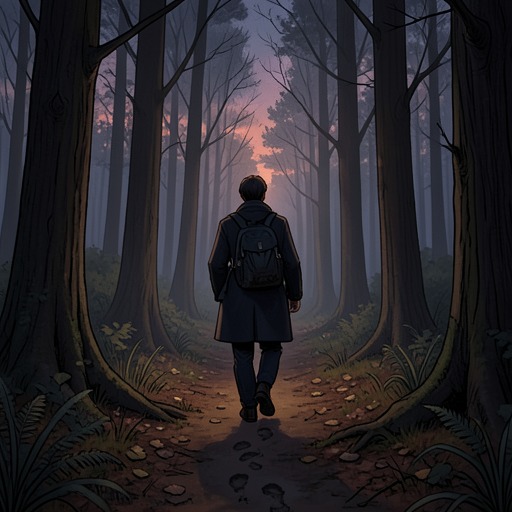
His return to the past began tentatively. On sleepless nights, he walked for hours around the city, sometimes becoming so absorbed that he later found himself in unfamiliar places without knowing how he had got there. Images then began to surface in quick succession. Many concerned ordinary childhood scenes and offered no apparent help with the investigation. Their importance lay in the fact that Adam had assumed even such everyday memories were lost for good; each fragment felt like evidence of a life he had not been able to access.
What Adam Recalls
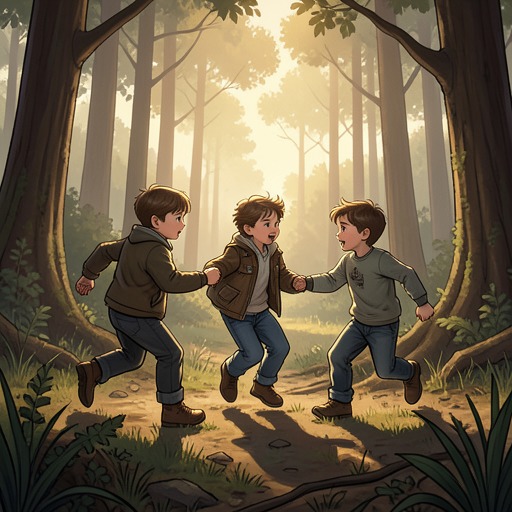
The assault memory arrives suddenly in the night, waking Adam from a restless doze. Its recollection first establishes the children’s approach to the clearing: Peter warns the others to get down, and Adam, Peter, and Jamie move through the undergrowth cautiously. The sounds they hear signal that something is wrong before they can see what is happening. The memory then resolves into a group assault on Sandra. Several men are restraining her while another attacks her; one of them strikes her when she tries to make herself heard.
The scene is significant not only because of what the children witness but because of their immediate response. Adam, Peter, and Jamie run, despite being noticed. Their flight leaves them with no opportunity to intervene, and the men yell after them. The recollection presents the children as witnesses who understand enough to be frightened and leave, but who do not then tell anyone what they saw. It does not establish what each child thought afterward or why they remained silent; the remembered facts are their flight and the silence that follows.
The next day, Adam and Jamie see Sandra at a shop. She is dressed differently from the day before and appears affected by what has happened. The children know that she has seen them, but none of them looks at the others. This encounter makes their shared knowledge visible without turning it into a conversation: the witnesses and the victim occupy the same ordinary setting, yet the assault remains unspoken.
Disclosure During the Investigation
Once awake, Adam telephones Cassie in the middle of the night. He tells her that, sometime during that summer, he, Peter, and Jamie saw Jonathan Devlin and his friends assault a girl. Cassie initially asks whether the children might have misunderstood what they witnessed. Adam rejects that possibility, describing the victim as restrained and struck when she tried to scream. He also confirms that the assailants saw the children and shouted at them as they ran.
Adam can identify the girl only uncertainly at first, recalling her as Sandra and not knowing her full name. Cassie recognizes the possible significance immediately: the memory implicates a member of the Devlin family in a serious crime and offers two additional witnesses who have since disappeared from the story of the event. She says they will begin trying to locate Sandra the following day. Her response shifts the recovered memory from private recollection to investigative information, though the conversation alone does not establish that a warrant was issued or that Sandra was subsequently found.
The disclosure also exposes Adam’s conflict of interest. He has been working the case while concealing both his childhood connection to Knocknaree and his possible knowledge of another serious crime. The memory supplies a reason that connection matters, but it does not erase the earlier decision to hide it. In this way, the revelation changes the investigation while also sharpening questions about Adam’s judgment and the reliability of his role within it.
Recovery, Loss, and Narrative Significance
The memory’s return is part of a wider, uneven process rather than a complete recovery. Adam had begun trying to remember the wood for the first time in earnest, approaching the past cautiously and learning to hold on to images as they appeared. The assault becomes the most consequential recovered scene because it connects his childhood friends, Sandra, and Jonathan Devlin to a crime. Yet the account does not present recovered memory as a simple cure for amnesia: vividness and emotional force do not restore the whole of Adam’s childhood or settle every question about his past.
Later, during the long period of withdrawal that follows the investigation, Adam’s memories of Knocknaree seem to disappear again. He can remember what it was like to recover scenes of Peter, Jamie, the men in the wood, and Sandra, but those scenes have become distant, almost secondhand images rather than memories that feel like his own. He fears they will fade further. Only one ordinary image remains clearly available: he and Peter in Peter’s front garden, trying unsuccessfully to make a periscope from an old comic’s instructions, using rolled-up newspaper because they lack the cardboard tube they need. That small remnant underscores the unresolved ending of the memory arc. The assault is recovered, disclosed, and consequential, but Adam does not gain lasting possession of the childhood world from which it came.