Bronze Age ceremonial stone
In the WoodsThe Bronze Age ceremonial stone is the ancient feature that gives the discovery of Katy Devlin’s body its unsettling archaeological setting. Its physical details draw investigators’ attention to traces that may long predate the murder, while its uncertain history becomes a point of tension between evidence and public speculation.
Form and Excavation Setting
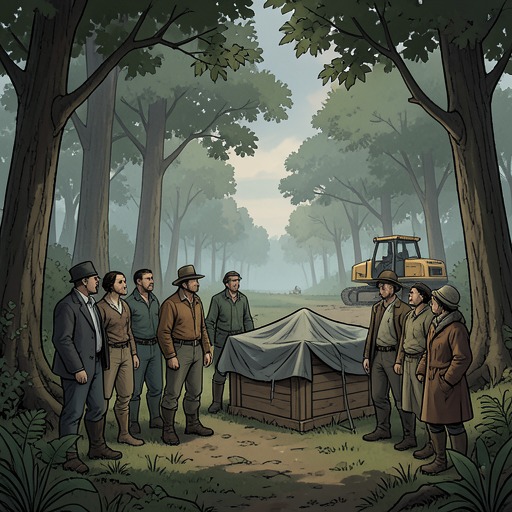
The stone is a massive, flat block, approximately seven feet long, three feet wide, and three feet high, chipped from a single boulder. The surrounding field has been crudely bulldozed, but a cushion of ground around the block remains untouched, leaving it raised like an island amid churned earth. Katy’s body lies on top, partly obscured by nettles and long grass. The contrast between the disturbed excavation ground and the preserved patch around the stone makes the feature conspicuous before its history is understood; the body’s presence there initially sends the investigation toward the wrong possibility, as the narrator briefly thinks of Jamie Rowan before recognizing that the victim is someone else.
Traces and Forensic Interpretation
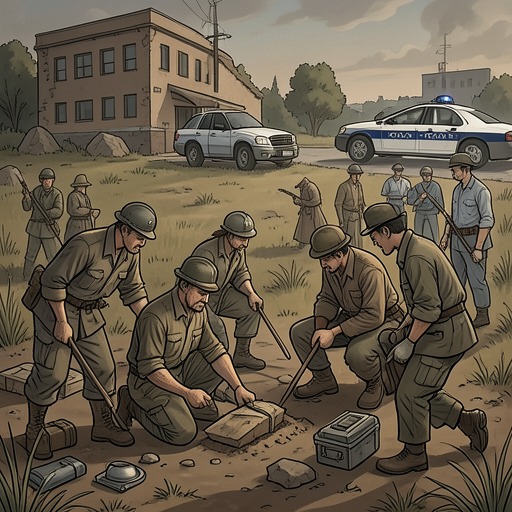
A narrow groove runs around the stone’s upper surface, about a finger’s width and an inch or two in from the edge. Time and weather have smoothed it, but a slipped chisel left a small jagged overhang; beneath it, technicians found a dark smear and swabbed it for testing. Sophie reported that it was blood, though whether it was human remained unknown, and she considered it likely to be years old rather than connected to Katy Devlin. The distinction mattered: the blood on Katy’s body had dried before she was brought to the stone, and investigators found no blood spatter on the surface. The stone therefore marked where her body was left, not where she was killed; its older trace opened a separate question about the site’s past without resolving it.
Archaeological Meaning and Public Speculation
The stone’s identification as a Bronze Age sacrificial altar gave the discovery an evocative history, but not a settled explanation. Archaeologist Ian Hunt confirmed that it was a rare artifact and that the shape and dimensions could be consistent with human sacrifice; he also stressed that the sacrifices might have been animal rather than human, and no further evidence at the site established what had taken place there. The distinction mattered as reporters framed Katy Devlin’s body as part of a supposed ritual. When a journalist asked whether Druids had used the altar for human sacrifice, Rob Ryan declined to comment, while recognizing that the stone’s blood-draining groove recalled the tables in the morgue. The resemblance sharpened the scene’s macabre associations without proving any link between ancient practice and the modern murder.
The altar also stood at the intersection of archaeological heritage and the proposed road. Mark Hanly criticized politicians for posing with heritage before supporting its destruction, while Ian Hunt described the road as a terrible loss to a site of immense religious importance in the Bronze Age. That collision of meanings made the stone especially vulnerable to sensational treatment: its genuine antiquity and uncertain ritual history invited speculation, but neither established a satanic cult or explained Katy’s killing. The stone’s significance therefore remained double-edged—an artifact whose past could not be fully recovered, and a contested landmark whose future was threatened by development.
The Confession and the Limits of Identification
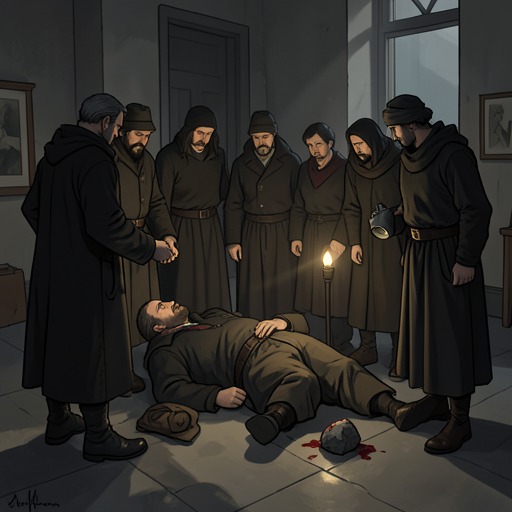
Much later, during questioning, Damien Donnelly admitted that he had struck Katy with a rock. Investigators also confronted him with the post-mortem findings and the trowel recovered from the tools shed, evidence that established further violence after the killing. His account gives the murder investigation a blunt-force object, but it does not identify that rock as the Bronze Age ceremonial stone. The distinction matters: the confession links a rock to the attack, while the evidence presented here places Katy’s body on the altar only after she had been killed elsewhere.
The altar’s imposing presence can invite the assumption that its ancient ritual associations explain the modern crime. The later evidence instead leaves that history unresolved. The stone remains part of the scene where investigators found Katy, but neither Damien’s admission nor the forensic findings described in his questioning connect her murder to an ancient rite or establish that the altar itself was used as a weapon.