Dynamo Development
In the WoodsDynamo Development is one of three companies that acquired extensive land around Knocknaree in connection with the planned motorway corridor. Sam’s investigation places it within a layered network of landholding companies whose purchases and successful rezoning applications could turn public infrastructure planning into large private increases in land value, while leaving the company’s ultimate ownership and any criminal connection unresolved.
Identity and Place in the Land Network
Sam identifies Dynamo Development as one of the three companies behind much of the land acquired around the proposed route, alongside Global Irish Industries and Futura Property Consultants. The companies’ holdings appear as colored blocks on his map: Dynamo’s land is marked in red. He explains that the three companies were difficult to trace because the immediate buyers were often holding companies owned by other companies. In the investigation, Dynamo therefore appears not as a clearly transparent standalone purchaser but as a name within a chain of corporate land ownership.
A later note, passed to Sam by the journalist Kiely on a tightly rolled piece of silver cigarette paper, associates Dynamo with Kenneth McClintock. The note also names Terence Andrews beside Futura Property Consultants and Jeffrey Barnes and Conor Roche beside Global Irish Industries. It provides investigative leads about the people linked to the three companies; the evidence does not establish that McClintock was Dynamo’s owner or specify his formal role.
Land Acquisition and Rezoning
The land purchases are tied to the announcement, in March 2000, of the motorway plans. Sam’s map shows the planned route cutting through the wood and the archaeological dig, while his account describes the three companies as holding almost all the surrounding land by the time the route was announced. The purchases were made through various other names, making the companies’ interests less immediately visible. Sam reports that local farmers were offered prices above the going rate for agricultural land, and that the four who initially held out hoped to discover why the buyers wanted the properties.
The new road made the area more accessible and increased the prospect of industrial and residential development. The four holdout farmers tried to have their land rezoned themselves, but their applications were refused; one farmer applied four times. After the three companies had acquired the land, they applied for rezoning and succeeded. Sam’s account thus sets the farmers’ repeated refusals against the developers’ later approvals, without supplying proof of the mechanism behind the difference.
Expected Gains and Limits of the Case
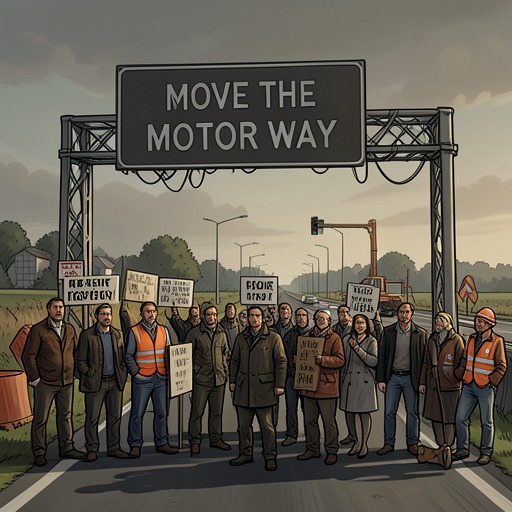
The route was not the only possible one. Sam compares it with a proposed alternative favored by the Move the Motorway campaign, running two miles away and four or five miles distant in some places. Estate agents told him that industrial land beside the motorway could be worth up to twice as much as comparable land three miles from it. He estimates that the difference across the companies’ holdings could amount to millions, giving the land purchases a clear potential financial stake in keeping the original route.
Sam suspects that the three companies had influence over the county council’s rezoning decisions and observes that their investment would have been threatened by moving the motorway. He also considers whether the potential gains might help explain threatening calls, but the investigation does not prove that connection. Dynamo Development’s significance lies in the contrast between the public motorway scheme and the private value attached to its route: the company is part of a substantial landholding pattern, but the evidence stops short of establishing bribery, a conspiracy, or responsibility for the threats.