Futura Property Consultants
In the WoodsFutura Property Consultants is one of three companies whose landholdings around Knocknaree came under scrutiny after the motorway route was announced. Sam O'Neill traced purchases made through layers of holding companies back to Futura, Global Irish Industries, and Dynamo Development. The companies had acquired much of the land around the planned route, positioning them to benefit from the motorway's effect on access, rezoning, and development value; the investigation raises serious questions about the arrangement without establishing that Futura itself committed a crime.
Identity and Ownership
Futura Property Consultants appears in Sam's investigation as a landholding company and one of the three principal entities behind purchases around the motorway corridor. Many of the immediate buyers were companies that Sam described as holding companies, with ownership passing through further corporate layers. His work was aimed at identifying who ultimately controlled the land, rather than treating each registered purchaser as an independent owner.
Sam traced Futura's registration to Hungary, while two of the three companies were registered in the Czech Republic. On the map he prepared, Futura's holdings were marked in green, alongside Global Irish Industries in blue and Dynamo Development in red. The geographic pattern made the companies' common interest visible: their holdings clustered around the stretch of the proposed motorway crossing the wood and archaeological dig.
Land Purchases and Rezoning
The government announced the motorway plans in March 2000 and bought land from local farmers during the following year under compulsory purchase orders. By the time the route was announced, the three companies had acquired almost all the land around this section, according to Sam's reconstruction. Four farmers had held out, hoping to understand why buyers were offering prices above the going rate for agricultural land. Once the motorway made Knocknaree more accessible, the farmers recognized the prospect of industrial estates and residential development and sought rezoning for themselves. Their applications were refused repeatedly.
Sam's map recorded the sequence in miniature: notes for farmer Maurice Cleary list four rejected applications between May 2000 and January 2002, a sale marked with FPC in August 2002, and rezoning in October. Cleary had wanted to remain on his farm. He eventually sold after a representative of one of the holding companies warned that a proposed pharmaceutical plant beside his land could not be guaranteed to keep chemical waste from contaminating water and harming his cattle. The account presents this as a threat as Cleary understood it, while Sam acknowledged that he could not determine whether that interpretation was correct. After the Big Three acquired the land, using various other company names, they applied for rezoning and succeeded.
Suspected Connections and Limits of the Case
The sequence prompted suspicion that the developers had been tipped off about the motorway plans, but Sam stressed that the investigation could not prove such advance knowledge. He also considered tax evasion a more likely explanation for the opaque corporate structures and proposed passing relevant information to the Revenue; at that stage he did not see how the land dealings connected to the murder investigation. The county council's explanations of its rezoning decisions struck the detectives as evasive, but the evidence presented does not establish that Futura bought council decisions or that the company alone directed the process.
A small silver-paper note later supplied by a reporter linked Futura to Terry Andrews. The note gave names beside each of the three companies, identifying Andrews with Futura; it offered a lead, not proof of the full ownership or decision-making chain. In a separate recorded exchange, Andrews angrily complained that injunctions had disrupted the development timetable. That complaint illustrates the pressure surrounding the wider project, but does not by itself establish Futura's role in the dispute.
Route Change and Significance
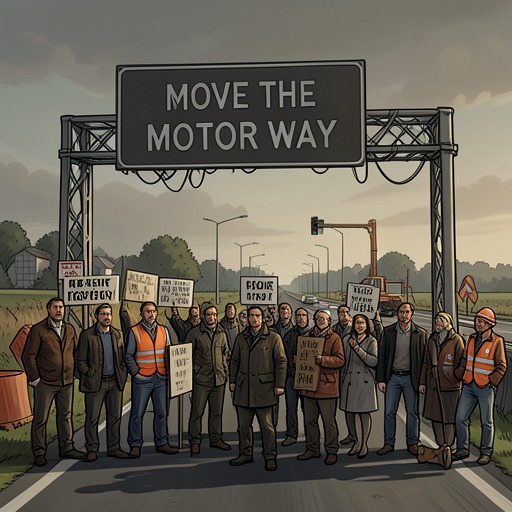
Sam compared the planned route with the alternative favored by the Move the Motorway campaign. The alternative lay about two miles from the original route, and four or five miles away in some places. Although land north of the original route would remain accessible, holdings south of it would lose value. Estate agents told Sam that industrial land beside a motorway could be worth up to twice as much as comparable land three miles away; he estimated that changing the route could therefore cost the developers millions in potential value.
Futura's significance in the investigation lies in this chain of public planning and private advantage. The motorway promised to make rural land more accessible, and thus more valuable for industrial and residential uses; purchases, rezoning, and political scrutiny followed that prospect. The company's presence in that chain makes it part of the suspected development network surrounding Knocknaree, while the available evidence leaves the precise extent of its knowledge, influence, and responsibility unresolved.