Ian Hunt
In the WoodsIan Hunt, addressed as Dr. Hunt, is the excavation’s specialist in medieval material and one of the people with a key to its finds shed. His records help establish when an important coin was discovered, while the inquiry into Katy Devlin’s death examines his access to the site and ultimately checks his account of the night against several independent details.
Role at the Excavation
When asked about the finds shed, Hunt explains that the team checks it every night, mostly for pottery. He also identifies himself as a medieval specialist, noting that there is no coin specialist on site. The distinction matters when an unusual coin is found: the excavation has a responsible expert, but identifying the object takes time.
Hunt’s logbook confirms that Sean Callaghan found an Edward VI base penny, dating from the early 1550s, on the Monday a few hours before Katy Devlin died. Hunt describes the find as wonderful and says that it took the team a considerable time to identify it. The record gives the investigation a specific point of comparison between the coin’s discovery and the killing.
Access and the Search
Hunt has a key to the finds shed, as do Mark Hanly and Damien Donnelly. He says their keys are used in connection with tours, so visitors can see the finds. During the police search, Cassie Maddox reports that Hunt, Mark Hanly, and Damien Donnelly each hold a key that fits all the Portakabins; Sean Callaghan has none, and there are no spare keys. The holders say that they have never lost, lent, or misplaced theirs.
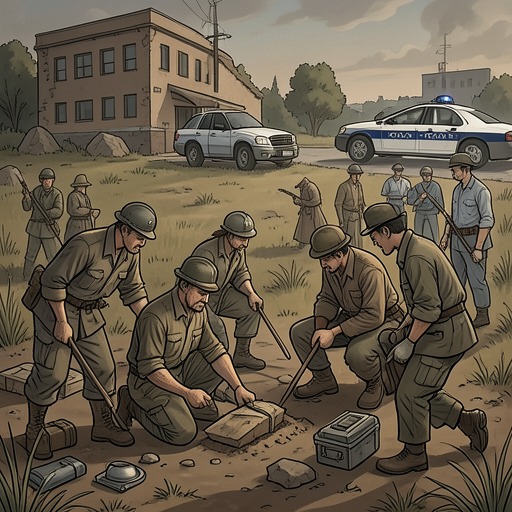
Hunt permits the investigators to search the site. The detective narrator reads his quick agreement as a reason to move him further down the suspect list, though it does not by itself establish innocence. The search proceeds: Hunt and others are kept in the canteen while the team examines the finds shed and other buildings. His access remains a relevant practical detail, but the inquiry does not treat access alone as proof of involvement.
Alibi and the Inquiry’s Assessment
O’Kelly later reports that Hunt’s account of Monday night is supported by several checks. Hunt said he had been at home with his wife, having tea and watching television until he went to bed at eleven. His wife gives the same account, and the television guide confirms the programmes he described, including documentaries about meerkats and Richard III.
A neighbour also places Hunt at home later that night: the neighbour’s dog barked, and he heard Hunt shout out the window at about one in the morning. Hunt is confident about the date because workmen had installed new decking that day and, he said, their work had upset the dog. Together, the account, television listings, his wife’s corroboration, and the neighbour’s recollection lead O’Kelly to exclude him from the leading suspects. Hunt’s place in the investigation thus shifts from a person with relevant keys and site knowledge to one whose presence at home is supported by a detailed, cross-checked chronology.