Katy Devlin’s killing and the relocation of her body
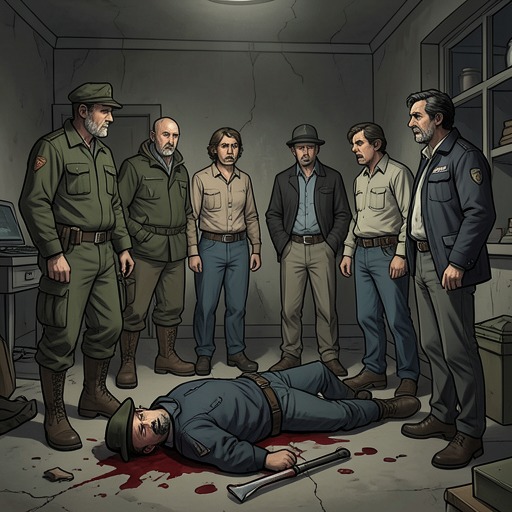
In the WoodsKaty Devlin’s killing and the relocation of her body emerge through Damien Donnelly’s account during police questioning, rather than through a continuous, independently witnessed scene. His confession establishes that he struck Katy at Knocknaree, caused her death, and moved her body before it was eventually placed on the altar stone. The account is also marked by omission: detectives later tell him that the evidence contradicts his version and confront him with an assault he had not disclosed.
The confession and its conditions
The interview turns when Cassie Maddox returns to the theory she had held from the start: the person responsible was not necessarily a habitual or willing killer, but someone who had acted under pressure and did not want to cause harm. Rob Ryan acknowledges that the rest of the team had doubted her, then reinforces her argument by describing the psychological collapse that can follow a killing and the fear of living under the threat of discovery. Cassie contrasts that concealed life with the possibility of confessing, serving a sentence, and eventually beginning again.
The detectives’ appeal is not neutral. They present remorse, sleepless fear, breakdown, and even suicide as possible consequences of keeping silent, while confession is framed as the path by which a culprit might survive. Damien is visibly tense; after being asked whether the description sounds familiar, he eventually nods. He then says that it just happened. The confession follows a sustained effort to make him identify himself with the reluctant perpetrator Cassie has described, so the scene records both an admission and the persuasive circumstances in which it was obtained.
Ryan arrests Damien on suspicion of murdering Katharine Bridget Devlin at Knocknaree in County Dublin on or around 17 August of that year. The formal arrest follows the admission, but does not settle every question about the killing. Damien continues to shake, and the detectives take away the photographs and offer him tea, a sweater, or food. Ryan experiences the aftermath as unreal and connects the case to his own lost memories, his return to Knocknaree wood, the risk to his career, and the damage to his partnership. The confession is therefore a procedural breakthrough with immediate personal and professional costs for the investigator.
The killing at the finds shed
In Damien’s later account, Katy arrived earlier than expected, at about a quarter to one rather than one o’clock. He says she knocked at the door of the finds shed carrying chocolate biscuits, gave him one, and spoke briefly about a ballet school. He describes directing her to look at a shelf and then striking her from behind with a rock. The detail of the biscuits and the short conversation places the attack within an ordinary meeting that Damien had been expecting, while the sudden violence marks the break between that anticipated encounter and what followed.
Damien says that when Katy struggled towards the door, he struck her again with the rock. He describes her becoming unconscious but still breathing, and says that he could not bring himself to strike her again. He then took a plastic bag used for finds and held it over her head until she stopped breathing. His description presents the fatal act as a continuation of an attempt to prevent her from leaving, while also emphasizing his claimed reluctance to inflict further harm. The account establishes the sequence he admitted to; it does not, by itself, resolve the wider question of motive.
Concealment and the return to the site
After Katy’s death, Damien says he first planned to carry her out to the archaeological site. He left the bag in place because there was blood on her and he did not want it to spread. That plan changed when he saw a light in the wood, like a campfire, and feared that someone might see him. He returned to the sheds rather than continue across the site with her body.
In the tools shed, Damien wrapped Katy in a tarp used to cover parts of the excavation when rain threatened and put her beneath the other tarps. He says he was worried that animals might reach her if he left her in a field, and that he hoped he would know what to do by the following night. The account conveys a makeshift effort to conceal her while also giving his stated reason for keeping her sheltered. It does not turn that explanation into proof of his intentions: it remains Damien’s account, offered during questioning.
Damien later says he put gloves on again, removed Katy from the shed, and carried her to the site. He placed her on the altar stone, describing it as a place where she would be safe from animals and found sooner. He says he tried to make her appear to be sleeping, discarded the rock, rinsed the plastic bag, and returned it to its place. He could not find her torch, which he said was somewhere behind the tarps. When Ryan asks why he did not bury her, Damien answers that he had not thought of it; he says he wanted to leave quickly and did not think of burying her as a way to dispose of her. In his account, the altar stone becomes the final destination not through a settled plan, but after fear interrupts his first attempt to move her and he chooses a location where she might be found.
What the account leaves unresolved
The confession is not complete. Damien has described the killing and the movement of Katy’s body but has skipped the trowel. When Ryan later challenges him, he cites the post-mortem and the trowel found that morning in the tools shed, then tells Damien that the evidence indicates a further assault with its handle. Damien denies the accusation before breaking down. The confrontation shows that the initial admission did not include all the acts the detectives believed the physical evidence established.
That gap matters to how the episode should be understood. The interview first draws out a broad admission through an appeal to fear, remorse, and the possibility of eventual release; later, it becomes a direct evidentiary challenge focused on what Damien has withheld. The novel thus distinguishes confession from full disclosure. Damien’s account supplies a detailed route from the finds shed to the tarps and back to the altar stone, but the omission and the detectives’ subsequent confrontation prevent his narrative from serving as an unqualified explanation of the crime.