Knocknaree
In the WoodsKnocknaree is a small County Dublin settlement whose carefully planned estate sits beside the wood and archaeological site that become central to the novel’s crimes and its narrator’s damaged memory. Conceived amid promises of a thriving suburban future, it remains sparsely developed; later, the proposed motorway cuts through the wood and dig despite local opposition. Knocknaree’s history thus joins private loss to public change: the same landscape is a childhood playground, the setting of disappearances and murder, and a place progressively altered by development.
Setting and Development
Knocknaree begins as an orderly cluster of near-identical houses on a hill a few miles from Dublin. The government’s vision cast it as a future urban center and a remedy for overcrowding and poverty. Its first residents, including families seeking better homes and space for their children, arrived while the settlement was still little more than a handful of new semi-detached houses reached by a rough two-track path. The promised scale of development did not follow. In a later conversation, a local man suggests that the early promotional rhetoric may have helped sell the houses at inflated prices before plans for further construction were abandoned. He presents this as speculation, not established proof; the gap between the ambitious promise and the limited estate nonetheless remains part of Knocknaree’s history.
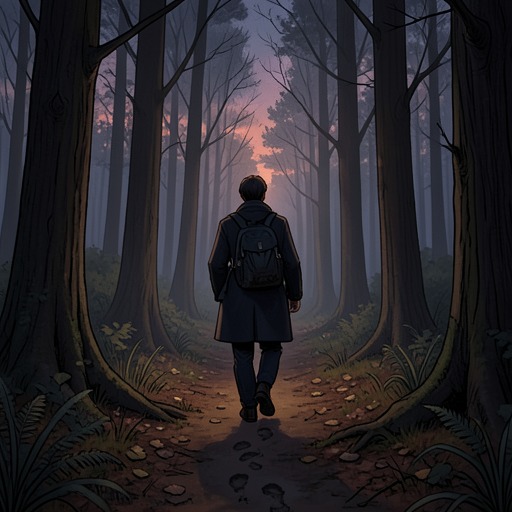
In 1984 the estate was still sparsely built, and a sizable wood bordered it across a wall about five feet high. The children who lived there could pass from the streets into a familiar landscape of trees and paths. The proximity made the wood part of ordinary childhood life rather than a remote wilderness: children often played there, and residents knew the route between their homes and the trees. Later, that easy boundary between estate and wood became charged with fear, investigation, and memories that the narrator could neither recover nor retain securely.
The site’s archaeological remains add another layer to the setting. The dig included trenches, a tower, a cottage, and a locked finds shed, with the wood adjoining the excavated ground. This combination of ancient remains, active archaeological work, nearby homes, and woodland gives Knocknaree several overlapping identities. It is at once a residential development, a place of historical interest, and a landscape that remains accessible to local people.
Childhood and the 1984 Disappearances
On Tuesday, 14 August 1984, Germaine Elinor Rowan, Adam Ryan, and Peter Joseph Savage, all twelve, spent the afternoon playing around the estate. Residents saw them at different times balancing along the end wall, riding their bicycles, and swinging on a tyre swing. Around three o’clock, they left their bicycles in the Savage family’s front garden and told Peter’s mother they were going into Knocknaree wood, where they often played. She asked Peter to be home by half past six for tea. A neighbor confirmed the conversation, and other witnesses saw the children climb over the wall and enter the trees.
The routine character of their departure makes the subsequent disappearance especially difficult to separate from the ordinary life of the estate. The children were not embarking on an unfamiliar expedition: they knew this part of the wood, and Peter’s mother had no reason to think they would get lost. For Adam, who grew up in Knocknaree, the place later became inseparable from the loss of his two friends and from a childhood he could not reliably remember. When he returned during the investigation, the estate’s streets seemed much like any others. He hesitated to visit Peter’s family because he feared they might recognize him before he could recognize them; his old address, 11 Knocknaree Way, returned only as something learned by rote.
The Estate and Katy Devlin’s Case
Years later, the missing-person procedures and local loyalties again brought Knocknaree into focus. Katy Devlin, twelve, was reported missing from her home in Knocknaree Grove at 10:15 the previous morning, after her mother found she had gone. Because she was twelve and appeared to have left of her own accord, Missing Persons initially allowed time for her to return before sending officers to search. A press release had already been prepared for the evening news. The episode also gives the estate a distinctive everyday geography: several streets share variations on the Knocknaree name, and residents’ mail is often misdirected.
During door-to-door inquiries, detectives found that the Devlins were generally regarded as decent but unusually private. In a small community, that reserve had been taken badly by some neighbors. Katy, however, was widely cherished. Her place at the Royal Ballet School had made her a source of local pride; residents, including people from poorer households, had attended the fundraiser, and many wanted to tell the detectives about her dancing. The warmth directed toward Katy contrasted with the suspicion and resentment some residents felt when asked about Jonathan Devlin’s Move the Motorway campaign. The estate’s social atmosphere therefore shapes the inquiry: local knowledge is plentiful, but it is entangled with pride, reserve, and political disagreement.
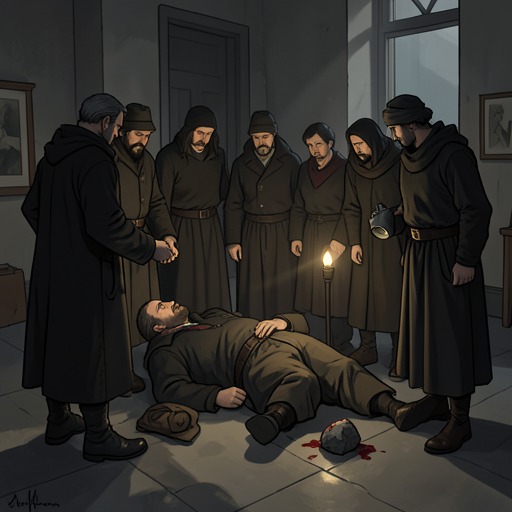
The archaeological site becomes crucial to the murder investigation. Investigators establish that a trowel has disappeared from the locked finds shed on the night Katy died. It belonged to Sean Callaghan, whose initials were burned into its handle, and he says he had forgotten it in the shed at half past five on Monday evening. The implement matches the description of the weapon used to sexually assault Katy, leading detectives to consider the shed a likely primary crime scene and the trowel a weapon of opportunity. The discovery shifts the investigation from general suspicion around the dig toward the specific relationship between its working spaces, tools, and access.
Damien Donnelly later describes walking to the dig by back lanes so he would not have to pass the estate. He went into the tools shed for gloves, picked up a rock from the ground at the edge of the dig, and entered the finds shed. He says that after Katy was there, he tried to move her toward the site but saw a light in the wood and became afraid of being noticed. His account links the residential routes, the cottage, the sheds, the excavated ground, and the adjacent trees in a single chain of movement. Rob Ryan arrests him on suspicion of murdering Katharine Devlin at Knocknaree on or around 17 August.
The Motorway and the Changing Site
Knocknaree’s next transformation begins with a plan announced in March 2000. The proposed motorway is marked by two parallel lines across Sam O’Neill’s detailed map, passing through both the wood and the archaeological dig. The government buys land from local farmers over the following year under a compulsory purchase order. The map makes the conflict legible as a line on a page, but its route cuts across a place already burdened with personal and historical significance.
Jonathan Devlin’s Move the Motorway campaign delays the project through injunctions and constitutional challenges, which may have reached the European High Court. Protesters calling themselves Knocknafree then camp at the site, holding up the bulldozers for several more weeks before the government obtains a court order against them. The resistance slows construction but cannot change the planned route. The novel leaves open whether Jonathan believes that public opinion could prevail or whether he felt obliged to struggle despite expecting defeat; either way, his campaign gives local opposition a visible form.
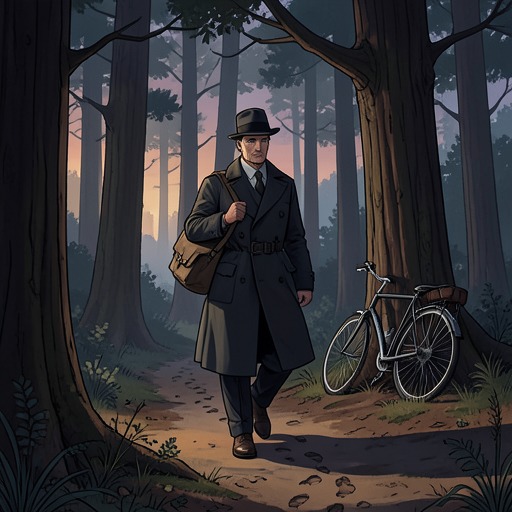
When construction begins, Rob Ryan returns to the site while supposed to be conducting a separate inquiry. The ground is already being torn up by bulldozers, and the remaining strip of wood is nearly gone. A small group of protesters holds signs in defense of heritage, while workers and machinery continue around them. Ryan’s memory briefly returns to the wood not as an enemy or a hiding place, but as a beloved childhood refuge: he recalls climbing the castle wall with Peter and Jamie nearby. The memory complicates the association that has dominated his adult understanding of Knocknaree. The wood had been frightening because of what happened there, but it had also been beautiful and familiar before that history eclipsed it.
Memory and Narrative Significance
Knocknaree matters not only because crimes occur there, but because its landscape organizes the novel’s account of memory. The estate appears ordinary enough to frustrate the narrator’s expectations: returning to his old road does not restore his childhood, and the sameness of its streets leaves him feeling at a disadvantage. His address survives as rote knowledge, while the people and places associated with his early life remain uncertain. The location thus holds traces of a past that its returning resident cannot simply retrieve by standing where it happened.
The destruction of the wood creates a further contrast between material change and unstable recollection. As construction removes the trees, a childhood image surfaces with unusual physical force; later, the narrator finds that memories recovered during the investigation have again become distant and alien to him. Knocknaree cannot guarantee that remembering will last. Its landscape can prompt a memory, but it cannot restore a settled identity or make the past fully available.
The novel also places development beside the loss of both heritage and living connection. The motorway proceeds along its original route after the campaign and protests have delayed it, and construction damages the archaeological site and removes nearly all of the wood. Children still return to the estate wall to balance while the work continues, echoing the play of the children from 1984. That recurrence does not undo what happened; it shows ordinary life continuing beside an altered landscape. Knocknaree’s significance lies in this unresolved coexistence: domestic routines, public ambitions, historical remains, childhood refuge, and traumatic memory occupy the same ground, while none can wholly displace the others.