Knocknaree archaeological site’s threatened status
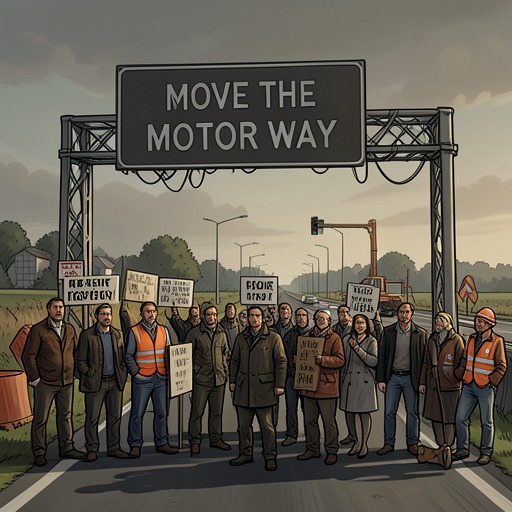
In the WoodsThe Knocknaree archaeological site’s threatened status makes the excavation a contest against a fixed construction deadline. With the motorway expected to begin work on Monday if the injunction is lifted, the archaeologists are left with a final week on the site. Their dwindling time gives the dig’s work a grim urgency, while the planned destruction hangs over the investigation taking place there.
The deadline and the excavation
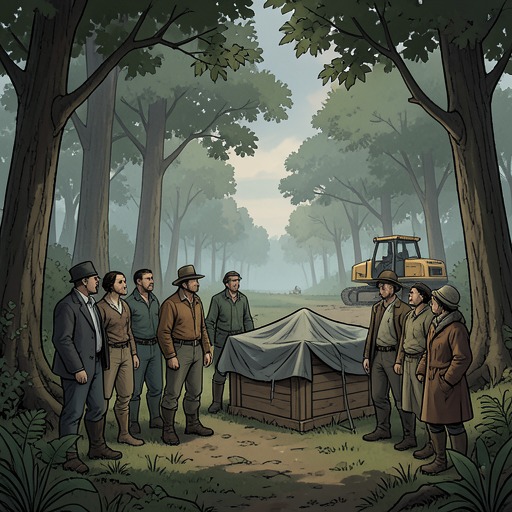
When Rob Ryan returns to the site, the archaeologists are working in silence at a punishing pace. The motorway contractors are due to start on Monday if the injunction is lifted, and this is the team’s last week. The approaching deadline is visible in the strain of the work: Mel pauses, grimacing and breathing hard, then gathers herself and lifts her mattock again. The excavation is not simply unfinished; its continuation is conditional on a legal obstacle that may soon disappear.
The threat shapes the archaeologists’ response when Rob asks Mark Hanly to bring the team into the canteen. Mark refuses to treat the police request as more important than the hours the team has left. He objects that even a spectacular discovery would not prevent the site from being levelled on Monday, and insists that the archaeologists have until half past five on Friday and will not leave before then. His anger gives the deadline a human face: the site is both a place of investigation and the object of work the team is trying to complete before construction can erase it.
Archaeology, publicity, and uncertainty
The site’s significance is also shaped by claims about its past. During the investigation into Katy Devlin’s death, a reporter presents a stone at the site as an ancient ceremonial altar and raises the possibility that Druids practised human sacrifice there. Another reporter asks whether Katy’s death was the work of a satanic cult. The police publicly reject that theory, stating that there is no evidence of a cult connection; the archaeological and religious claims do not establish how the girl died.
The distinction between the stone’s historical associations and evidence about the murder matters because the site attracts speculation as well as archaeological attention. A television report again links the stone with possible ancient sacrifice, while reporting the police denial of a religious-cult explanation for Katy’s death. In parallel, the investigation’s tip line receives a flood of calls, including religious denunciations of Katy and other unfounded claims. The press coverage and public response make Knocknaree a stage for competing stories, but neither sensational claims nor the site’s ancient associations amount to proof about the crime.
The site within the investigation
The excavation is also set beside the unresolved disappearance of Peter Savage and Jamie Rowan, two local children who vanished in 1984. News coverage invokes that earlier case while reporting Katy’s death, joining the site’s archaeological past to its more recent history of loss. Yet the cases do not thereby become one evidentiary narrative: as Rob considers the developing evidence, he concludes that Katy’s death almost certainly has no connection to what happened to Peter and Jamie that could be entered into evidence.
That separation sharpens the site’s role in the story. Knocknaree holds archaeological remains and memories of earlier violence, but those layers do not automatically explain the present crime. At the same time, the investigation unfolds under the prospect that motorway construction will transform the place before the archaeologists can finish their work. The site’s threatened status thus places two kinds of uncertainty side by side: what the investigation can establish about the deaths and disappearances, and what will remain of the ground in which those histories are embedded.