Knocknaree motorway construction and protests
In the WoodsKnocknaree motorway construction and protests mark the defeat of efforts to preserve the site and the near-destruction of the wood beside it. The road goes ahead along its original route despite injunctions, constitutional challenges and a protest camp; when Rob Ryan visits during construction, the scene forces him to remember the place not only as a shadow over his past but as a landscape he once loved.
Background and public attention
The development unfolds in a landscape already burdened with competing meanings. During the investigation into Katy Devlin’s death, reporters connect the body’s discovery at the Knocknaree altar stone with claims that ancient Druids may have practiced human sacrifice there. The police reject the suggestion of a religious cult, but the site’s archaeological history becomes part of the story told about it. A sensational frame gathers attention around the possibility of ritual violence, even though investigators say there is no evidence for that explanation.
The public response also shows how speculation can crowd the investigation. The murder hotline receives a record number of calls, many of them useless accusations or claims based on visions and moral judgments rather than verifiable information. This media climate does not cause the motorway dispute, but it places the archaeological site in a public arena where dramatic associations can eclipse what is actually known. The excavation and the threatened landscape are both made available to competing narratives: ancient mystery in the news, and development in the government’s plans.
Campaign and defeat
The Move the Motorway campaign delays construction for a considerable time through injunctions and constitutional challenges. Rob recalls that campaigners may have taken the fight as far as the European High Court, though he presents that recollection tentatively. The delays demonstrate that opposition can interrupt the project, but they do not alter its outcome: the motorway proceeds along the route originally planned.
A separate group calling itself Knocknafree establishes a camp on the site to obstruct the bulldozers. Rob supposes that Mark Hanly may have been among the protesters, but he does not claim certainty. Their presence holds up the work for several more weeks, until the government secures a court order against them. The episode draws a clear contrast between the protesters’ direct, physical presence and the institutional power that ultimately clears their way. However long the resistance lasts, it cannot stop construction.
The site under construction
Rob visits after seeing in the newspaper that construction has begun. He is meant to be going door to door in Terenure to ask about a stolen car used in a robbery, but leaves that assignment for about an hour. He does not describe the visit as a dramatic attempt at closure; instead, he recognizes it as a belated impulse to see the place once more. The detour makes the encounter personal without turning it into a resolution.
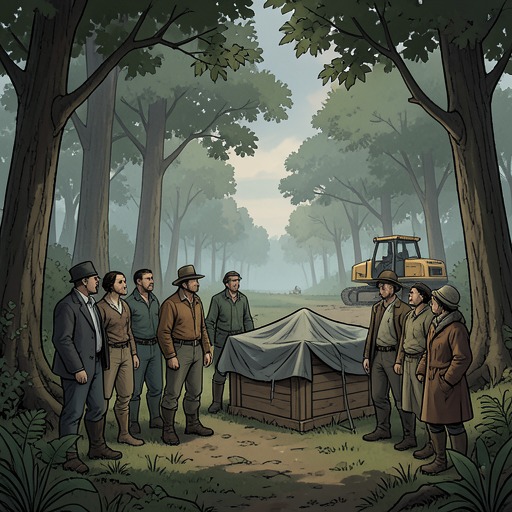
The site is far more extensively altered than he had expected. Machinery can be heard before he reaches the top of the hill, and the archaeological excavation has become a work zone occupied by workers in protective clothing and bulldozers shifting earth around the remains of walls. A small group of protesters stands by the roadside with handwritten heritage signs, hoping the media might return. Their appeals remain visible against the scale of the work, but the construction has already transformed the scene into something Rob barely recognizes.
The change is clearest in the wood. The raw earth seems to stretch beyond the former limits of the dig, and Rob realizes that the last strip of trees is almost gone. Trunks have been cut, roots exposed, and chainsaws are working on what remains. The description makes the loss gradual and material: not a single dramatic destruction, but the progressive removal of the landscape as the project advances. The protesters’ signs and the active machinery occupy the same roadside view, yet only one of them determines what happens to the site.
Memory and aftermath
Seeing the trees being cut down brings back a childhood scene. Rob remembers climbing a castle wall with Peter Savage and Jamie Rowan nearby: Peter’s runner searching for a foothold, Jamie’s blond hair visible among the leaves, and the familiar physical effort of climbing. The recollection revises the emotional meaning the wood has acquired for him. He had become accustomed to treating it as an enemy, the dark presence over concealed parts of his memory; now he recognizes that it had also been an easy playground and a beloved refuge. Its destruction reveals a beauty he had not fully acknowledged while the place still stood.
The visit does not reverse the project or restore the landscape. Rob watches the remaining work while two young children briefly balance on their stomachs across the estate wall; workers wave and shout until they disappear, but they return a minute or two later. Nearby, protesters open umbrellas and share sandwiches. Rob stays until his mobile vibrates repeatedly and the rain intensifies, then puts out his cigarette, buttons his coat and returns to the car. The small persistence of the children and protesters contrasts with the machinery’s continuing advance, but the ending offers no suggestion that their presence can halt it.
The motorway’s completion and the wood’s removal give the event its double consequence. The campaign succeeds in delaying construction but not in changing the route, while Rob’s last visit restores a more complicated memory of the place just as its physical form is being erased. The threatened landscape is therefore both a public heritage site and a private childhood refuge: its loss belongs to the development conflict, but it also exposes what Rob’s trauma had left out of his own account of the past.