Knocknaree site damaged by road construction
In the WoodsThe state of the Knocknaree archaeological site after motorway construction is not simply a matter of excavation giving way to development: it is the physical end of a landscape that had held archaeological remains, public controversy, and Rob Ryan’s childhood memories. The route proceeds despite legal challenges and protest. When Rob returns, the machinery has made the site unrecognizable, and the last strip of wood is nearly gone. That destruction forces him to remember what his investigation had obscured: the wood had been not only a source of fear and secrecy, but also a playground and refuge he had loved.
From contested site to construction ground
The Knocknaree archaeological site had already become a focus of public attention through the discovery of Katy Devlin’s body. Reporting linked the Knocknaree altar stone to claims that the Druids may have used it for human sacrifice, while the police stated that there was no evidence that Katy’s death involved a religious cult. A tabloid reporter pressed the possibility of a satanic connection at the site; Rob rejected it as unsupported. The altar’s association with ancient ritual thus circulated beside the investigation as a sensational explanation, even as the available evidence did not sustain it.
The construction damage follows a different kind of public contest. The Move the Motorway campaign delayed the planned route through injunctions and constitutional challenges, which Rob thinks may have reached the European High Court. Protesters calling themselves Knocknafree then camped at the site to oppose the bulldozers. The government obtained a court order against them, and their presence held up construction for only a few more weeks. The motorway nevertheless went ahead along its original route. The sequence makes the limits of opposition concrete: litigation and direct protest can impose delay, but in this case they do not prevent the development or preserve the site.
The site under the machinery
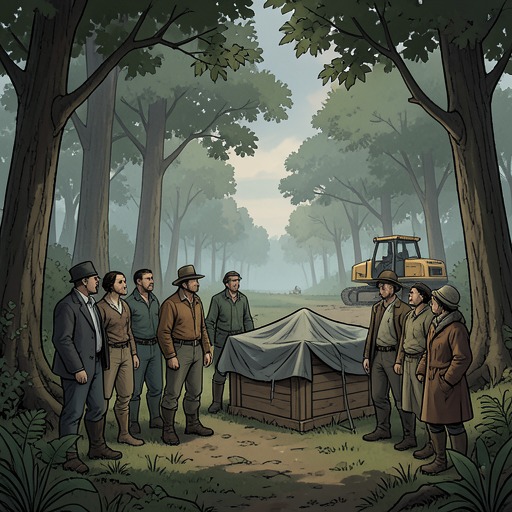
Rob learns in a newspaper that construction has begun and goes to see the place again, although he is meant to be canvassing in Terenure for witnesses to a stolen car used in a robbery. He does not describe the visit as a final attempt at closure; it is a belated impulse to see the site once more. The scale of what he finds exceeds his expectations. Machinery can be heard before he reaches the hill, and bulldozers move earth around the excavated remnants of walls while workers in protective clothing call to one another over the noise.
At the roadside, a small group of protesters stands on ground that is still untouched. Their hand-lettered signs appeal to heritage and history, but the view beyond them is dominated by churned earth. Rob takes time to understand why the site seems larger than the dig he remembers: almost all of the last strip of wood has disappeared. Pale trunks and exposed roots remain, and chainsaws are at work on the few trees still standing. The damage is therefore not confined to the archaeological remains. Construction is also removing the wooded landscape that had bordered and shaped Rob’s experience of the place.
A return of childhood memory
The sight of the destruction brings back a specific memory of climbing a castle wall with Peter and Jamie. He recalls the other boys’ positions as they climbed, the movement of Jamie’s hair among the leaves, and his own practiced effort against the stone. The remembered scene contrasts sharply with his previous understanding of the wood as an enemy, a shadow over concealed parts of his past. He had become so accustomed to that threatening image that he had forgotten the place’s other history in his life: it had been an easy playground and a refuge shared with his friends.
The memory changes the meaning of the construction scene without reversing its outcome. Seeing the trees cut down makes the wood’s beauty newly legible to Rob, but that recognition arrives as the landscape is being dismantled. His recovered affection does not restore the place, and the remembered climb cannot protect the remaining trees. The contrast gives the damage a personal dimension: the destroyed site is also a lost childhood setting, whose value becomes vivid to him at the moment its physical survival is nearly over.
Protest, repetition, and an unfinished ending
Rob stays at the roadside after speaking with a construction worker and lending him a lighter. He lights a cigarette and watches the work continue; the metal object he has been carrying has left slender red marks across his palm. Two children, perhaps eight or nine, balance on their stomachs across the estate wall. Workers wave and shout until the children disappear, but they return a minute or two later. Nearby, the protesters raise umbrellas and share sandwiches. The small acts of watching, returning, and remaining form a subdued counterpoint to the machinery, but the scene gives no indication that they can stop it.
Rob waits until his mobile vibrates insistently and the rain grows heavier, then puts out his cigarette, buttons his coat, and goes back to his car. The ending offers neither a victory for the protesters nor a decisive personal resolution. The motorway project continues, the site has been transformed, and Rob leaves after witnessing it. What changes is his apprehension of the place: the destruction brings back a memory of affection that had been buried beneath the wood’s association with trauma and uncertainty. The damaged landscape thus stands at once as the consequence of a development project and as the material trigger for a belated recognition of what Rob has lost.