Memory and identity
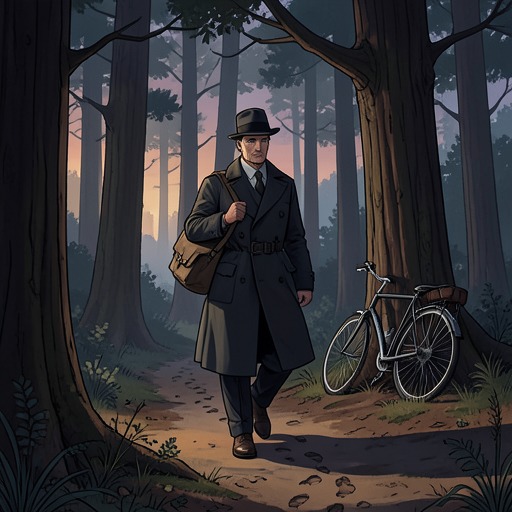
In the WoodsMemory and identity are bound together in Rob Ryan’s story by a childhood he cannot reliably remember and a past he deliberately keeps hidden. His changing access to Knocknaree does not restore a stable account of who he was: recovered scenes offer partial knowledge, intensify uncertainty about his place in the events, and eventually fade, leaving only one enduring memory of childhood friendship.
Childhood Loss and Adult Identity
After the events in Knocknaree wood, Ryan’s memory of his early life was largely absent. During the first weeks of questioning, he recalls his attention giving way to an empty mental scene; repeated interviews brought back the fear of that blankness, but not information that could answer the investigators’ questions. They returned over the years, first during school holidays and later less often, before eventually stopping. The absence became part of his sense of himself: he had learned to regard the first twelve years of his life as effectively gone.
At boarding school, he stopped using Adam and began using his middle name, Rob. The change helped distance him from the publicity surrounding the missing children and made it less likely that anyone would connect the adult detective, with his English accent, to Adam Ryan of Knocknaree. His name thus became a practical boundary between his public identity and a childhood he could neither explain nor remember.
That boundary also shaped his professional choices. Once a case seemed connected to the events in Knocknaree, Ryan knew that disclosure to O'Kelly could remove him from the investigation because of the rule against working on a case involving a personal emotional conflict. It could also expose him to renewed questioning. He told himself that revealing his history would not help the case, but later recognized that secrecy had appealed to his ego and to the image of the enigmatic detective he wanted to embody. His silence was therefore not only protection from a painful past; it was also a chosen part of his adult self-image.
The Return of Fragmented Memories
The Katy Devlin case prompted Ryan to try, for the first time in earnest, to recover what had happened in the wood. On sleepless nights when he was not staying with Cassie Maddox, he took long walks through the city, sometimes coming to himself in unfamiliar places without knowing how he had arrived. He describes the process as gradual: images surfaced in rapid succession, and he learned to hold onto individual fragments long enough for them to take shape.
The returning scenes were not all directly connected to the disappearance. They included his parents taking the children to buy First Communion clothes, Peter and Jamie laughing at Jamie’s formal outfit, and an old school desk bearing years of marks and a dated inscription. Another recollection concerned Mad Mick, a local man whose story Peter had told the children. These ordinary and secondhand elements mattered to Ryan because even small pieces of a childhood he had assumed was lost seemed newly significant. Their emotional force, however, did not establish how each fragment had entered his mind or whether it was complete.
A later memory returned with exceptional force during the night. Ryan remembered himself, Peter, and Jamie approaching a clearing and seeing Sandra Scully being attacked by three boys. The recovery connected his lost childhood to a violent event, but it did not give him a full or straightforward account of the past. The memories arrived in fragments, while his experience of recalling them remained distinct from the events themselves.
Memory, Evidence, and Complicity
Ryan’s history makes recovered memory both a source of knowledge and a source of doubt. He had encountered extensive publicity about the disappearances as a child and had furtively read relevant newspaper coverage. Much later, while the investigation was underway, he also reasoned from facts such as his age and the blood in his shoes. These circumstances complicate any simple division between remembered experience, information encountered later, and conclusions drawn in the present. The vividness of a returning scene cannot, by itself, settle its accuracy or completeness.
The cost of concealment became clear when O'Kelly confronted Ryan about withholding his connection to the old case. Ryan had not considered that he might be treated as a suspect in Peter and Jamie’s disappearance. Once O'Kelly set out the possible consequences, Ryan recognized that his role as lead detective could undermine the investigation in court: he was also an eyewitness and a survivor of an unsolved related case, and the defense could challenge his impartiality or point to the withheld information. He also realized that this could affect cases he had previously investigated. His private story of courageous independence collapsed into the recognition that his decision had been reckless and damaging.
The Memories Fade
After the investigation, during months spent largely alone in his apartment, Ryan’s thoughts returned to Knocknaree despite his resolve not to dwell on it. He then found that the memories he had recovered had disappeared again. Peter, Jamie, the boys involved in the attack, Sandra Scully, and the wood itself seemed remote, like scenes from films or stories rather than experiences that belonged to him. He expected even those distant images to fade further and felt that their loss reflected something he had forfeited.
One memory remained. Ryan recalls a summer afternoon with Peter in Peter’s front garden, where the two boys tried unsuccessfully to make a periscope from newspaper because they did not have the cardboard tube the instructions required. Unlike the other fragments, this scene stayed clear and warm. It preserves no explanation of the disappearance and does not repair Ryan’s larger break with his past; its importance lies in being a moment of friendship that still feels unmistakably his.
Significance
The movement of Ryan’s memories is not a progression from ignorance to complete recovery. Fragments surface during the Katy Devlin investigation, briefly allowing him to connect his adult life with childhood events, but they remain vulnerable to gaps, later knowledge, and interpretation. Their subsequent disappearance makes the distinction between remembering an event and remembering having once recalled it central to his sense of identity.
The last surviving image is strikingly modest: an imperfect homemade periscope and a shared afternoon with Peter. Against the recovered memory of violence and the professional consequences of secrecy, this ordinary scene offers no final solution. It is instead a limited point of continuity—a childhood moment Ryan can still claim as his own even when almost everything surrounding it has receded.