Move the Motorway campaign
In the WoodsThe Move the Motorway campaign is a Knocknaree local organization founded and chaired by Jonathan Devlin to oppose a proposed motorway route through the archaeological site. Its public campaign for the site’s protection becomes entangled with a land-development dispute and threats against the Devlin family, making it both a civic protest and a consequential lead in the investigation of Katy Devlin’s death.
Purpose and local setting
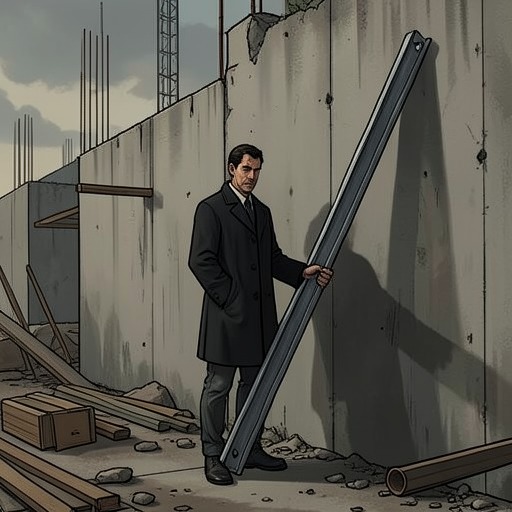
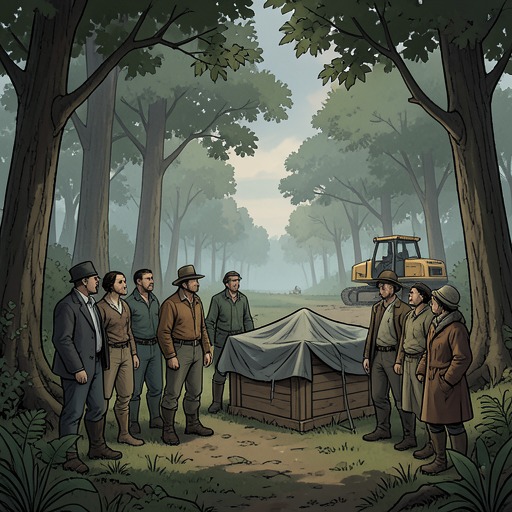
Jonathan describes the proposed road as a threat to a site that should be protected as a heritage site. He says it is unique and belongs to the local community, and objects that the government is prepared to destroy it without asking residents. The campaign’s name gives its immediate demand: move the motorway away from Knocknaree rather than accept the chosen route.
The community is not presented as unanimous. Jonathan says most local people oppose the route, while some are more interested in the rise in house values they expect if the road passes near the estate. This division places the campaign between two kinds of anticipated change: the loss of a valued archaeological landscape and the prospect of private gains from improved access. Jonathan says the campaign pickets government buildings and writes to politicians, although he considers those efforts largely ineffective.
Jonathan Devlin’s leadership and the threats
Jonathan is the campaign’s founder and chairman. At first, his manner gives the investigators little reason to expect that he leads a sustained public campaign; as he talks about it, however, his distress steadies and his commitment becomes clearer. His role gives him a public position in the dispute, but also makes his family a target of anonymous intimidation.
Jonathan recounts a late-April call from a man who insulted him and accused him of not understanding what he was interfering with. He initially thought it was a wrong number. On 3 June, at about half past one in the morning, another caller asked Katy whether she was Devlin’s daughter and told her to make her father back off the motorway, adding that the caller knew where the family lived. Jonathan took the telephone from Katy and heard a further menacing remark about her. He describes the voice as that of an older man with a country accent, though he could not identify a region or recognize the speaker.
Jonathan says Katy was a light sleeper and reached the hall telephone before him. The threat therefore did not remain an abstract warning to the campaign’s chairman: it reached his daughter directly. When investigators ask about the calls, Jonathan wants them to find out who made them and whether the caller had anything to do with Katy’s death. The investigation briefing refers to three anonymous calls over the preceding months, while Jonathan’s account supplies details of the first two. The evidence raises a connection to investigate, not proof that the caller was involved in the murder.
The route and the value of land
Sam O’Neill’s investigation of land ownership gives the campaign’s opposition a concrete economic context. The motorway plans were announced in March 2000, and the government bought land from local farmers during the following year under compulsory purchase orders. Sam says three companies came to own almost all the land around the relevant stretch by the time of the announcement. Their acquisitions, made through other names, could ultimately be traced back to those companies.
Four farmers held out after receiving offers above the ordinary agricultural value of their land. They suspected that the buyers anticipated a change in the area’s prospects once the motorway made Knocknaree more accessible. The farmers sought rezoning themselves, hoping to benefit from the land’s potential for industrial and residential development, but the county council rejected their applications repeatedly. One farmer, Maurice Cleary, applied four times. He eventually sold after a representative of a holding company warned that a proposed pharmaceutical plant beside his farm might allow chemical waste to seep into the water and poison his cattle. Sam cannot establish whether that warning was intended as a threat, but reports that Cleary sold anyway.
After the major landholders acquired the land, they applied for rezoning and obtained it. Sam suspects that the companies had influence over the county council, but the account does not establish a specific payment or prove that any official acted corruptly. The potential financial stakes are clearer: the campaign wanted the route shifted roughly two miles or more from the chosen corridor, while Sam’s inquiries with estate agents suggested that industrial land beside a motorway could be worth up to twice as much as comparable land three miles away. He estimates that the difference could amount to millions. The route thus connects infrastructure planning to land acquisition, planning decisions, and sharply different possible returns.
The campaign as an investigative lead
After Katy’s body is found at the archaeological site, the investigation treats the campaign and its opponents as one of several lines of inquiry. Cassie Maddox tells her colleagues that Jonathan’s activism has angered people and that investigators need to determine who has a serious stake in the motorway passing through Knocknaree. O’Kelly immediately recognizes that this inquiry would involve property developers and county councils. The campaign’s local protest has become relevant to a murder investigation because the threats name the motorway and reach the Devlin household.
Jonathan initially interprets a threatening call as evidence that the campaign is beginning to matter: whoever called, he thinks, would not have bothered unless the protest posed a real threat. That reaction changes after Katy’s death. His confidence that the campaign can unsettle powerful interests sits beside his demand that police identify the caller and determine whether the threats relate to the killing. The contrast shows the cost of political attention when intimidation crosses from a public dispute into family life.
Protest, loss, and limits
The campaign’s significance is also measured against the people and place it seeks to defend. During questioning, Cassie Maddox recalls Peter Savage as a child who might have led the campaign alongside Jonathan had he lived. She points to the enduring absence left by Peter and Germaine Rowan, whose families have preserved their memories and continued to live with the possibility that the children might return. Her comparison links Jonathan’s present fight over Knocknaree to a history of loss in the same community, without suggesting that the campaign could have prevented or resolved that earlier disappearance.
The archaeological team’s resistance to police demands further conveys what the site means to those working there. Mark Hanly, who says he has spent half the year working for the campaign, protests that the road will level the place and asks to be left in peace during the remaining days before construction. His anger reflects both the practical urgency of the impending destruction and the workers’ attachment to their work. The campaign’s efforts, however, do not stop the project in the evidence presented: the proposed route remains a threat to the site, and the police investigate its political and financial context without establishing that the campaign’s opponents caused Katy’s death. Its importance rests in the collision it exposes between heritage, public infrastructure, local protest, and private land value.