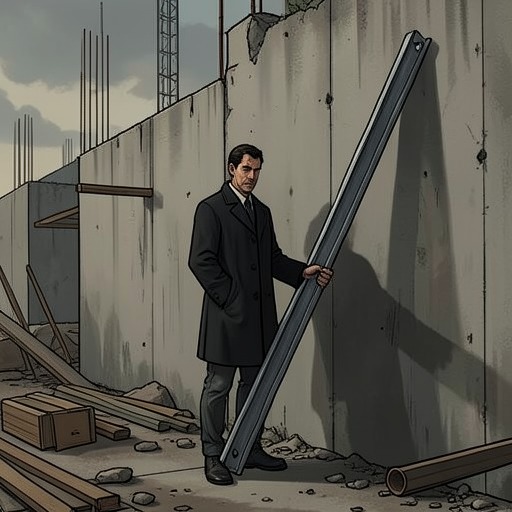
O'Kelly
In the WoodsSuperintendent O'Kelly is the hard-edged commander of the murder investigation in Knocknaree, a figure whose authority is felt in clipped orders, long hours, and the pressure to produce a confession. He is not simply an obstacle to the detectives: he assigns their work, weighs risks to the case, and ultimately recognizes Cassie Maddox's sound judgment. Yet his command is abrasive and sometimes contradictory, especially when loyalty, evidence, and the institution's reputation collide.
Identity and Supervisory Style
O'Kelly is the superintendent who directs Rob Ryan and Cassie Maddox after they are pulled from another investigation to take on the killing of a young woman in Knocknaree. When Cassie objects that her team is already occupied, he dismisses the objection: a day out of the city had seemed acceptable, so he insists they can take on a serious murder inquiry as well. His response establishes both his authority and his impatience with what he sees as selective limits on the detectives' time.
His manner toward Cassie is sharpened by a set of prejudices that Rob identifies as predictable: her sex, clothes, age, and record of notable police work. Rob's account suggests that the predictability itself is particularly frustrating to Cassie. O'Kelly's irritation is not confined to her, however. He speaks contemptuously of Dr. Cooper when the post-mortem cannot be completed until the following morning, even though Cooper has been called to court. The two men dislike one another, and O'Kelly's demand for priority meets Cooper's refusal to treat his cases as the only matters requiring attention.
O'Kelly's authority is reinforced by the small, controlled details of his office. There is only one chair for visitors, a faux-leather ergonomic seat that Rob reads as a signal not to take up much of the superintendent's space or time. During a briefing, O'Kelly makes clear that he has somewhere to be at eight and tells the detectives to be quick. His brusqueness is personal as well as institutional: after his wife left him the year before, his attempts at dating became office gossip, including a notably unsuccessful blind date with a former sex worker he had repeatedly arrested while working in vice.
Directing the Knocknaree Investigation
O'Kelly expects the investigation to proceed on several fronts. When Cassie reports that the victim was struck on the head and asphyxiated, with sexual assault still a possibility pending the post-mortem, he reacts angrily to the delay and tells her to press Cooper. Cassie explains that she has already done so and then begins outlining the lines of inquiry. O'Kelly accepts the briefing, rummages for a pen, and listens as the detectives work through their plan.
He also decides who should help them. Rob argues that Sam O'Neill's contacts in local circles would be valuable if the detectives were to investigate county-council business without making unnecessary waves. O'Kelly weighs the advantages and risks, then authorizes Sam's involvement with a warning that the job must be done without antagonizing anyone. He requires written reports every morning. The order shows the method behind his bluntness: he permits an approach he has reservations about, but attaches oversight and a clear expectation of progress.
The investigation's punishing schedule is part of O'Kelly's command. The detectives are officially assigned a nine-to-five shift, yet they arrive before eight, often remain past eight in the evening, take paperwork home, and continue discussing the case late into the night. Their meals are pushed to nine or ten, and exhaustion and caffeine become routine. On a Friday, a new temporary worker assumes he will return on Monday and receives the team's sardonic response; O'Kelly corrects him by making clear that he is expected at eight the next morning. The long hours are not an incidental backdrop but the working tempo the superintendent imposes on the case.
O'Kelly also manages the investigation's public presentation. After a television report links the area's ancient altar stone with possible human sacrifice, he appears before a police backdrop and delivers the detectives' reasons for rejecting a cult explanation. The list includes the absence of ritual positioning and slaughtered livestock. The televised briefing turns the team's negative findings into a public response to sensational speculation, and O'Kelly is the senior officer who presents that response.
Authority, Evidence, and Institutional Risk
O'Kelly's control is most complicated when Sam reports that his uncle has ordered him to erase a phone-tap recording, end surveillance of Terry Andrews, and leave Andrews alone. The uncle argues that Sam has no evidence connecting Andrews to the murder and warns that continuing could eventually cost both men their positions. He also insists that the conversation and tape should be treated as if they never existed. Sam understands the demand as an attempt at concealment, though the account leaves O'Kelly's own motive unresolved.
Later, O'Kelly asks Sam what he intends to do about the Andrews matter. Sam says he will drop it, and O'Kelly accepts that answer. He also docks Cassie five days of holiday. The sequence places professional discipline beside the unsettled question of institutional pressure: O'Kelly demands that the matter be dropped, while the consequences of pursuing it have already been made explicit. The available account does not establish that he ordered the original destruction of evidence, and his role is best understood through what he asks Sam to do and the penalty he imposes on Cassie.
O'Kelly's concern with the integrity of the main murder case becomes unmistakable when he confronts Rob about hiding his connection to an earlier unsolved case. He summons Rob by telephone, a signal that a serious reprimand is coming, and challenges him for not disclosing the connection. He lays out the damage a defense lawyer could inflict: Rob is the lead detective, the sole eyewitness, and the only surviving victim in a related unsolved case. That combination could make him appear biased or even place him under suspicion, while media attention might eclipse the accused and the case itself. O'Kelly's anger is severe, but its substance is procedural. Rob's silence has created a vulnerability that could compromise the investigation at trial.
The Suspects and Cassie's Assessment
As the investigation narrows, O'Kelly presides over the shift from competing suspects to an interview strategy. Once Sean Callaghan is eliminated, the team compares Ian Hunt, Mark Hanly, and Damien Donnelly. Hunt's account is supported by his wife, television listings, and a neighbor who recalls hearing him complain about a barking dog on the night in question. Mark has admitted being at the scene, while Damien appears to fit the suspected pattern of the crime. O'Kelly asks the team to weigh the remaining possibilities, then assigns Rob and Cassie to question Damien, sends Sam to pursue Mark, and directs other officers to check Hunt and the alibi witnesses. His demand is not merely to make an arrest but to obtain a confession.
O'Kelly initially resists Cassie's claim that Rosalind Devlin fits the clinical description of a psychopath. He treats the term as sensational shorthand and challenges her to explain what she means. Cassie gives a list of traits, including lack of conscience and empathy, pathological lying, manipulation, charm, attention-seeking, and a tendency to become nasty when thwarted. She distinguishes this description from mental illness, saying Rosalind is sane and that the label would not provide an insanity defense. These are Cassie's assessment and interpretation, not a formal diagnosis established in the account.
Cassie explains that she began to suspect Rosalind during their first meeting but did not think the suspicion relevant then: the killer did not appear to fit that profile, and Rosalind had a perfect alibi. She also questions whether Rob would have believed her. When O'Kelly proposes frightening Rosalind into confessing, Cassie argues that the tactic will fail because, in her view, a psychopath is unlikely to respond with fear. She says Rosalind would be more likely to exploit Rob's usefulness to her than to confess to him, whereas Cassie's hostility makes her a more promising person to speak with. O'Kelly agrees to a covert conversation, initially proposing a voice-activated recorder; Cassie insists on a transmitter sending to a nearby backup van.
Change and Narrative Role
O'Kelly's later response complicates his earlier skepticism. After Cassie's encounter with Rosalind, he acknowledges that Cassie was right about her. He asks whether Rosalind truly believes that making her sister ill was for the sister's own good. Cassie answers that Rosalind does not organize the world around truth and falsehood, but around what suits her. O'Kelly does not independently establish that analysis, but his question and acknowledgment show that he has come to take Cassie's reading seriously, even as he retains his blunt, mocking manner.
Across the investigation, O'Kelly embodies the pressure of police command: he demands speed, manages personnel, controls public messaging, and worries about what a defense lawyer or institutional scandal could do to a case. His abrasive conduct toward Cassie and his handling of the Andrews affair prevent that authority from appearing uncomplicated. At the same time, his assignments and later concession show that he can revise his view when the investigation gives him reason to do so. He is a source of friction, but also the supervisor whose decisions keep the inquiry moving and whose insistence on defensible procedure makes Rob's concealment impossible to treat as a private matter.