Operation Vestal
In the WoodsOperation Vestal is the investigation into Katy Devlin’s death, a case whose apparent lack of direction conceals a pattern of family manipulation and whose investigation briefly reopens Rob Ryan’s buried connection to Knocknaree. Led by Rob and Cassie Maddox, the operation expands rapidly across the estate and its surrounding area. Its early work produces more noise than answers; only later do the small, disconnected details begin to align, even as Rob’s own recovered memories eventually disappear again.
Launch and investigative scope
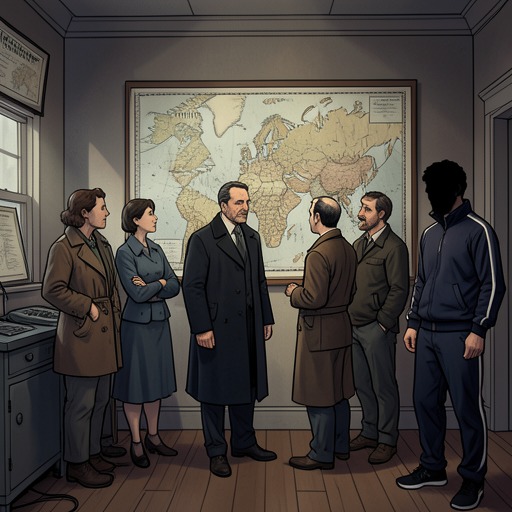
The operation begins with a briefing for a large team of detectives and other personnel. O’Kelly announces the headquarters-assigned name, Operation Vestal, whose reference to an ancient sacrificial figure sits uneasily beside the facts of the case. Rob and Cassie recognize the name’s possible ritual associations, while O’Kelly objects that it may encourage people to imagine a cult motive. The exchange establishes a tension that persists through the investigation: the imagery surrounding Katy’s death can invite dramatic explanations, but the team must work from evidence.
Cassie gives the team an account of the case but minimizes the possible connection to the 1984 disappearances, presenting it as a remote possibility she can investigate in spare time. The detectives divide up extensive practical work. They plan door-to-door inquiries across the estate, establish a public tip line, seek information on sex offenders near Knocknaree, check with British police and transport authorities for suspicious recent arrivals in Ireland, and obtain Katy’s medical and school records alongside full background checks on the Devlin family. Rob, Cassie, and Sam O’Neill leave the team to carry out those assignments and go to see Dr. Cooper.
The circumstances at the Devlin home shape the initial search. Katy had not been taken from her bed: she had put on outdoor clothes after her parents were asleep and left on her own, carrying her house key because she expected to return. The detectives search the bedroom she shared with Jessica Devlin, considering both clues to where Katy might have gone and the possibility that a family member could have staged her departure. The room’s contrasting displays—Jessica’s idealized art and Katy’s ballet pictures, including her Royal Ballet School acceptance letter—offer a concrete view of the sisters’ different interests, but no immediate explanation of Katy’s death.
An expansive search and a stalled case
During the first two weeks, the team and local officers speak with everyone living within four miles of Knocknaree and with people who had known Katy. They check the Devlins’ Mass cards and trace people who contributed to Katy’s fees; they also monitor who leaves flowers at the altar stone. Investigators interview Katy’s friends, including Christina Murphy, Elisabeth McGinnis, and Marianne Casey. The girls are upset but have no useful information about the death. Their concerns about Jessica’s possible learning disability and their questions about whether a sexual offender was responsible broaden the inquiry without resolving it.
The tip line brings an exceptionally large volume of calls, many irrelevant or founded on prejudice, speculation, or claims of visions. Investigators follow up even when the callers’ theories appear implausible. They also examine convicted sex offenders in south Dublin and people suspected of online predatory behavior but never convicted. Cassie’s initial sense that the crime did not fit a sexual motive does not spare the team from checking these possibilities; it remains one hypothesis among several, not a substitute for investigation.
The work is exhaustive but, in the investigators’ own retrospective account, initially goes nowhere. Leads end in dead ends, public pressure mounts, and O’Kelly urges the team not to give up. Newspapers demand justice and circulate imagined likenesses of Peter Savage and Jamie Rowan as adults, drawing the old disappearances into public attention as well as the investigation’s wider atmosphere. Rob remembers this period as a sequence of fragments—faces, phrases, rooms, and calls—that seemed disconnected at the time. Hindsight makes those fragments appear ordered, but that later clarity does not remove the strain and uncertainty of the initial search.
Medical and family evidence
Katy’s medical records provide one of the investigation’s most consequential leads. She had been healthy apart from ordinary childhood illnesses until she was eight and a half, when severe bouts of stomach illness began. After a particularly bad episode, exploratory surgery led to a diagnosis of idiopathic pseudo-obstructive bowel disease with atypical lack of distension. The diagnosis named the condition but did not explain its cause. Rob raises the possibility that someone might have induced or exaggerated Katy’s illness, but Cassie notes that the available information does not fit a straightforward pattern of a parent seeking attention through medical care: Margaret Devlin had no medical background, and other family members, including Jonathan and Rosalind, had sometimes taken Katy to hospital.
The records therefore open a question rather than settle one. In retrospect, that distinction matters: a plausible suspicion is not yet a proven account of what happened. The team’s investigation later uncovers Katy’s diary, which records Rosalind pressuring her to take something that Katy believed made her ill and linking it to her ability to dance. Katy also writes of being frightened by Rosalind’s anger and of losing contact with friends after Rosalind attributed hostile remarks to her. The diary gives the medical pattern a personal context and points toward deliberate interference with Katy’s ballet ambitions.
Interrogation and the limits of confession
The investigation’s interview with Damien Donnelly produces an admission, but not a complete or reliable explanation. Cassie describes her longstanding view that the killer was someone who did not want to kill and was not naturally violent. The detectives use that theory to encourage Damien to see confession as a way out of continuing fear. After Rob asks whether their description sounds familiar, Damien gives a small nod. In the subsequent account of the killing, he says that Katy arrived earlier than expected, brought chocolate biscuits, and spoke briefly about ballet school before he directed her attention toward a shelf and struck her with a rock.
That admission does not resolve the whole case. Damien’s account omits evidence concerning an archaeological trowel found in a toolshed. Rob confronts him with the post-mortem findings and the newly located tool, indicating that Katy had suffered an additional assault after her death. Damien breaks down rather than offering an explanation that accounts for the evidence. The scene thus distinguishes his admission to killing Katy from a full disclosure of the events and motive: the interview yields important information, but his version remains incomplete.
Damien also describes Rosalind as someone he loved and believed had entrusted him with a secret. He says she had portrayed herself as being mistreated at home and had refused to leave Jessica behind, even when he proposed that they move away together. He presents her refusal as an act of courage and explains that she feared intimacy because of her past. These claims help explain Damien’s emotional investment in Rosalind, but they do not establish that his account of her family life is true. The investigation supplies counterevidence: the records contradict key claims he repeats, and Katy’s diary provides a different account of Rosalind’s treatment of her.
Revelations and retrospective cost
The later evidence changes the meaning of the early medical clue. In a recorded exchange during the investigation, Rosalind says that she wanted to stop Katy from becoming too self-important and resented the attention she received for ballet. She admits that she had tried to stop Katy dancing by making her sick. Katy’s diary independently records Rosalind insisting that she take something despite Katy’s suspicion that it caused her illness. Together, the confession and diary connect the recurring illness to Rosalind’s efforts to control Katy’s choices and attention.
Operation Vestal also has a consequence for Rob that reaches beyond the solved details of Katy’s death. During the investigation, memories associated with Knocknaree return to him, including people and events from his childhood. Months later, while alone in his apartment, he finds that nearly all of those recovered memories have vanished again. Peter, Jamie, the wood, and the other scenes he had struggled to remember now feel distant and secondhand; only one image of himself and Peter remains. The operation therefore brings Rob closer to the history he had lost without restoring it permanently.
As an account of police work, Operation Vestal moves from broad canvassing and competing hypotheses toward the more intimate evidence of medical records, a diary, and interviews. As a narrated event, it is also shaped by belated understanding: Rob acknowledges that the clues only formed a pattern later, and his own connection to the 1984 events is initially held at a distance. The investigation’s early frustration is not simply an interval before the answer. It is the condition under which evidence accumulates, while the cost of that accumulation falls on Katy’s family, the detectives, and Rob’s unstable access to his own past.