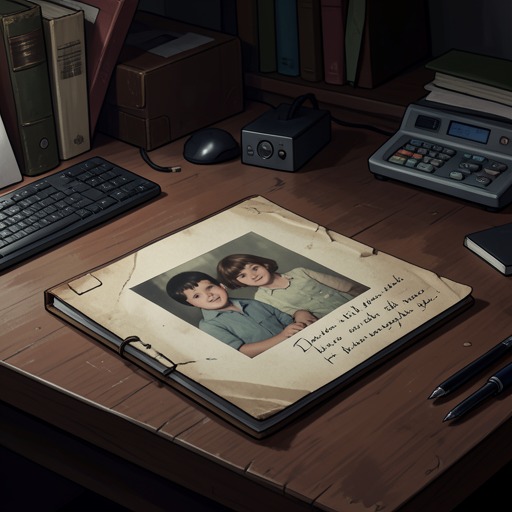
Peter Savage and Germaine Rowan disappearance case
In the WoodsPeter Savage and Germaine Rowan disappeared from Knocknaree in 1984, leaving their families without the certainty of death or the possibility of a settled farewell. Their disappearance becomes more than a parallel tragedy in the investigation of Katy Devlin’s murder: forensic evidence connects the cases, while the long absence of Peter and Germaine exposes what it means for a community to be unable to close a loss. The case is recalled through Rob Ryan’s uncertain memories of the wood and through the investigators’ reconstruction of what happened there; its central fact remains an absence that has endured for decades.
Background and Disappearance
A few days after the rape of Sandra Scully, Peter and Germaine vanished. In Knocknaree wood, Rob’s recovered recollections place the children’s earlier play among faint trails, a twisted apple tree, and small clearings. He remembers that he and the others watched Jonathan Devlin and his friends assault Sandra. He cannot fix the exact place where Peter and Germaine disappeared: perhaps it was where he stood, perhaps somewhere nearby. The wood returns not as a map that resolves the event, but as a landscape in which recognition repeatedly approaches and then slips out of reach.
Rob’s account also associates the disappearance with Adam Ryan’s own loss from the area. Adam’s parents moved away because of the publicity and fear that whoever had taken the children might come back for him. They withdrew from public view, and Adam grew up living with the consequences of what happened. The evidence distinguishes his fate from Peter and Germaine’s: Adam survived, but could not return to the community he had known. His absence therefore became another lasting measure of the damage caused by the case, not an answer to the question of what happened to the missing pair.
The Case Reopened by Katy Devlin’s Murder
Years later, the investigation of Katy Devlin’s murder gives the old disappearance new evidentiary force. Cassie Maddox tells Jonathan Devlin that forensic evidence links Katy’s death to the 1984 disappearances of Peter Savage and Germaine Rowan. The connection points toward a murderer who is local, knows Knocknaree intimately, and is probably at least thirty-five, with strong ties to the area extending back more than twenty years. Many men who fit that description have alibis, narrowing the field. The old case thus changes the present inquiry: it is no longer only a search for a killer in Katy’s death, but an investigation into a pattern reaching back to the children who vanished.
Cassie also rejects the assumption that the offender must be a habitual or eager killer. Her theory is that he did not want to commit the crime and felt compelled to do so. Rob supports that profile in questioning Damien Donnelly, arguing that someone who commits an act he cannot live with may eventually confess. Damien’s response is not, by itself, proof of the disappearance case’s solution; the interrogation material establishes the investigators’ working theory and pressure strategy, not a complete account of Peter and Germaine’s fate. The distinction matters because the forensic link makes the cases relevant to one another without making every uncertainty disappear.
Witnesses and Limits of Testimony
Jessica Devlin’s halting evidence illustrates how difficult it is to turn remembered fragments into a dependable chronology. Earlier, she says that a man frightened Katy; later, she identifies a man who spoke to Katy on the road while Jessica and Katy were returning from a shop. When asked to place the encounter in time, Jessica corrects the suggestion that Katy had gone away, saying that Katy had been killed, then loses her focus. These statements concern a possible lead in Katy’s case; they do not establish that the man was responsible for Peter and Germaine’s disappearance.
Rosalind Devlin attempts to supply or prompt Jessica’s account, but Rob insists that the investigators need to hear the information directly from Jessica because Rosalind’s version would be hearsay and inadmissible in court. Jessica’s dependence on prompting, followed by her withdrawal, leaves the testimony fragmentary. The episode sets a procedural limit beside the emotional urgency of the investigation: a clue may matter, but an adult’s retelling cannot simply substitute for a child witness’s own admissible account.
The Families’ Continuing Loss
Cassie makes the duration of the disappearance tangible by naming the people still living around it. Peter had been regarded as a natural leader and might, she says, have led the Move the Motorway campaign had he lived. His parents could not bring themselves to move house. Peter’s father, Joseph Savage, once received an offer of his dream job in Galway, but the family could not bear the thought that Peter might someday return and find them gone. Their refusal to leave keeps open the possibility that has governed their lives: that he may come home.
Germaine, also known as Jamie, had wanted to become a vet. Her mother, Alicia Rowan, has left her room untouched and dusts it every Saturday. When telephone numbers changed to seven digits in the 1990s, Alicia pleaded with Telecom Éireann to let her keep the old six-digit number in case Jamie tried to call. These routines do not solve the case; they show how the missing person remains present in a household organized around waiting.
Cassie contrasts those families’ unresolved hope with Jonathan Devlin’s grief after Katy’s death. The Savages and Alicia Rowan, she tells him, envy the certainty of being able to bury a child: they have endured the same fear that Katy was missing, but for twenty years. The comparison does not equate the losses. It reveals the particular cruelty of disappearance, which denies families both a return and a confirmed ending. Peter and Germaine’s case remains tied to the present investigation by forensic evidence, while its human consequences continue in rooms preserved, addresses retained, and families unable to stop waiting.