Rob Ryan’s nighttime return to Knocknaree Wood
In the WoodsRob Ryan’s nighttime return to Knocknaree Wood is a deliberate attempt to recover the childhood past he has kept hidden, but it ends not in an explanation of the 1984 disappearances, but in panic and renewed loss. The episode makes the wood at once a place of remembered childhood and a source of danger: Rob follows a fragile thread of memory into it, then runs out as if he himself has become the quarry. Even he cannot determine whether what happened was recollection, dream, or hallucination.
A return kept secret
Rob had concealed his connection to the Knocknaree disappearances throughout his adult life. He knew that his work on a case that might connect to the old one should have prompted him to inform O’Kelly. Instead, he kept silent: disclosure would likely remove him from the investigation because of the rule against working on a case involving personal emotional conflict, and would bring renewed questioning about his childhood in the wood. His earlier interviews had left him with a frightening impression of mental blankness, as though his mind had been wiped and replaced by an empty test pattern. Detectives had questioned him repeatedly over the years, first every few months during school holidays and later about once a year, before eventually stopping. Rob had regarded that cessation as sensible and saw no practical reason to reverse it.
His silence also held an element of self-dramatization. Rob recognized that carrying an unsuspected secret through the investigation appealed to both his ego and his taste for the picturesque: it let him imagine himself as an enigmatic maverick. The return therefore follows a long conflict between his knowledge that he should disclose his connection and his wish to keep it private. It is not an official investigative step, but a solitary effort to approach the memory on his own terms.
Choosing the night and entering the wood
By the time Rob went back, he had begun trying to remember what had happened there. On sleepless nights he walked for hours through the city, sometimes coming to awareness in unfamiliar places without knowing how he had got there. The effort produced scattered childhood scenes rather than a coherent account: time with Peter and Jamie, details of their neighborhood, and ordinary objects such as a school desk marked with old graffiti. Because Rob had long assumed that the first twelve years of his life were gone for good, even minor fragments felt powerful, though none by itself helped solve the case.
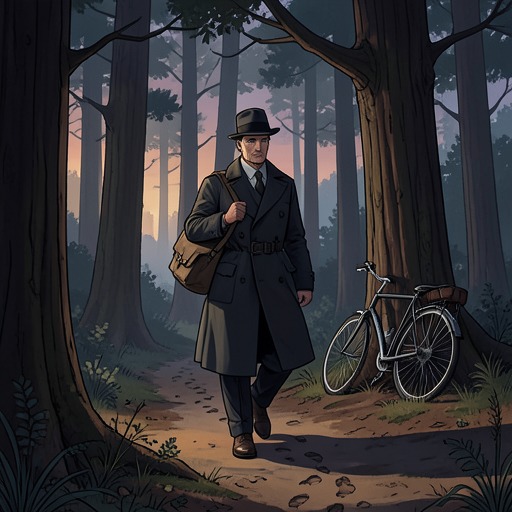
He saved the wood for Saturday night, choosing a time when Sam O’Neill was away in Galway for a family christening and Cassie Maddox and Heather had plans of their own. He brought a sleeping bag, torch, thermos of spiked coffee, and sandwiches. He brought nothing with which to light a fire: residents of the estate were on edge and might report an unexplained light to the police, and he did not trust himself not to set the remaining wood alight. The practical care of the preparations sits uneasily beside their childlike cast; packing made him feel like a boy running away from home.
Rob arrived around seven and crossed the archaeological site by the rough trails used by the archaeologists. The evening was clear and still. Slanting light turned the tower’s stone rose-gold, while the excavated trenches and earth heaps seemed ragged and desolate. He followed those tracks toward the wood, carrying his camping gear into a landscape already charged with the childhood past he hoped to recover.
A memory begins to open
The attempt did not produce a controlled or complete recollection. Rob was so tired that he began to fall asleep in his sleeping bag. He then woke abruptly, sitting upright before he was fully conscious, after hearing a voice beside his ear. The lights in the estate had gone out; the wood was quiet, and a twig cracked somewhere nearby. The voice recalled a childhood moment when Peter, on a castle wall with Rob and Jamie, had suddenly stopped their play to ask what they had heard. The return thus brought back not only scenes of childhood, but the instant when their ordinary play gave way to alertness and the unknown.
As Rob kept trying to follow the memory, his body registered the strain: sweat soaked him beneath the sleeping bag, his back stiffened against the tree, and his head jerked in convulsions. In his mind, bright images of running with Peter and Jamie gave way to darkness and a faint, quick sound spreading through the wood. He tried to hold onto the thread of memory rather than lose it. The sounds grew closer, and something screamed on the far side of the wood. Darkness seemed to gather ahead of him; he thought he saw a large presence across the clearing and remembered a glimpse by the river of water flashing around golden, owl-like eyes.
The recovered past also included a far more disturbing scene: Rob remembered approaching a clearing with Peter and Jamie and seeing men assault Sandra Scully. One held her arms, another her legs, while a third was on top of her; when she made choking sounds instead of screaming, one of the men struck her and she stopped. This memory gives the childhood mystery a concrete horror, but it does not furnish a complete account of what happened to the children afterward. In the later conversation with Cassie Maddox, Rob could remember entering the wood, what the children had been talking about, and hearing something before going to investigate; he could not remember what they heard, and the recollection ended in his own panic.
Flight and immediate aftermath
Unable to keep still or make sense of the darkness, Rob tore himself out of the sleeping bag and ran away from the clearing. Brambles caught at his legs and hair; he collided with a tree, stumbled through hollows and undergrowth, and feared he would never get out. In that terror he imagined Cassie Maddox finding his sleeping bag among falling leaves. A glimpse of the new moon showed him that he had reached the archaeological site. He stumbled over uneven ground, struck his shin against an old wall, and kept running toward his Land Rover.
The escape changed his sense of his role. As a detective, Rob had taken for granted that he was the hunter; it had not occurred to him that he might have been the hunted. Yet even the physical evidence of his flight was uncertain to him: his jeans were smeared with mud, though he could not remember falling. At Cassie Maddox’s home, she quietly asked whether he had remembered something. Rob began to cry, an unusual response for him, and described the fragmentary recollection and the panic that cut it off. Cassie Maddox treated the recovery of any part of the afternoon as a significant step and expected that he might remember more next time, but the episode itself offered no such assurance.
Uncertainty and lasting loss
Rob later stressed that during Operation Vestal he was far from a normal frame of mind. He had entered the wood on very little sleep and less food, under accumulated tension and after drinking vodka. He could not rule out that the night’s events were a dream or a hallucination, and neither possibility comforted him. In the immediate aftermath, he slept for extraordinarily long stretches, while the memories and their stranger accompanying effects stopped abruptly. At first, he felt relief: anything connected with Knocknaree seemed like the worst possible news. Only later did he understand that the silence might represent not deliverance but a missed chance to recover his past.
During the long months afterward, Rob’s thoughts returned to Knocknaree despite his resolve to put it out of mind. By then, the memories he had laboriously recovered during the investigation had disappeared. Peter, Jamie, the men in the wood, Sandra, and the landscape itself survived only as remote, secondhand images, like scenes in old films; Rob feared that even those would eventually fade. One image remained: a summer afternoon when he and Peter lay in Peter’s front garden, trying unsuccessfully to make a periscope from an old comic’s instructions because they had rolled newspaper instead of using the required cardboard tube. The night return therefore marks both a brief opening in Rob’s childhood amnesia and a painful limit: the attempt brings him close to what he lost, but does not allow him to retain it.