Sean Callaghan’s trowel
In the WoodsSean Callaghan’s trowel is an archaeological implement whose disappearance and recovery helped reshape the investigation of Katy Devlin’s murder. First treated as a missing tool, it became evidence linking the excavation site to the assault: its distinctive handle identified it as the implement the investigators were seeking, and forensic examination found blood in its cracks. Its ordinary usefulness had concealed its importance until it was out of place, hidden, and examined as evidence.
Identity and Ordinary Use
Sean Callaghan described finding an old-looking coin and carrying it on his trowel to show Ian Hunt in the finds shed. The small number of coins discovered on the dig made the find notable, and the trowel served as a practical surface for carrying it: Sean understood that handling an old coin directly could damage it with oils from the skin. While Ian Hunt consulted books to identify the coin, the workday ended. Sean left the trowel on a table in the finds shed at about half past five and forgot to take it home.
The trowel was a familiar working tool, not an object anyone had initially singled out as dangerous. In Rob Ryan’s account of the investigation, it had a leaf-shaped metal blade attached to a wooden handle about five or six inches long, narrowing toward the blade and rounded at the end. Its handle bore the owner’s initials, sc, burned into the wood. Those practical and personal details, unremarkable in the daily life of the excavation, later made the missing tool identifiable.
Disappearance and Recovery
Sean said he returned to the finds shed the next morning, but the trowel was gone. He did not immediately report its disappearance as a crime: for a time he did not need it, because the workers were using mattocks on a drainage ditch, and he assumed somebody had picked it up and would return it. When he needed it again, on the day the investigators came to speak with Mark Hanly, he asked around and found that nobody admitted seeing it. The delay helps explain why the missing tool surfaced in conversation only after the inquiry had already begun to focus on the excavation site.
Rob Ryan told the search team that the trowel had disappeared from the locked finds shed on the night Katy died. No signs of either lock being forced or picked were later found, which left the investigators considering people with access to the shed as well as Sean’s own account of having left the tool there. The team identified Ian Hunt, Mark Hanly, and Damien Donnelly as key holders, while keeping open the possibility that Sean’s story might be false. The trowel’s absence therefore became both a clue to the weapon and a problem of access: the investigators had to establish how it had left a locked room and who could have taken it.
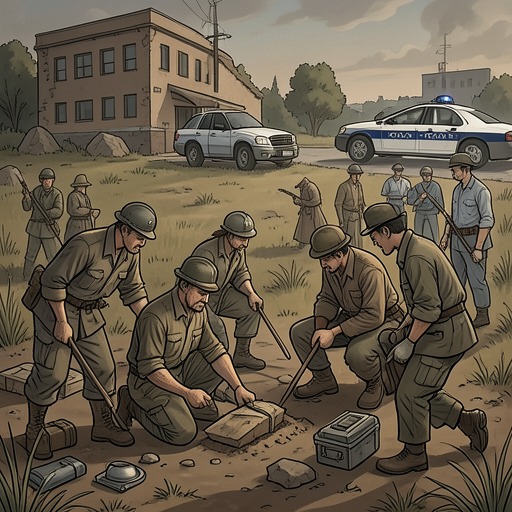
They eventually found it in the tools shed, jammed behind a pile of tarpaulins and against the wall. It had been pushed in hard enough for its point to rip the tough material. The shed was dim, and there was no lightbulb; Sam O’Neill used his torch to illuminate the handle and make out the large, uneven, Gothic-style sc initials, charred into the varnished wood. The concealment and the damage to the tarp transformed a familiar tool into a deliberately hidden object, while its marked handle connected the recovered implement to Sean’s account.
Forensic Significance
Sophie reported that the locks had not been forced or picked and confirmed that the trowel matched the implement used in the sexual assault. Although it appeared to have been washed, traces of blood remained in the cracks of the handle. The cleaning had not erased the evidence embedded in the object’s surface. A substantial amount of blood was also found on one of the tarpaulins, giving the material concealing the trowel an independent investigative importance. The evidence did not by itself establish every movement of the weapon or the precise location of the assault, but it gave the team concrete grounds to search the sheds and the site for a primary and secondary crime scene.
That forensic development narrowed the distance between an abstract description of a weapon and a specific, traceable object. The trowel had belonged to a named worker, been left in a particular room at a particular time, vanished without an obvious break-in, and turned up hidden beneath tarps with blood still in its handle. Rob Ryan accordingly treated the finds shed as a possible primary crime scene and directed the search toward the trowel, a bloodstained plastic bag, and evidence of both crime scenes. The tool’s recovery made the excavation sheds central to the inquiry without, on its own, resolving who had used or hidden it.
Public Story and Narrative Role
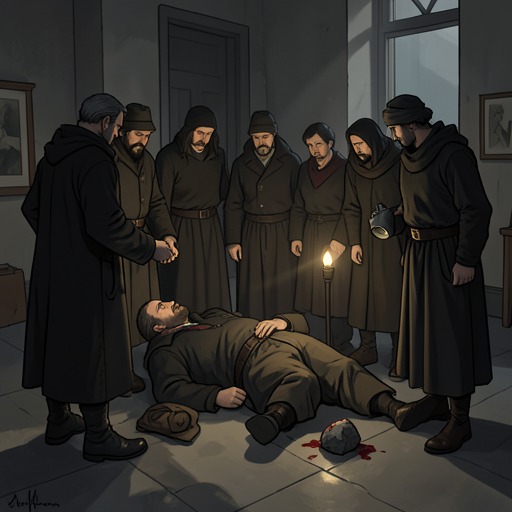
The trowel’s significance emerged against a noisier public story about the ceremonial stone at the site. A reporter asked whether the murder was the work of a satanic cult and invoked claims that Druids may have practiced human sacrifice there. Police stated that there was no evidence of a cult connection. The altar imagery offered a sensational explanation, but it did not identify a weapon, establish access, or account for blood. The trowel, by contrast, belonged to the material sequence of the investigation: it could be described, searched for, recovered, and tested.
The contrast also marks a shift in what the site means to the inquiry. Public attention turned the ancient stone into a supposed explanation for violence; the investigators’ attention to a small, missing work tool brought them back to the contemporary sheds, their locks, and the people with access. The trowel’s movement from useful equipment to missing property, concealed object, and forensic evidence supplies a compact chain of changing value. Once recovered, it helps replace unsupported cult speculation with a testable connection between the excavation and Katy’s death.