Technical Bureau
In the WoodsThe Technical Bureau is the police forensic unit that examines crime scenes and physical evidence in the investigations connected with Knocknaree. Its work supplies concrete leads, but rarely a complete answer: fingerprints may associate an object with someone without proving when it was handled, and a matching blood type cannot by itself identify a unique source. That tension between material traces and the conclusions investigators can responsibly draw defines the Bureau’s role in the story.
Role and Methods
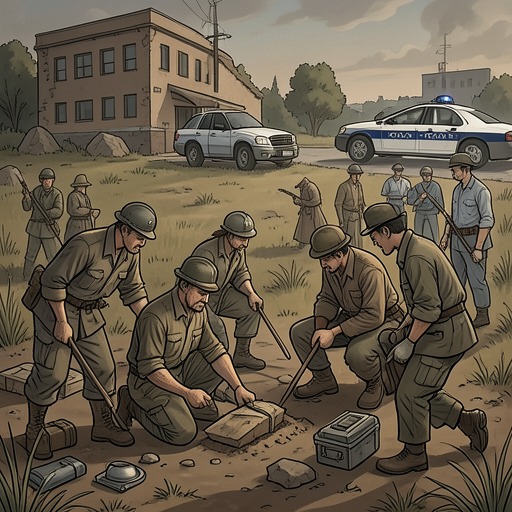
The Bureau’s personnel process scenes through photography, fingerprint examination, and the collection and analysis of physical traces. Their work is visible in the practical choreography of an investigation: crime-scene tape controls access, numbered markers locate items, technicians dust surfaces, and recovered objects are examined for prints and biological evidence. The work is collaborative rather than self-sufficient. Detectives identify questions and suspects, while technical findings can test a theory, narrow possibilities, or expose how much remains unknown.
Sophie, a crime-scene technician, is a prominent representative of that work. At the excavation site where Katy Devlin’s body is found, she and another technician examine the stone while colleagues photograph the scene and process it for fingerprints. Sophie’s assessment of the location is itself forensic reasoning: there is no blood spatter on the stone, including none from the head wound, so she concludes that it is not the primary scene and that Katy was probably killed elsewhere before her body was left there. Her inference shapes the investigation, but remains an inference from the scene rather than a direct observation of the killing.
The Bureau’s approach also emphasizes elimination and comparison. When Damien Donnelly has touched and leaned over the body, Rob Ryan tells Sophie that his prints and hair will be needed for elimination. The request recognizes that contact with evidence after discovery can create traces that must be distinguished from traces connected with the crime. A forensic item is not self-explanatory: investigators need to know who handled it, under what circumstances, and whether a result fits more than one account.
Evidence from the Earlier Disappearances
Fourteen months after Peter Savage and Jamie Rowan disappeared, a local resident walking his dog finds Peter’s watch in undergrowth roughly two hundred feet from the tree where Rob Ryan had been found in 1984. The distinctive watch has a footballer on its face and a football at the end of its second hand; Peter’s parents identify it as his, and his mother confirms that he wore it on the afternoon he vanished. The circumstances of its recovery give the object a connection to the disappearance, but do not explain what happened to Peter or Jamie.
The Technical Bureau finds partial fingerprints on both the strap and face. Those prints are consistent with prints on Peter’s belongings. This is an association, not a complete reconstruction of the watch’s movements: the result supports the identification of the object as part of Peter’s world, but does not establish who tore the strap, when the prints were deposited, or where Peter went afterward. The strap appears to have been pulled forcefully from the metal face, perhaps after catching on a low branch while Peter was running, but that possibility is not a Bureau identification of the person responsible or proof of the precise circumstances.
Other evidence from the 1984 case makes the limits of forensic certainty particularly clear. Blood on Rob’s running shoes and socks is type A positive, as is Rob’s own blood; Germaine Rowan’s medical records also show type A positive. Peter is excluded as the source because both his parents were type O, while investigators cannot rule out a fourth person or multiple sources. DNA analysis was not available in Ireland in 1984. The findings therefore distinguish some possibilities without identifying a single source. The Bureau’s fingerprint result and the blood-group evidence contribute different kinds of information, neither of which closes the disappearance case.
Processing the Katy Devlin Investigation
In the investigation into Katy Devlin’s murder, scene observations direct attention away from the place where her body was discovered. Sophie reports that an approximately eight-inch rock found in grass by a wall is likely to be one of the weapons. Hair, blood, and bone fragments are present on one end, but the rock yields no identifiable prints; the few smudges appear consistent with gloves. Its position near the wall raises the possibility that someone came over from the estate, though Sophie cautions that the placement could have been intended to suggest that route. Its having been discarded, rather than simply left in a garden, is another circumstance investigators weigh, not a conclusive account of the perpetrator’s actions.
The excavation provides a separate line of inquiry. On the night Katy died, a trowel disappeared from the locked finds shed. Rob describes the missing tool as a leaf-shaped metal blade on a short wooden handle, marked with Sean Callaghan’s initials. Cooper’s findings make the tool relevant to the assault, and the fact that it was left in the shed points to a possible weapon of opportunity. Because it was still missing when the search began, detectives treat the shed as a possible primary scene and ask Sophie’s team to examine it. The team uses luminol and searches for the trowel, a bloodstained plastic bag, and evidence of primary and secondary scenes.
The subsequent technical update supplies both positive results and exclusions. Neither lock shows signs of being forced or picked. The recovered trowel appears to have been washed, but blood remains in the cracks of its handle; a tarp also carries a substantial amount of blood. A small torch bearing a Hello Kitty design is found under the tarps, with prints that appear to be the victim’s. Meanwhile, the technicians find no semen, saliva, or blood that fails to match Katy, and partial prints on a rubber glove do not identify a person. These findings help establish what objects and traces matter, but do not by themselves identify who used the tool or transported the body.
Findings, Limits, and Investigative Consequences
A later blood-group result creates a link between Katy’s case and the old disappearance. Sophie reports that a small, previously discovered spot of blood is type A positive, while Katy’s blood type is O negative. Rob recognizes the resemblance to the blood evidence from the earlier case. The result is tentative: type A positive is shared by more than one possible source, and a blood group is not a unique identifier. Its value lies in opening a connection for investigation, not in proving that the two cases have the same perpetrator or that the blood came from a particular person.
The Bureau’s work also changes the practical direction of the inquiry. Once the trowel and tarp are found, detectives can revisit accounts given by people connected with the site, including who had keys to the sheds and who could have moved an object or body. Sophie’s update that there is no sign either lock was forced narrows one aspect of the possibilities, while the recovered tool and bloodied tarp give investigators new grounds to challenge an incomplete account. The scientific results do not replace interviews; they give the detectives evidence against which statements can be checked.
Across both investigations, the Technical Bureau functions as a source of disciplined partial knowledge. A print is consistent with Peter’s belongings, but does not explain his disappearance; a blood type links evidence without uniquely identifying its source; and the absence of traces can constrain a theory without establishing exactly what happened. The Bureau’s significance lies not in producing an instant solution, but in making the physical record more precise—and in exposing the distance between a clue, an inference, and proof.